

Africa is undergoing a major solar boom that far exceeds official statistics, according to Ember and the African Tech Futures Lab.
Using Chinese panel export data, they estimate 17 GW of new capacity in 2026, after 12 GW in 2025. Around three-quarters of recent additions are small, distributed systems that often go unreported, leaving international agencies and many governments badly underestimating Africa’s clean-energy surge.
Africa is experiencing a rapid expansion of solar power, but much of the growth remains missing from official statistics.
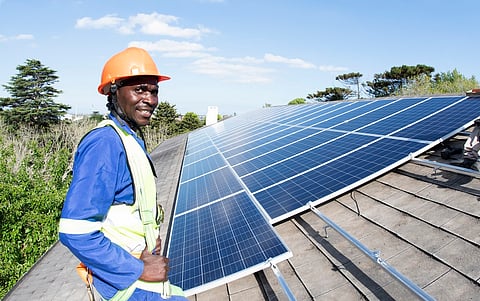
A new analysis by energy think tank Ember and the African Tech Futures Lab finds that the continent’s solar boom is being driven increasingly by distributed solar systems including rooftop installations, commercial systems and smaller off-grid projects that are poorly captured by national reporting systems.
Published on 27 August 2026, the analysis estimates that Africa could add 17 GW of new solar capacity expected to be installed in 2026, a 45 per cent increase from 2025. This would be equivalent to roughly 100,000 solar panels being installed every day. The growth follows a 51 per cent increase in solar installations in 2025 and 25 per cent in 2024.
The estimate is based on a new methodology that tracks Chinese solar panel exports to Africa, providing an alternative way to measure installations that may not appear in government records.
The solar expansion is occurring across the continent. Thirty-six of Africa’s 54 countries are expected to install record amounts of solar in 2026, while 19 countries are projected to record year-on-year growth of more than 100 per cent. The Democratic Republic of the Congo (DRC) leads with an estimated 544 per cent increase, followed by Zimbabwe at 282 per cent, Egypt at 176 per cent and Zambia at 117 per cent.
However, much of this expansion remains invisible in official statistics. Ember estimated Africa’s 2025 solar growth at 12 GW, almost twice the International Energy Agency’s 6.2 GW estimate and significantly above the International Renewable Energy Agency’s 4.6 GW figure. Official national data was available for only 36 countries, with just 14 reporting figures for 2025.
A major reason for the statistical gap is the rapid expansion of distributed solar, which is small-scale, customer-side solar installed mostly on rooftops — makes up most of Africa’s solar growth, and it’s the hardest type to measure.
Ember estimates that about 75 per cent of the 26 GW of solar capacity added between 2023 and 2025, around 20 GW was distributed solar. There are just 12 countries that report an official or semi-official distributed solar figure, yet those still underestimate the growth.
Several factors explain the problem. Many systems are installed informally, while weak or absent regulations for distributed generation provide little incentive for privately owned systems to register. Even where regulations exist, they are often poorly implemented. By contrast, countries such as Tunisia and South Africa, which have relatively mature permitting and regulatory systems, show much smaller shares of unrecorded distributed capacity.
At least 15 African countries have registration and permitting procedures at an advanced draft stage, while others have introduced regulations or pilot programmes. South Africa has developed a digital platform for small-scale embedded generation used by more than 55 municipal distribution utilities, which moves permitting online and captures each installation’s geolocation. Eswatini and Namibia are also expected to launch similar systems in September 2026.
Better data will be critical as Africa’s solar market accelerates. Capturing distributed installations more accurately can help governments understand the true scale of the clean-energy transition, improve planning and ensure that investment and energy policies keep pace with developments on the ground.
