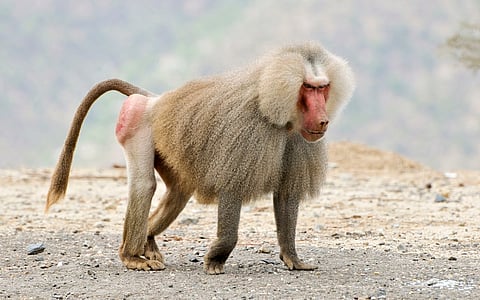


The baboon is not a likeable animal in most African cultures today. That is mainly because they destroy crops. However, there was one culture on the African continent that not only venerated these primates but also deified them. Scientists now think they know the reason why.
According to new research from the University of St Andrews in Scotland, UK, the ancient Egyptian god Thoth, the deity of wisdom, writing, magic, and the moon is often represented as a sacred ibis (Threskiornis aethiopicus) and sacred baboon (Papio hamadryas).
While the reasons suggested for the god being depicted as an ibis are its physical traits especially its curved, crescent-moon shaped beak and its black-and-white pied colouration, the baboonification of Thoth is far more puzzling, according to a statement from the university.
Recent scholarship traced the origins of the Egyptian name for Thoth to North African linguistic terms for “bright/white thing,” and drew connections with the brilliant white plumage of sacred ibises.
“Building on this work, researchers from St Andrews and Dartmouth University used spectroscopy – measuring the various light wave frequencies given off by colours – to avoid the pitfalls of relying on human subjective impressions of colour, which are notoriously sensitive to cultural influences, and discovered that both the ibis and baboon have spectral profiles indistinguishable from moonlight,” noted the statement.
This finding, say the researchers, bolsters the idea that divinity was conferred on the sacred ibis and baboon because their colouration resembles moonlight.
Lead author Professor Catherine Hobaiter, primatologist from the School of Psychology and Neuroscience at the University of St Andrews, said: “Why would two such different animals be used to represent one deity? Most other Egyptian deities are represented by just one type of animal. Ancient Egyptians were familiar with at least three species of ibis, but they chose the white one for embodying Thoth. They were also familiar with two species of baboon, along with vervet monkeys and patas monkeys, but again they chose the silver-white species. So, sacred ibises and hamadryas baboons are different in many ways, but one thing that unites them is their moon-like colour.”
The paper has been published in the journal Time and Mind.
