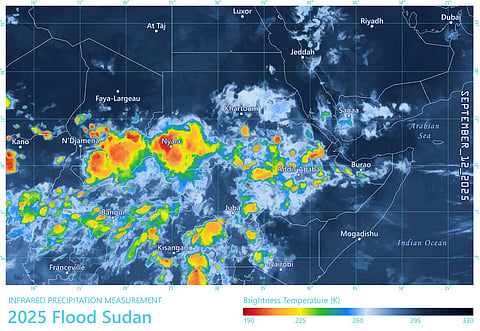


Eastern Africa recorded 6,227,072 internal displacements across nine countries in 2025, with conflict accounting for the majority while climate-related disasters, particularly floods, added significantly to displacement pressures, according to a new report published by Intergovernmental Authority on Development (IGAD)-Climate Prediction and Applications Centre (ICPAC) on September 3, 2026.
The report, State of the Climate in Eastern Africa 2025 documented 639 distinct displacement events during the year. Conflict accounted for 4,730,816 displacements, or 76 per cent of the regional total, while disasters triggered another 1,496,256 movements, equivalent to 24 per cent.
The concentration of displacement was particularly severe in Sudan, South Sudan and Ethiopia. Sudan recorded 2,677,298 displaced people, representing about 43 per cent of the regional total, followed by South Sudan with 1,682,754 and Ethiopia with 1,085,752. Together, the three countries accounted for 87.5 per cent of all internal displacements recorded across the region in 2025.
Climate and weather-related disasters played a major role in the remaining displacement. Floods were responsible for 1,035,524 disaster-related displacements, or 69.2 per cent of all displacement caused by disasters. Flooding, landslides and other climate hazards repeatedly damaged homes, roads, bridges, water systems and other critical infrastructure, forcing communities to move from high-risk areas.
The displacement crisis was closely linked to the region’s highly variable climate in 2025.
The region’s climate in 2025 was influenced by major climate drivers, including the El Nino-Southern Oscillation (ENSO), Indian Ocean Dipole (IOD), Madden-Julian Oscillation (MJO) and tropical cyclones. These systems produced highly uneven rainfall. The March-May and June-September seasons brought significant wet spells to several areas, while the October-December season saw below-average rainfall across eastern Kenya, Somalia and southeastern Ethiopia.
Temperatures also remained persistently above average, making 2025 one of the warmest years recorded in Eastern Africa. The heat compounded risks to human health, agriculture, water availability and ecosystems, particularly in communities already affected by conflict and poverty.
Food insecurity remained critical, with around 42 million people across six IGAD Member States —Djibouti, Kenya, Somalia, South Sudan, Sudan, and Uganda — facing crisis or worse levels of acute food insecurity. Poor October-December rainfall contributed to crop failures, pasture degradation and water shortages, particularly in eastern parts of the region.
The impacts extended to health and ecosystems. Flooding increased risks from waterborne diseases, while drought and heat intensified water scarcity and health pressures.
The report also highlights how climate-related displacement can intensify existing social and security pressures. Below-normal rainfall in pastoral areas reduced access to pasture and water, prompting herders to move livestock across administrative and national boundaries and increasing competition over resources. This dynamic was particularly evident along the Dollow-Beled Hawo-Mandera corridor linking Somalia, Ethiopia and Kenya.
The security impacts were especially pronounced in a few areas. In South Sudan, flooding pushed displaced herders into farming areas, contributing to tensions and cattle-related violence. In Somalia, flooding along the Shabelle and Hiraan rivers destroyed crops and damaged infrastructure, disrupting food access. Flood-induced displacement was also associated with increased gender-based violence across several countries.
As climate risks intensify, the findings of this report underscore the urgent need for sustained investment in climate services, stronger institutional coordination, and greater integration of climate risk into policy, planning, and development processes. Building resilience in Eastern Africa requires moving beyond reactive response towards more anticipatory, inclusive, and risk-informed systems that enable governments, communities, and partners to act timely and prepare better for future climate shocks.
