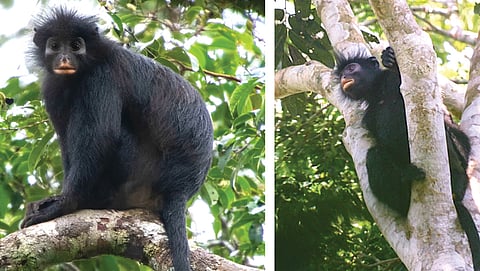


Scientists have categorised a rare, orange-mouthed monkey from Africa as a new species after it was first spotted almost two decades ago.
Named as Colobus congoensis and known locally as the ‘Likweli’, the primate is only the fifth such discovery from Africa in 75 years.
The monkey was identified in the remote interfluve (between rivers) region between the Lomami and Congo (Lualaba) rivers in the Democratic Republic of Congo (DRC) in 2008. But scientists dug deeper only in 2018 when it was spotted again by a team of researchers. They followed this up by collecting more evidence to declare it as an entirely new species.
The first hint of its existence came in 2008, when researchers captured a partial blur photograph of an unidentified primate in the high canopy of the Lomami Basin.
However, in 2018, another photograph was captured of a black monkey with a prominent orange-cream patch surrounding its mouth and nose—a feature unlike any known primate in the region.
“Comparisons of the photos taken in 2008 and in 2018-2019 showed that the monkey (Jean-Pierre I.) Kapale encountered was the same species as the previously unknown monkey seen a decade earlier,” the study published in the journal PLOS One noted.
Following Kapale’s reports, the researchers conducted a review of photographs with records of primate sightings in earlier surveillance patrols by other teams.
“We found that the same monkey had been seen and photographed in August 2018 in an area 35 km north of Kapale’s discoveries, but that the monkey had been misidentified in the patrol report and never announced at that time,” they said.
The Likweli belongs to the genus Colobus and was not much known by the local communities living in its proximity, in sharp contrast to the detailed knowledge of other primates these communities possessed.
The study said among local residents, only eight of the 52 surveyed localities bordering the new species’ range reported knowledge of the primate and could accurately describe it.
“In one interview, a hunter who had once opportunistically killed the monkey described it but could not give it a local name. Another hunter described the species’ strong odor. Eventually, the people of the Balanga ethnic group living in the buffer zone west of the Lomami River and bordering the species’ range gave Jean Pierre Kapale the vernacular name, Likweli,” the study noted.
It added that the Mituku local communities, who occupy the eastern limits of the range, referred to the species as kasaba nkoni, which means “the branch shaker.” The species was described as quiet and cryptic with a localised distribution. Several informants stated that its calls, reported mostly to be heard at dawn, resembled the roars of C. angolensis.
Comparative analysis of C. congoensis vocalisations also reveals structural similarities with C. satanas to the exclusion of other Colobus species, they said.
The mitochondrial and morphological data confirm the attribution of C. congoensis to the genus Colobus and reveal that it is the sister to Colobus satanas, from which it is geographically separated by more than 1,200 km, the scientists revealed.
With regards to the physical features, features, C. congoensis is distinguished from C. satanas and other Colobus species by its small size, a striking orange cream patch surrounding the mouth, philtrum, and portions of the inferior nasal alae on an otherwise black face, and a white perianal patch that is covered with fine white hairs in males and is glabrous (hair free) in females.
“It possesses a nearly entirely black face, save for a striking piebald pattern of bare pinkish-to-orange-cream skin around the mouth and philtrum,” the study said.
The scientists estimate the Likweli split from its sister species approximately 4.1 to 5.0 million years ago. “Using a calibration point on the African-Asian colobine split from a recently published set of curated primate fossil calibrations, the split between C. congoensis and C. satanas is estimated at 5.0 million years ago,” they observed.
The species is limited to an incredibly small geographic range of just 1,700 sq km. It is largely confined to high, closed-canopy upland forests growing on deep clay soils, and researchers believe that nutrient-poor white-sand soils in the region may act as a natural ecological barrier.
The rivers that border the C. congoensis range to the west and east appear to represent biogeographic barriers for the species through different mechanisms. The Lomami river, which defines the western boundary of the C. congoensis range, borders the species and subspecies ranges of several other primates in the Lomami National Park and buffer zone region, the authors said.
With an average width of over 200 metres, the Lomami river appears to represent a formidable barrier to dispersal, they added.
“At the eastern limit of the C. congoensis range, the Lilo River is less than 50 meters wide, and in some places is covered by canopy traversable by arboreal primates. However, the Lilo River and all other major tributaries within the Lomami-Lualaba interfluve in the C. congoensis range have “elbows,” right-angle changes of course that are characteristic of captured or “beheaded” rivers. All these rivers are also characterised by depositions of white sands and seasonal inundations in regions that were occupied by the former course of the captured flowage. Nutrient-poor, whitesand soils and their associated vegetation have been recognised as ecological barriers for a number of plant and animal taxa in Amazonia, and in some cases have been demonstrated to promote allopatric speciation,” the study underlined.
The Likweli is often seen moving in mixed-species groups with up to six different types of primates. They are also known for their rapid, pulse-like roaring calls, which can be distinguished from other species by a distinctive snort produced between roar sequences.
The scientists have proposed a preliminary IUCN Red List classification of Endangered (EN) for the species. They said that while most of its range lies within the protected Lomami National Park, the Likweli faces rising threats from hunting pressure and habitat conversion as human populations in the DRC grow. The population growth in DRC is estimated to be 3.2 per cent annually, one of the most rapidly growing national populations on the African continent.
