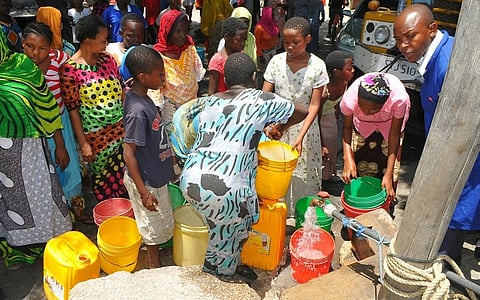


At dawn, long before Dar es Salaam’s bustling streets thicken with traffic and commerce, the scramble for water has already begun.
At a borehole in Mabwe township, a low-income neighbourhood on the city’s outskirts, men and women gather quietly around a borehole. They arrive in flip-flops and bare feet, hauling yellow plastic containers that have become symbols of survival in Tanzania’s largest commercial city. Water, not time, dictates the rhythm of the morning.
The containers are lined up carefully, forming an uneasy order that threatens to collapse the moment the pump sputters to life. When water finally comes, it is not the clear, life-giving stream people hope for. It is murky, carrying the smell of soil. Impurities settle at the bottom as it splashes into the containers.
No one steps back. Bodies press closer. Hands grip the pump harder. Elbows nudge for space.
“The water is unsafe, but it is still better than going without.” says Rehema Kwayu, a mother of four who confesses she has been waking before dawn for weeks. “I honestly don’t have enough money to buy water. If I spend the little I have on water, my family will suffer. I would rather collect this water for free, even though it is not very clean.”
Dar es Salaam, one of Africa’s fastest growing cities, is facing a serious water crisis as prolonged drought linked to climate change sharply reduces flows in the Ruvu river, the main source supplying Tanzania’s smoke-belching commercial capital. With production falling and demand rising in a city of more than six million people, authorities have introduced rationing that has left taps dry for days in many neighbourhoods, forcing households to queue for hours at communal wells or turn to costly private vendors and unsafe sources. The shortages are exposing long-standing inequalities in access to basic services, hitting low-income communities hardest while businesses and wealthier areas rely on storage tanks and trucked water to cushion the impact.
In Mabwe, buying water from private vendors has become an unbearable expense. A 100-litre container can cost more than a day’s food for an entire family. With taps dry and public supply unreliable, residents are pushed toward unsafe alternatives — boreholes, ponds and shallow wells — despite the health risks.
Juma Kalinga, a casual labourer, rests his jerrycan on his knee as he weighs the daily dilemma. “If I buy water, my children sleep hungry,” he told Down To Earth. “If I fetch this water, we may get sick. Either way, we suffer.”
Across Dar es Salaam, once a city where taps flowed day and night, water scarcity has become a defining feature of daily life. Millions now endure days without a drop, while queues form before dawn at public wells.
In recent weeks, the city’s main water source — the Ruvu river — has fallen to its lowest ebb as rainfall patterns grow increasingly erratic, a stark symptom of climate change tightening its grip across East Africa.
In informal settlements such as Mbagala, Manzese, Tandale and Buguruni, the struggle is real. At 5:30 a.m. in Manzese, a queue snakes down a dusty street toward a communal well. Women clutch buckets and plastic containers, hoping to fill them before the sun becomes unbearably hot.
“I wake up before sunrise because if I come later, there’s nothing left,” said Josephine Mushi, 27, balancing a toddler on her hip. “Some days we return with only one container — and that must last us until the next rationed supply, if it comes at all.”
In Vingunguti, 38-year-old Amina Saleh pushes a wheelbarrow toward a muddy pond she now calls her “source.” Taps at her home have been dry for three weeks now.
“We used to rely on piped water for cooking and washing,” she said, scooping murky water into jerrycans. “Now this is all we have. I boil what I can — but sometimes the water still makes my children sick.”
The Dar es Salaam Water Supply and Sanitation Authority (DAWASA) has introduced emergency rationing as flows from the Ruvu river decline. Under a schedule released in mid-December, water is allocated to different zones on alternating days.
Neighbourhoods such as Kimara, Ubungo, Mwenge, Msasani, Masaki, Tabata and Kisarawe now live by rigid and unpredictable timetables. Even then, supply often arrives sporadically — or not at all.
In wealthier areas, residents cushion the impact with storage tanks and private boreholes. In informal settlements, families jostle over dwindling and often unsafe supplies.
Officials have urged farmers drawing water directly from the Ruvu river for irrigation to stop, warning that declining river levels threaten household supply.
“These are immediate measures to ensure fairness,” Water Minister Jumaa Aweso said during a December 12 press briefing, urging patience as authorities manage the crisis.
Beyond the informal settlements, the water shortage is also straining unlikely corners of the city. Along the Indian Ocean coastline, five-star hotels are incurring unprecedented costs to keep guests supplied. At a luxury property in Oyster Bay, General Manager Harold Kwayu said tanker trucks now deliver water daily to fill rooftop reservoirs.
“We used to depend entirely on municipal supply,” he said. “Now we import water at premium rates just to ensure guests can shower, kitchens can operate and pools stay open.”
The added cost, he said, is ultimately passed on to customers — a bitter irony in a city where many struggle simply to drink.
Amid the hardship, new survival economies are taking shape. On Dar es Salaam’s dusty outskirts, bodaboda (motorcycle taxi) riders have carved out a niche delivering water. By mid-morning, riders navigate pothole-riddled roads with jerrycans strapped to seats and handlebars.
For TZS 1,000 per container, they ferry water from distant wells to homes in affected neighbourhoods.
“Some call it a crisis, but for me it’s income,” said Abdul Kessi, 32. “I earn more carrying water than transporting passengers.” The work is gruelling and risky, but for many, it is the only option.
Experts say the crisis exposes deep structural weaknesses. Dar es Salaam’s population has surged from about 4.4 million in 2012 to over 5.8 million today. Water infrastructure, built decades ago for a far smaller city, has failed to keep pace. Nearly half of treated water is lost through leaks, vandalism and illegal connections.
Back in Mabwe, as the morning deepens, the borehole slows. Voices rise. A woman pleads for one more container. A man gestures angrily at the thinning stream.
Some will boil the water, if they can afford charcoal. Others will drink it as it is.
By the time the rest of the city fully wakes, Mabwe’s residents will have spent hours securing water that should be a basic right. “We used to take water for granted,” said Amina, watching her children near stagnant pools. “Now every drop is planned. Nothing is wasted.”
As Dar es Salaam waits for rain and relief, its residents continue to adapt — but the crisis has exposed the deep inequalities of a rapidly growing city in a warming world, where survival is increasingly measured in buckets, queues and endurance.
