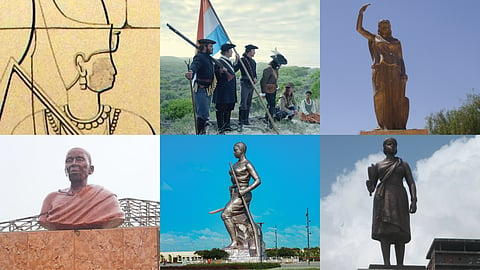


For a layperson, Africa does not usually conjure images of feminism and women’s empowerment in the first instance. African culture, for the most part, has been patriarchal and male-dominated, with tribes across the Continent being usually headed by men. Gender roles have been strictly segregated with men being viewed as providers and decision makers whereas women have traditionally been associated with domestic duties.
But time and again, across the long arc of African history, there have been women who have been exceptions to this state of affairs. Call them ‘outliers’, if you will, but these women have left their mark on history. Indeed, these women whom we are going to talk about did not just figure in African history. They changed and shaped it.
Today, Africa is the world’s youngest continent demographically, with half of its population being women. The shining examples of women leaders who wielded agency at a time when patriarchy was by and far the norm, are beacons for today’s generation of women in Africa.
Just south of ancient Egypt was the land of Nubia, along the valley of the Nile in what is today northern Sudan and southern Egypt. In Antiquity, it was ruled by a powerful kingdom known as Kush.
Rich in gold and ivory, Kush was a powerful state. Indeed, so powerful that the rulers invaded and conquered Egypt in 747 Before Common Era (BCE). They then ruled over a united Egypt and Nubia.
Among the stalwart rulers of Kush, one name stands out. Amanirenas, who ruled from 40-10 BCE, was the Kandake (queen) of Kush.
She ruled at a time when the Roman Empire, under Emperor Augustus, conquered Egypt. Amanirenas saw this as a threat, as she knew Rome would expand into Nubia next.
Amanirenas then pre-emptively attacked Roman garrisons stationed in Syene, Philae, and Elephantine in 24 BC, initiating the Meroitic War.
Rome counterattacked and advanced. It was then that Amanirenas started guerilla warfare. Leading from the front, she ultimately held back Roman forces to a stalemate.
Amanirenas subsequently negotiated a treaty directly with Augustus, which maintained Kush’s independence and exemption from paying tribute to Rome.
The ‘one-eyed queen’ of Kush stands as a symbol of African resistance to imperial power in the ancient world.
Kahina or Dihya, was a queen on the Berber (Imazighen) people of North Africa. During the 7th century, Arab Muslim forces were sweeping across North Africa, with Egypt falling to them in 642 Common Era (CE).
As they advanced further west into the lands of the Berber people, the Imazighen under Kahina put up fierce resistance from the Aurès Mountains in today’s Algeria.
She famously defeated the Arab commander Hassan ibn al-Numan in the 690s and forced him to withdraw for five years.
Kahina then adopted a scorched earth policy to deter further invasion by the Arabs. This created dissension in her ranks. Al-Numan then attacked again, with a larger army in the early 700s. Kahina was defeated and killed, according to legend near a well that now carries her name, Bir al-Kahina. The defeated Berbers became Muslim and helped the Arabs to conquer the Iberian Peninsula in 711 CE.
Today, Kahina is a powerful symbol for several groups, especially Berber nationalists and feminists in North Africa. Much of her life is shrouded in legend and mystery, which has made the allure of her mystique only greater.
Nzinga Mbande was the ruler of two kingdoms in the heart of the African Continent at the time of one of the most horrific events in human history: the Transatlantic slave trade.
Nzinga Ana de Sousa Mbande had inherited the rule of her kingdom of Ndongo in 1624 at a time of great flux and turmoil.
“At that moment, the kingdom was under attack from both Portuguese as well as neighboring African aggressors. Nzinga realized that, to remain viable, Ndongo had to reposition itself as an intermediary rather than a supply zone in the slave trade. To achieve this, she allied Ndongo with Portugal, simultaneously acquiring a partner in its fight against its African enemies and ending Portuguese slave raiding in the kingdom,” the Metropolitan Museum of New York notes in an article on its website.
It adds that by 1626, Portugal had betrayed Ndongo and Nzinga was forced to flee west with her people. She founded a new kingdom named Matamba.
“To bolster Matamba’s martial power, Nzinga offered sanctuary to runaway slaves and Portuguese-trained African soldiers and adopted a form of military organization known as kilombo, in which youths renounced family ties and were raised communally in militias,” says the article.
Nzinga also allied with the Protestant Dutch, the archenemy of the Catholic Portuguese. However, their combined forces could not make the Portuguese leave Angola.
“From this point on, Nzinga focused on developing Matamba as a trading power by capitalizing on its position as the gateway to the Central African interior. By the time of her death in 1663, Matamba was a formidable commercial state that dealt with the Portuguese colony on an equal footing,” says the Met article.
Mbande’s life was thus remarkable: one of hard choices and flexibility, of female power in a largely patriarchal continent and of survival in the face of brutal colonialism.
In 1642, the Dutchman Jan van Riebeeck landed at the Cape of Good Hope with express orders to start a way station that could resupply and restock ships of the Dutch East India Company (VOC) rounding the headland on their way to the east.
The Cape was not empty. It was home to the Khoi Khoi and the San, the former being pastoralists who grazed their herds of cattle and sheep.
Krotoa (1642-1674) was born at this time of change and flux as the niece of the Khoi chieftain Autshumao. She played her own significant role in the early years of the Dutch Cape Colony.
Taken into the household of van Riebeeck at age 11, Krotoa became fluent in Dutch and Portuguese. It later helped her act as an interpreter between her people and the Dutch, when the latter took to attacking the former over control of the land. In this capacity, she is often compared to Pocahontas from the English Jamestown colony in North America and La Malinche, who acted as interpreter between the Aztecs and the Spaniards of Hernan Cortes.
But Krotoa was much more than a peace negotiator or interpreter. She later became the first indigenous person in the Cape Colony to be baptised as a Christian, ‘Eva’.
She later married Pieter van Meerhoff, a Danish surgeon and explorer, making the marriage the first mixed-race one in the colony. One again can’t but help note parallels with Pocahontas who married John Rolfe.
However, Krotoa’s life later took a turn for the worse. Her husband died in 1667 during an expedition to Madagascar. She subsequently struggled with alcoholism and was eventually rejected by both the Dutch and Khoi societies.
She ended her days at Robben Island, where she had been banished, dying on July 29, 1674.
Krotoa thus used her agency to navigate two complex worlds at a time when Southern Africa was changing completely.
The Kingdom of Dahomey is today part of the Republic of Benin. It was “a unique centralised state on the Bight of Benin in West Africa, composed of people who identified ethnically as Fon, and occupying part of a coastal region that came to be called the Slave Coast”.
For almost 300 years, from the early 17th till the late 19th centuries, Dahomey was one of West Africa’s most effective military powers, as also the largest slave trading nation.
“It was especially renowned for its unique female fighting force, coined the Dahomean ‘Amazons’ by contemporary Europeans—an exceptional corps of women soldiers and palace guards at the direct command of the king,” according to the 2025 paper An African Art Re-Discovered: New Revelations on Sword Manufacture in Dahomey. They were known as ‘Agojies’ in the Fon language.
The Dahomey Amazons were formed by Queen Hangbe, who ruled as a queen or regent between roughly 1708 and 1718, following the death of her twin brother, King Akaba.
Despite her significant contributions, her name was largely erased from the official oral history of the Dahomey kings, likely due to a power struggle with her successor, King Agaja.
Hangbe and the Dahomey Amazons have left an everlasting impact on the landscape of West Africa. They were recently celebrated on celluloid with the 2022 Hollywood movie, The Woman King, telling their story.
Yaa Asantewaa (1840–1921) was the Queen Mother of Ejisu in the Ashanti Empire (modern-day Ghana) and a legendary leader of the Ashanti resistance against British colonial rule. She is best known for leading the War of the Golden Stool (also called the Yaa Asantewaa War) in 1900, the last major war on the African continent to be led by a woman.
In 1900, the British Governor, Sir Frederick Hodgson, demanded the Golden Stool—the sacred symbol of Ashanti unity and sovereignty—to sit upon.
Male leaders hesitated to fight the British. But Yaa Asantewaa mobilised the Ashanti. Elected as the commander-in-chief, she led an army of nearly 5,000 soldiers that laid siege to the British fort at Kumasi.
Although the Ashanti were eventually defeated by superior British weaponry and reinforcements, the Golden Stool remained hidden and protected. Yaa Asantewaa was captured and exiled to the Seychelles, where she died in 1921.
Her story is a powerful metaphor of indigenous African resistance to a major colonial power. Yaa Asantewaa is today celebrated as a national heroine in Ghana and a female icon.
