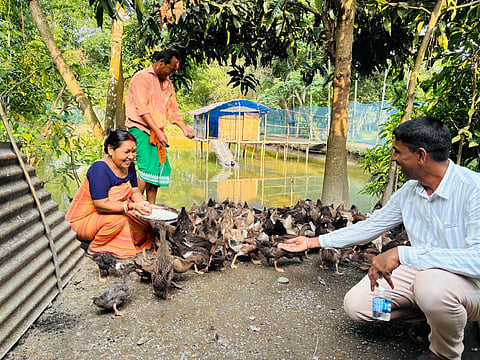


Standing beside her fishpond in Paschim Satgaon village of Assam’s Nagaon district, 43-year-old farmer Swapna Marak points to her vegetable patch, pig and poultry shed.
“Earlier, if one crop failed, everything failed,” she says. “Now every part of the farm supports another.”
For years, like many farmers across Northeast India, Marak depended largely on commercial crops and chemical inputs. Herbicides became common as labour costs rose and weeds flourished in the region’s heavy rainfall. But over time, production costs increased, pests became harder to manage, soils weakened and returns became uncertain.
“We spent more every season but earned less,” she recalls. Disease outbreaks repeatedly damaged her crops, forcing her to shift towards cash crops such as areca nut and horticultural plantations. “The soil was losing its strength, and even beneficial insects had become scarce.”
Her experience mirrors a larger shift unfolding across the region. As monoculture farming expanded, many farms became increasingly dependent on external inputs while becoming more vulnerable to climate shocks, pest outbreaks and volatile markets.
Today, farmers like Marak are trying a different approach. They are bringing crops, livestock, fish and water management together into a single farming system.
Integrated Farming Systems (IFS) combine vegetables, fishponds, livestock, pigs, poultry and trees within one farm so that the output of one component becomes the input for another.
“The idea is to keep resources circulating within the farm,” says Patai Boro, a lead farmer from Khatarbari village in Assam’s Tamulpur district.
“Animal waste becomes manure for crops and fishponds. Crop residues feed livestock. Pond water irrigates vegetables during dry periods. Instead of treating everything separately, the farm works like one ecosystem.”
His wife, Mina Boro, says the change has also reduced waste. “Now nothing is wasted. Every part of the farm has value.”
The approach is being promoted under the Joint Initiative for Village Advancement (JIVA) programme in parts of Assam and Arunachal Pradesh. Supported by NABARD, with technical guidance from Watershed Support Services and Activities Network in collaboration with Deutsche Gesellschaft für Internationale Zusammenarbeit, the initiative works through local organisations Kalong Kapili and Gramya Vikash Mancha in Assam, and NOSAAP Producer Company in Arunachal Pradesh to help farmers diversify production while reducing dependence on external inputs.
Beyond introducing integrated farming models, the programme is strengthening farmer-to-farmer extension through trained lead farmers and encouraging local production of bio-inputs and other farm resources.
For smallholders, the biggest advantage is spreading risk.
“Income now comes from different sources throughout the year,” says Marak. Vegetables provide regular harvests, fish are sold seasonally, while pigs and poultry generate additional earnings. “Even if one enterprise performs poorly, others help sustain the household.”
In Samuguri village of Nagaon district, farmer Ranjit Rabha says fishponds are no longer viewed only as places to raise fish.
“They store water for irrigation, and their bunds grow vegetables and fodder,” he says. Around the ponds, naturally growing taro, fiddlehead ferns and other edible plants thrive alongside cultivated crops.
Livestock manure enriches both soil and fishponds, reducing the need for chemical fertilisers. The result is a farming system where nutrients remain within the landscape instead of leaving it as waste.
Integrated farms also create habitats for birds, insects, fish and soil organisms that often disappear in monoculture landscapes.
“Vegetable gardens, trees, ponds and livestock together support much richer biodiversity,” says Dipika Sonowal, a farmer from Jona Kachari village in Arunachal Pradesh’s Namsai district.
For farmers, healthier ecosystems are becoming an economic asset.
Across project villages, farmers say diversified farms have become more resilient to erratic weather while reducing dependence on expensive external inputs.
In many ways, the approach is reviving farming practices long embedded in the region’s indigenous knowledge systems.
“Our elders always believed every part of the farm should support another,” says Sonowal. “We are simply learning that lesson again.”
As climate uncertainty grows across Northeast India, farmers say resilience may lie not in producing more of a single crop, but in rebuilding farms as connected ecosystems where crops, animals, water and biodiversity work together.
Monuhar Pegu works as Regional Coordinator-Northeast India for Watershed Support Services and Activities Network (WASSAN), Kaziranga, Assam.
Views expressed are the author’s own and don’t necessarily reflect those of Down To Earth