
Subscribe

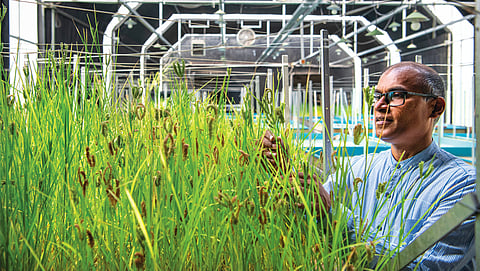
It is January in Srinagar. Outside, temperatures hover below freezing and fields lie fallow. Inside a research facility at Sher-e-Kashmir University of Agricultural Sciences and Technology (SKUAST), however, rice plants behave as if it were summer—the season when the crop is sown in the Kashmir valley. Instead of waiting the usual 130 to 140 days for a harvest, scientists say the plants can be coaxed to flower and set grain within 60 days.
This technique, known as speed breeding, is crucial for plant breeders racing against climate change. It allows to do something that nature rarely permits: grow four to five generations of rice in a single year, rather than just one. “In Kashmir, we usually grow only one crop in summer,” says Asif Bashir Shikari, principal investigator of speed-breeding programme, SKUAST. Using the technique in 2024 and again last year, his team has validated four generations in a year.
Crop breeding is a meticulous business. Breeders must decide which traits they want—higher yields, better nutrition or resilience to drought, heat and pests. They then cross plants that appear to possess the traits, select promising lines and run field trials over multiple seasons and locations to see if the new varieties are an improvement. This process is slow. “From the first cross to large-scale cultivation, a variety takes 10 to 14 years,” explains Sobhan Sajja, senior scientist at International Crops Research Institute for the Semi Arid Tropics (ICRISAT) in Hyderabad. “If we are asked to develop a variety today, in 2026, we might deliver it by, say, 2036. By then the weather may have changed in ways we did not anticipate, defeating the purpose of the variety,” Sajja says. Erratic rainfall, heatwaves and novel pests mean breeders are under growing pressure to deliver improved varieties more quickly than ever before. Speed breeding helps by shortening each stage of the plant’s life cycle, pushing it rapidly from one generation to the next.
This is done by carefully manipulating the signals plants use to measure time and seasons. “Plants take cues from the number of hours of sunshine and darkness, the quality of light, relative humidity and temperature to decide when to grow in height, produce leaves and switch from the vegetative stage to flowering, fruiting and maturity. We mimic the conditions…
This article was originally published in the February 16-28, 2026 print edition of Down To Earth