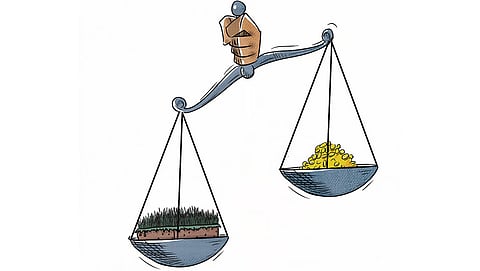

In the parched outskirts of Koppal, Karnataka, 58-year-old Mallamma gazed out at her three-acre field being covered by glass panels, where tur dal (pigeon pea) once grew. In the 2025 season, she didn’t sow anything. She looked at her hands and said, “These hands knew nothing else other than to prepare the field; sow the seeds; tend to the sprouts; and then care for the crop until harvest time.” Instead, she had leased the land to a wealthy farmer, Nagaraj, to establish a solar park. “At least I’ll get Rs 20,000 without worrying about rains, pests, or failed harvests,” she said.
The decision, once unthinkable for a family that had survived for generations on rainfed farming, is now becoming common across the country’s rain-fed belts. Mallamma was already in debt due to the erratic monsoons, which made it difficult for her to provide one meal a day for her family. The solar park, she said, is a boon to her.
Rainfed agriculture, which once covered over 60 per cent of India’s cropped area and sustained millions of small and marginal farmers, is quietly vanishing. As the monsoon becomes increasingly erratic and the economics of farming become unsustainable, a silent transformation is underway: farmers are leasing, renting, or selling their lands, abandoning the uncertainty that rain-fed agriculture brings.
For decades, rain-fed agriculture has been the backbone of India’s food and ecological systems. It has not only supported millets, pulses, oilseeds, and coarse cereals, which require minimal water, but also promoted pastoral activities, nurtured biodiversity, local food cultures, and climate resilience.
Yet today, rainfed areas are slowly declining. The younger generation is tired of having witnessed their parents’ gamble with cultivating “uncertain” crops; instead, they prefer migration and wage labour. The result is a significant shift in India’s rural landscape, from cultivation to contractual arrangements and assured earnings.
The 2025 Indian monsoon season experienced above average rainfall overall. Although there were regional variations, with some regions experiencing excess rain and others scanty rain. However, the downpours in some regions, such as Maharashtra and Rajasthan, resulted in significant crop damage, while in other regions, there was a bountiful harvest.
To many families, such vagaries in rainfall have become unbearable, serving as a silent yet significant reason for withdrawal. It isn’t just climate; mega infrastructure projects, such as greenfield airports and airport expansion projects, highway expansions, industrial corridors, and utility-scale solar parks, are quietly acquiring prime agricultural land. Additionally, the commons are being encroached upon as well.
A newer and faster form of diversion is emerging: the transformation of rainfed farmlands into large-scale solar parks. In Karnataka’s Pavagada Solar Park, one of the world’s largest, over 13,000 acres of semi-arid farmland were leased from local farmers for a period of 25 to 30 years. The lease payments bring in Rs 21,000 per acre annually, which is hardly sufficient, pushing all able-bodied men to move into urban centres to drive the gig economy.
In Rajasthan’s Jaisalmer and Bikaner districts, solar expansion has consumed vast tracts of pastoral and rainfed land, displacing not only crop cultivation but also traditional grazing routes. Similarly, in Gujarat’s drylands, once used for growing bajra (pearl millet) and castor, are being acquired or leased for solar and hybrid renewable energy projects. Land-grabbing instances in Nagaon District, Assam, from the poorest of the poor in elephant territory, and the broker-initiated sale of farm lands in Chamarajnagar, Karnataka, in the foothills of the Cauvery Wildlife Sanctuary, are other unfortunate stories of exit from farming. These renewable energy projects — vital for India’s green transition — raise difficult questions about climate justice: Who owns the land? Who makes the decisions? Who benefits? And who loses? And who bears the brunt of climate change?
The Land Acquisition Act of 1894 underwent significant amendments in 2010, 2013, and 2015, which were essentially fair and progressive. However, the Right to Fair Compensation and Transparency in Land Acquisition, Rehabilitation and Resettlement (RFCTLARR) Act, 2013 remains dormant, primarily due to the minimal uptake of its fair provisions by individual states across the country. Land is unfairly acquired at far below market prices, leased at very low prices, or appropriated through threats and violence. More importantly, it is the small landholders who are displaced from their land and livelihood due to such land grabs. Additionally, other factors such as market instability, falling prices, high input costs, and a lack of transport and storage have only made rainfed agriculture even more challenging.
Reports of the Intergovernmental Panel on Climate Change (IPCC), the United Nations body for assessing the science related to climate change, have emphasised land tenure security as an important tool to mitigate climate change. But, across the country, farming communities are being systematically stripped of their land and livelihood. With the younger generation leaving in distress, many farmer families are left with older people and women, particularly who find it easier to rent or lease out land rather than toil through the uncertainties. In the outskirts of Bengaluru, many farmers said that they had lost their land to the airport expansion. They now work as security guards on contracts.
In Tamil Nadu, a middle-aged farmer in Parandur shared how he had leased his land while working in Chennai in the construction industry. His land had been notified for the greenfield airport project, and he feared losing it for a small sum. Rina Mahindra in Bengaluru said she had spent nearly three decades trying to save her land from the city’s peripheral road, which had been encroaching on the agricultural and horticultural farms around Bengaluru. Farmers in Mavallipura, Bengaluru, have managed to shut down two landfills through legal efforts over the last two decades; however, they have now lost their fertile agricultural land to the Shivaram Karanth Residential Layout, developed by the Bengaluru Development Authority under the draconian provisions of the Land Acquisition Act.
A pastoralist in Koppal said, “It is not just the rains that have abandoned us. It’s the state too.” Rainfed areas remain neglected by policy. New leasing norms in several states have made it easier for agribusinesses to access land from smallholders, formalising a drift that began informally years ago. Farmers, with few alternative livelihood options, are often lured into such projects.
Across the country, a rise in “distress leasing” and small-scale sales has become the norm. Binod, who worked at a restaurant in Kerala, shared that farming became impossible for his family due to alternating incidents of drought and floods in a remote village in Odisha’s Kandhamal district. He had little option and urged his parents to lease the land for a stone crushing unit. “We still call ourselves farmers,” said Binod, “but we don’t farm anymore.” He added that this had led to the concentration of land among a few big operators who could afford inputs and machinery, thereby altering the socioeconomic and ecological landscape of the countryside.
The retreat from rainfed agriculture has serious implications. India’s rainfed agriculture is not just a livelihood; it’s a way of life that truly lives off the grid, nurturing local agro-biodiversity, traditional knowledge, and skills that are critical for the future. It includes a variety of other livelihoods, such as weaving and pottery that enhance local incomes. Along with it, there exists a rich cultural heritage of folk music, dance, theatre, and more. With the quiet exit from a life rooted in the land, a rich cultural heritage is slowly disappearing.
The distress sale of land is beginning to have profound implications for the girl child, as she is often the first to be pulled out of school to help at home and is soon married off. This is unfolding in increased maternal mortality and infant mortality, too. Skill building and job opportunities for women are almost absent except for those that reinforce gender and patriarchy, such as tailoring, cooking, beauty parlour courses, etc.
If rainfed agriculture is to survive, India must reorient its priorities. Today, industrial policies across states influence land reforms. Land is a state subject, and panchayats have a critical role. To achieve the goal of 500 GW of renewable energy, a straightforward approach would be to empower the over 0.2 million panchayats to re-imagine their land, livelihood, energy, and water security. Non-conventional energy is, after all, a function of the panchayat under the 12th schedule of the Constitution. Renewable energy is no rocket science, and farmers can genuinely be the ones harnessing this energy and selling it to the grid. A little re-imagination is all that is required to ensure no one is left behind.
Standing near her field after a late October 2025 shower, Mallamma smiled. She said softly, “Rain or no rain, life has to go on.” These words are like the booming call of farmers across the country's rainfed regions. However, there is hope; rainfed farming can still be made possible with the right political will. The country’s constitutional provisions, combined with science and technological advancements, traditional knowledge, local community participation, and informed decision-making, can help revive India’s rainfed agriculture acre by acre, grain by grain.
Bhargavi Rao is an independent researcher
This was first published in the State of India’s Environment 2026
