
Subscribe

Himachal Pradesh’s intensive apple and off-season vegetable cultivation has led to growing reliance on Highly Hazardous Pesticides.
Farmers in horticultural belts such as Shimla and Kullu face repeated occupational exposure through frequent spraying during a single crop season.
Public health and environmental concerns are rising, with pesticides linked to contamination of soil, water, food chains and pollinator decline.
The article calls for a state-led regulatory reset, including phasing out the most toxic pesticides and scaling up safer alternatives such as Integrated Pest Management and natural farming.
Himachal Pradesh, widely regarded as India’s fruit bowl, is central to the ecological imagination of the Himalaya. Yet behind the sprawling apple orchards of Shimla, Kullu and Kinnaur, and the vegetable belts of Solan and other parts of the state, lies a largely unacknowledged crisis.
Driven by intensive, high-value horticulture, the state has developed a deep reliance on Highly Hazardous Pesticides (HHP). Its people and environment are paying a heavy price.
The gravity of the HHP crisis in Himachal Pradesh is distinct from the agrarian struggles of many other states. The cultivation of high-value cash crops such as apples and off-season vegetables, along with the practice of clearing commons and forest land with herbicides to cultivate monsoon-season peas, demands intensive agrochemical use.
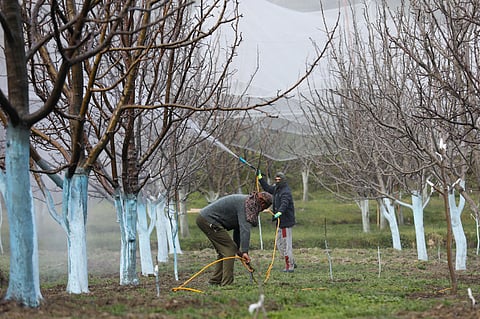
“By the time the apples are ready for harvest, I have already sprayed at least 10 or 12 times, and it is a growing concern year by year,” says a 65-year-old farmer from Banjar Valley in Kullu, who has more than four decades of orchard experience.
He is not an exception. Across the high-value horticultural belts of Shimla and Kullu, repeated spraying of multiple formulations through a single season has become the norm. Because of the sheer frequency of application, the occupational exposure faced by Himachal Pradesh’s agricultural workforce is exceptionally high.
The first casualty of this intensive HHP cycle is the farmer. Epidemiological studies from Kullu and Shimla reveal the suffering that has been normalised as the price of cultivation. Many farmers endure extreme fatigue, severe eye irritation, skin lesions and acute systemic toxicity as routine post-spray effects.
What begins as an occupational hazard quickly compounds into a wider public health concern. Today, Himachal Pradesh registers the second-highest cancer incidence in the country. The state’s cancer mortality rate stands at 9.5 per cent, higher than the national average of 7.7 per cent.
More alarming than the current caseload is its trajectory. Cancer cases in Himachal Pradesh are rising at an annual growth rate of 2.2 per cent, far above the national growth rate of 0.6 per cent. The state is not merely following a national trend; it is accelerating past it. The cancer figures cited in this report are drawn from a press statement issued by the Government of Himachal Pradesh on August 5, 2024, discussions held during the 2024-25 session of the Himachal Pradesh Vidhan Sabha as reported by The Tribune, and reporting by Down To Earth published in August 2024.
In the state assembly, Chief Minister Sukhvinder Singh Sukhu publicly attributed this alarming surge to the excessive use of pesticides and chemical fertilisers. The medical fraternity has echoed this concern. Leading oncologists in Himachal Pradesh have publicly called for a regulatory law, citing agricultural pesticides as a grave threat to public health.
The Indira Gandhi Medical College and Hospital and Himachal Pradesh University are now conducting joint research to quantify the extent of this contamination.
For decades, the movement of pesticide poisoning through contaminated water, soil and food chains has been a known byproduct of intensive Indian agriculture. Yet communicating the scale of these scientific warnings to the public, and converting them into policy, has historically been a challenge. In Himachal Pradesh, however, the consequences have become too severe to ignore.
Among HHPs, paraquat has become a symbol of the global debate over the issue. The herbicide has been banned or severely restricted in more than 75 countries because of concerns over human health, environmental contamination and occupational exposure.
In a significant development, its principal global manufacturer has announced a phase-out of production. Yet the chemical remains available in several agricultural regions, highlighting the need for a closer review of its continued role in Himachal Pradesh’s farming systems.
The scale of the public health concern is substantial. In Shimla division alone, forensic records documented 585 deaths linked to agricultural pesticides and phosphine compounds over five years. International evidence suggests such deaths can be sharply reduced when the most toxic pesticides are phased out, without losses in agricultural output.
This devastation does not end at hospital doors. It is also quietly affecting the environment.
As the “water tower” of North India, Himachal Pradesh’s ecosystem is uniquely sensitive. Peak pesticide application in the state coincides with heavy rainfall patterns. Rains wash toxic chemical loads off farms and into local mountain streams, or khuds.
Beneath the soil, the living foundation of agriculture is being damaged. Routine drenching with systemic HHPs adversely reduces beneficial soil microbial diversity. When natural nitrogen-fixing bacteria are affected, soil fertility declines. This forces farmers into an expensive fertiliser trap, compelling them to buy more synthetic inputs every year just to maintain baseline yields.
Above ground, the ecological fallout is visible. Himachal Pradesh’s apple economy relies heavily on insect pollination. Yet the indiscriminate use of HHPs is contributing to the decline of local bee populations. To protect their harvests, farmers are now forced to rent commercial bee boxes at high cost — a human-made ecological tax on what was once a self-sustaining ecosystem.
The growing body of evidence from public health, toxicology and environmental research points in the same direction: highly hazardous pesticides pose risks that cannot be effectively managed through safe-use instructions alone.
The immediate strategy for Himachal Pradesh must be a strict, state-led regulatory reset. This should begin with banning and phasing out the most lethal HHPs, particularly those with no known antidotes or high persistence in the ecosystem. Removing these pesticides from circulation can lead to immediate reductions in rural mortality and ecological damage without harming agricultural output.
However, a ban is only half the solution. A sustainable strategy requires equipping farmers with viable, long-term alternatives. The state must actively support the transition towards resilient horticultural crops that require fewer chemicals. It must scale up Integrated Pest Management and Integrated Weed Management to replace blanket HHP spraying with safer alternatives.
This transition must also draw momentum from national priorities such as the Khet Bachao Abhiyan, which aims to rescue farmland from soil degradation, and holistic health mandates such as SEHAT, reinforcing the link between toxic-free agriculture and human well-being.
Most importantly, the agrochemical phase-out must be integrated with Himachal Pradesh’s own natural farming initiative, the Prakritik Kheti Khushhal Kisan Yojana. But a natural farming transition cannot take root in soil already contaminated with HHP residues, or in an ecosystem where the pollinators required for the state’s fruit crops are being systematically weakened.
Phasing out HHPs is not a constraint on that mission. It is a precondition for it. The evidence from Himachal Pradesh’s hospitals, forensic labs and agricultural research institutions points in the same direction: the chemicals harming the state’s farmers are also entering its rivers, degrading its soils and damaging the biodiversity on which its agriculture depends.
This is one crisis and requires a clear, evidence-backed regulatory response.
The future of Himachal Pradesh’s agriculture depends not only on what grows in its orchards, but on the health of the farmers, rivers, soils and biodiversity that sustain them. Protecting them all requires confronting the challenge of HHP.
Guman Singh is coordinator, Himalaya NITI Abhiyan and Satya Sainath, Project and Policy Officer, University of Edinburgh
Views expressed are the author’s own and don’t necessarily reflect those of Down To Earth