

In Himachal Pradesh, a wool development programme has been underway since 2021, with a target of achieving 3,000 tonnes of wool production by 2027. Initiated under the National Livelihood Mission at a cost of Rs 6 crore, the programme began with the importation of Merino sheep from Australia, known for their fine-quality wool and high production of 4.3-4.5 kg per sheep per year.
In 2021, 240 Merino sheep, 40 males and 200 females, were brought to the government sheep-breeding farm at Nagwain in Mandi. The centre focuses on improving the genetics of indigenous sheep to enhance wool and meat production. Pahari sheep, which produce wool of approximately 27 microns, are crossbred with Merino sheep to develop fine, soft, apparel-grade wool in the 21-22 micron range through artificial insemination.
From these 240 flocks, 800 healthy lambs have been produced through the process of artificial insemination by crossing Merino and Gaddi sheep. Of these, 52 sheep (20 males and 32 females) were recently sent to Bharmour, the predominant original habitation of Gaddi pastoralists in the state for centuries.
Now, the plan is to introduce these mixed-breed lambs to local farmers and pastoralists, with the aim of achieving high-quality wool production and improving their traditional sheep breeds. Current wool production in the state is around 1,500 tons, meaning the target is to nearly double it.
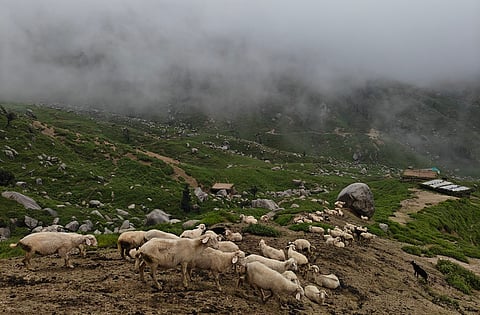
In Australia, Merino sheep are often grazed and managed intensively in large, fenced areas. High humidity and a strong monsoon season can cause skin and other health issues. Whereas Himachal Pradesh is home to a traditional pastoral culture, especially among the Gaddis, who are seasonal migrants. They cover altitude variation from 200m to 3400m. Gaddi sheep are embedded in a transhumant cycle of movement; they travel from low altitudes during summer to higher altitudes till the onset of winter. They can walk 10-15 km daily in rugged mountains and eat wild plants, which serve as both food and medicine. It makes the sheep physically strong, endows them with endurance, and provides them with resistance to climatic conditions and various diseases.
A staff member at a veterinary hospital noted that the state’s highly variable terrain and migratory pastoral systems create a more complex context. “Gaddi sheep move across diverse climatic zones, from plains to higher altitudes, whereas Merino-type breeds require more intensive care,” he said, adding that their performance under such conditions remains uncertain and will need to be observed over time.
One Gaddi mentioned concerns that dense, soft wool can act like a sponge during the heavy rainy season, making sheep more prone to skin infections and diseases like pneumonia, which Gaddi wool naturally resists. Also, being soft wool, it can get damaged by rough shrubs. Gaddi sheep have evolved their hooves to be as hard as possible. Merino breeds usually have softer hooves, which can make them more challenging to evolve and slow the flock’s movement. They may face challenges climbing high hills, and walking and grazing in the rain may be difficult.
If the focus shifts solely to market-driven fine wool production, it could, over time, lead to a gradual shift in the Gaddi breed toward crossbreeding. This could have consequences for traditional coarse wool, its culture, market, and knowledge, and may lead to the long-term loss of local breeds. This loss would be not only of a breed but also of the state’s culture, movement, and tradition. The Gaddis say that a coat made from the wool of the Gaddi breed is of top quality: “You can wear this coat throughout the year. During winter, it keeps your body warm, makes you feel normal during summer, and protects you from the rain as well.” Local wool is also used to make carpets and denser materials, such as an unali coat and pattu.
Crossbreeding can be beneficial if the Merino meets the ground realities. It can boost product market value in the short term, but it also poses a long-term risk to the indigenous Pahari breed.
Many pastoralists want to adopt new breeds, driven by the need to secure better incomes. However, some argue that improving returns from existing wool could be equally important.
“You are thinking about the future of indigenous wool, but here, the future of pastoralists themselves is uncertain.” This statement reflects a deeper concern — that without addressing livelihood security, such interventions alone may not sustain traditional systems.
The in situ condition of these lambs must continue to be monitored. It will be interesting to see how in situ reared Merino at the Nagwain breeding center will perform in ex situ conditions in the hands of pastoralists. Continuous assessment and feedback is needed to check the ground reality, before it gets complicated.
Many pastoralists still sell their wool to private traders at a very low rate of Rs 12-15/kg, far below the crossbreed price of around Rs 40-70/kg. This gap also highlights many issues, such as a lack of institutional capacity, market access, and federation among many pastoralists. Indigenous wool is a water-resistant material for sheep, helping them resist thorns in rough landscapes. Soft wool can develop serious issues, such as becoming heavy and dirty. This is not only wool but the soul of traditional crafts such as the unali coat and pattu.
Himachal Pradesh has taken these ambitious steps to position its wool economy by introducing fine wool. The interesting and serious question will be about how it will mix up and move alongside the indigenous breed. Gaddi sheep not only produce wool but also represent mobile ecological and cultural knowledge.
The Himachal Pradesh Wool Federation tends to offer relatively higher prices for white crossbred wool (around 20 per cent more than coarse wool), which is an indirect way of incentivising or attracting pastoralists to shift to crossbred flocks, as reflected in this author’s fieldwork where pastoralists showed interest in getting farm Merino lambs for better wool prices in the future. So, it is crucial to ensure that crossbreeding doesn’t exceed 50 per cent. Also, the quality of local Gaddi rams must be improved to maintain the traditional breed.
Vinay Kumar is a doctoral candidate at ATREE, where his research focuses on pastoralist-wildlife relationships in the Western Himalayas
Views expressed are the author’s own and don’t necessarily reflect those of Down To Earth