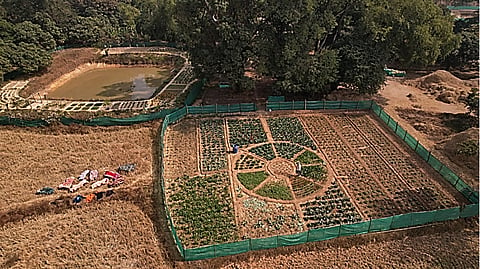


In Odisha’s Koraput district, farm ponds are helping rainfed farmers store monsoon runoff and use it for crops, fisheries and vegetable cultivation.
Pond-based integrated farming systems allow farmers to move beyond single-season paddy cultivation and generate income across the year.
The M S Swaminathan Research Foundation’s project in Koraput and Nabarangpur has helped farmers combine aquaculture, vegetables, fruit trees, pulses, millets, mushrooms and vermicompost.
Farmers say the model has reduced seasonal distress, improved household food security and made agriculture more resilient to climate variability.
In several Indian villages, the problem is not always the absence of rain. Often, it is the inability to hold on to it. Monsoon water runs off the land, carrying soil with it, while fields lie fallow after paddy harvest because farmers do not have enough stored water to grow another crop. For small farmers, this gap between rainfall and water availability can decide whether agriculture remains a seasonal activity or becomes a year-round source of food, income and resilience.
India’s agricultural future is closely linked to efficient water management. The country supports nearly 18 per cent of the world’s population and about 15 per cent of its livestock, yet has access to only 4 per cent of global freshwater resources. This structural mismatch makes water management one of the most critical challenges facing agriculture. Agriculture remains India’s largest consumer of freshwater. Rising population pressure, climate variability and unsustainable extraction have pushed many regions into water stress.
Irrigation has expanded over the years and continues to support foodgrain production. However, a substantial share of cultivated land still depends on rainfall for crop growth. These rainfed regions support a large farming community and remain central to the production of pulses, oilseeds and coarse cereals. Yet they are more vulnerable to climate variability and water stress. In this scenario, productivity enhancement in rainfed regions is critical.
Large parts of southern Odisha, particularly Koraput, depend largely on rainfed agriculture, with farmers cultivating only one crop — paddy — during the kharif season. After harvest, vast tracts of land remain fallow because of the lack of irrigation infrastructure, limiting income opportunities and increasing livelihood vulnerability.
These regions receive a substantial amount of rainfall. The problem lies not in rainfall scarcity, but in inadequate rainwater retention and storage capacity. A significant proportion of rainwater, around 10 to 15 per cent, is lost as surface runoff, causing soil erosion, reducing groundwater recharge and creating seasonal water shortages. This underscores the relevance of the national call to action: Catch the Rain Where it Falls, When it Falls.
Scientific studies across rainfed agro-ecosystems suggest that dryland and rainfed agriculture can remain productive if supported by appropriate practices such as crop rotation, intercropping, mulching, soil cover management and, most importantly, efficient water use. Enhancing water-use efficiency allows farmers to produce more food per unit of water, a necessity in a warming climate. The adoption of micro-irrigation, drought-tolerant crops, organic soil amendments and mulching can further reduce evaporative losses while improving soil health.
In this context, approaches such as pond-based integrated farming systems offer a viable pathway towards sustainable agriculture. In such systems, rainwater is harvested by storing excess monsoon runoff in farm ponds and then reused efficiently across crops, livestock and fisheries. This allows farmers to diversify crops, extend cultivation beyond the kharif season and stabilise incomes.
Since 2017, the Integrated Farming System project implemented by the M S Swaminathan Research Foundation in Koraput district, Odisha, has demonstrated this potential. Initially piloted with 20 aquaculture farmers, the initiative showed that farm incomes under integrated systems were nearly double those from conventional monocropping.
Following these outcomes, the programme was scaled up to include 193 farmers across Koraput and Nabarangpur districts, with support from the Directorate of Agriculture and Food Production, Government of Odisha, under the Rashtriya Krishi Vikas Yojana.
At the core of the system is a rainwater harvesting pond, scientifically managed for aquaculture and supplemental irrigation. Ponds are cleaned and conditioned with lime application to maintain optimum pH levels. Organic inputs, such as cow dung-based slurry, enhance plankton growth, which serves as natural fish feed.
Farmers stock Indian major carps such as catla, rohu and mrigal in scientifically recommended proportions, enhancing natural productivity with low-cost homemade fish feed and floating fish feed. Regular fish sampling helps monitor growth and adjust feeding practices.
The pond dyke and adjacent lands, traditionally left unused, are brought under intensive cultivation. Fruit trees such as banana, papaya, drumstick, guava, lemon, pomegranate and coconut are planted on the pond dykes, while vegetables are grown year-round on pond dykes and adjoining land using stored pond water.
Lowland paddy cultivation is improved through line transplanting, which facilitates mechanical weeding, reduces pest incidence and enhances plant population. Post-paddy pulses, such as green gram and black gram, grown on lowland not only provide additional income but also improve soil fertility through biological nitrogen fixation, lowering input costs over time.
Similarly, farmers adopted cultivation of finger millet in kharif and horse gram during the late kharif season on uplands. This diversified cropping practice improves soil health, strengthens farmers’ livelihoods, promotes food security, and supports household nutrition.
Oyster mushrooms are promoted to ensure the efficient and sustainable use of paddy and finger millet crop residues. Vermicomposting units recycle farm biomass, including spent mushroom substrate and other farm residues, into nutrient-rich manure, reducing dependence on chemical fertilisers.
The benefits under the integrated farming system are significantly higher than those under conventional practices. More importantly, income flows are distributed across the year, reducing seasonal distress and allowing farmers to lead more secure lives.
For farmers like Rama Gumia, 60, of Salapguda village in Boipariguda block, Koraput, the pond dyke has transformed livelihoods.
“I generate income from every nook and corner of the pond dyke area by growing vegetables based on market demand, and water availability makes it possible,” he says. “The pond is not just a piece of land. It is central to our lives, as we devote our heart and soul to it.”
Similarly, Khagapati Pujari, 45, from Khutuguda village in Boipariguda block, Koraput, reports earning Rs 25,000 per season from a small piece of land once considered barren because it lacked water for irrigation.
“I got financial support from M S Swaminathan Research Foundation under the integrated farming system project for pond renovation, which made it possible to store more water for a longer period. Our household vegetable expenses have reduced as we mostly get them from our garden,” he says.
“Vermicompost has eliminated the need for chemical fertilisers, reducing the cost of cultivation and increasing profit,” Khagapati adds.
For Dhanurjaya Nayak, 48, of Minarbali village in Boipariguda block, Koraput, scientific aquaculture has replaced traditional subsistence fishing.
“With technical support from MS Swaminathan Research Foundation, including proper stocking, pH management, feeding and other necessary inputs, I now earn nearly Rs 18,000 to Rs 20,000 annually from fish cultivation after meeting household consumption. Earlier, I hardly made Rs 5,000,” he says.
Integrated farming systems rooted in rainwater harvesting offer more than income enhancement. They strengthen climate resilience, improve nutritional diversity, conserve soil and water resources, and reduce pressure on groundwater. As climate change intensifies rainfall variability, such decentralised, community-driven solutions become vital.
The integrated farming system model needs to be scaled up, and this requires policy support, grassroots capacity building and community participation. When farmers manage water as a shared ecological resource, agriculture can move closer to sustainability.
Catching rain where it falls may be the simplest method, yet it remains one of the most powerful strategies to safeguard India’s food future.
Tripati Khura is a development associate at MS Swaminathan Research Foundation, Jeypore, Odisha
Views expressed are the author’s own and don’t necessarily reflect those of Down To Earth