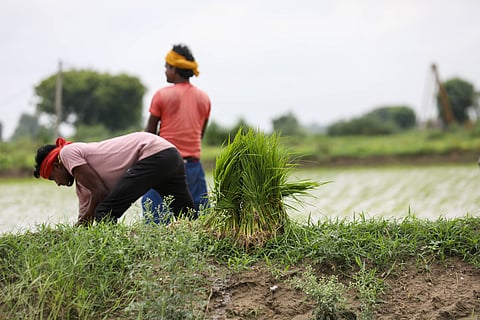


Kharif sowing recovered in July as rainfall improved, with the gap from last year narrowing to 2.9% by July 31.
Agriculture ministry data shows 89.42 million hectares had been sown by the end of July, compared with 92.07 million hectares last year.
Pulses, maize and bajra continue to lag, with maize acreage down 0.65 million hectares and bajra down 0.42 million hectares.
The recovery remains uncertain as IMD has forecast below-normal rainfall for many regions in August and September.
The gap between this year’s kharif sowing and last year’s has narrowed sharply after rainfall picked up in July, according to the latest data from the Union Ministry of Agriculture and Farmers' Welfare. Data released on August 4 showed that kharif sowing at the end of July was 2.9 per cent lower than during the same period last year. The gap had stood at 25 per cent at the end of June.
As of July 31, kharif crops had been sown over 89.42 million hectares across the country, compared with 92.07 million hectares at the same time last year. This leaves a shortfall of 2.6 million hectares.
The recovery marks a turnaround from earlier in the season. In mid-July, the sowing shortfall was still in double digits. It stood close to 16 per cent in the second week of July, before narrowing to about 6 per cent by July 17 as rainfall improved.
The southwest monsoon recovered in July after a dry June. All-India rainfall in July was 1 per cent above normal, although cumulative rainfall for June and July remained 13 per cent below normal.
The July rains have helped sowing recover, but the improvement has not been even across crops. Data from the Department of Agriculture and Farmers Welfare showed that acreage under pulses, maize and bajra continued to lag behind other kharif crops.
Among pulses, arhar (split pigeon pea) and moong (green gram) recorded the steepest declines, with both falling by more than 0.3 million hectares compared with last year.
The major states reporting lower area under pulses included Karnataka, Maharashtra, Rajasthan, Odisha and Madhya Pradesh. Bajra sowing also remained behind last year’s level, with acreage down by 0.42 million hectares. Maize recorded the steepest fall among coarse cereals. Acreage was down by 0.65 million hectares compared with the same period last year.
The shortfall is significant because maize is increasingly being used as a feedstock for ethanol. With the government pushing ethanol blending and relying on maize alongside rice to meet supply, a sustained sowing gap could tighten feedstock availability for ethanol producers later in the season.
Rice sowing picked up pace in the second half of July. The shortfall narrowed to 0.68 million hectares, with 30.14 million hectares sown as of July 31, compared with 30.83 million hectares last year.
Lower rice acreage was recorded mainly in Madhya Pradesh, Maharashtra, Gujarat, Tamil Nadu, Odisha, Haryana, Telangana and Uttar Pradesh.
Oilseeds and sugarcane, however, were running ahead of last year’s pace. Oilseed acreage was up by 0.12 million hectares as of July 31, while sugarcane acreage rose by 0.086 million hectares.
The narrowing overall sowing gap is a reassuring signal after a difficult start to the monsoon season. But risks remain. Scientists have warned that this year’s El Niño could become one of the strongest on record, with some describing it as a “super” El Niño whose effects could linger into 2027.
The India Meteorological Department has forecast below-normal rainfall for many parts of the country in August and September. Whether the sowing recovery holds will depend on how rainfall performs during the rest of the season, both in terms of volume and how evenly it is distributed.
The agriculture ministry had earlier identified 111 districts as high-risk and high-priority areas, where a weak monsoon outlook overlaps with irrigation coverage below 25 per cent. These districts have limited protection if rainfall weakens again.
Most are spread across 12 states, including Madhya Pradesh, Maharashtra, Gujarat, Uttar Pradesh, Rajasthan, Karnataka, Bihar, Jharkhand, Telangana, Andhra Pradesh and Odisha.