

India’s long-delayed transgenic mustard hybrid DMH-11, engineered for herbicide tolerance, is being pushed as a solution to low yields and rising edible oil imports.
But critics argue HT mustard clashes with India’s smallholder, mixed-cropping systems, threatens non-crop biodiversity, pollinators and nutrition sources, and deepens dependence on costly chemical inputs despite official promotion of low-input farming.
Nearly two decades after development, Delhi University’s transgenic mustard hybrid DMH-11 (Dhara Mustard Hybrid-11) is ready to be sown in Indian fields. Developed by Deepak Pental’s team at the Centre for Genetic Manipulation of Crop Plants, it carries three genes that are borrowed from the soil bacterium Bacillus amyloliquefaciens. Among these are barnase and barstar, which enable cross-pollination and hybrid seed production in a crop that normally self-pollinates, and the bar gene, which confers tolerance to the herbicide glufosinate. Around the same time, two major seed companies are preparing to roll out their own mustard varieties, bred through conventional induced mutagenesis, giving tolerance to imidazolinone herbicides. Since it carries no foreign gene, the mutant mustard follows the recent release of herbicide-tolerant (HT) rice varieties such as Pusa Basmati 1979 and Pusa Basmati 1985, which largely avoided the regulatory scrutiny that has kept transgenic HT food crops out of Indian farms for nearly two decades.
The timing is not accidental. Despite being one of the largest oilseed producers, India imports well over half of its edible oil as of now. We imported roughly 16 million tonnes of edible oil in 2024-25 alone, costing close to Rs 1.61 lakh crore. Solvent Extractors’ Association of India (SEA), the industry body that compiles and publishes the data, projected that the import bill will rise about 9 per cent this year. Palm oil alone constitutes nearly half of this import. On the other hand, India produces about 12 million tonnes of edible oils across 9 major oilseed crops. Among these, mustard alone contributes to about 45 per cent of the production, followed by groundnut and soybean at roughly 25 per cent each. This production deficit, combined with growing per capita consumption, has driven India’s edible oil import dependence to over 56 per cent. This has prompted the government to launch the National Mission on Edible Oils with an ambitious goal towards achieving self-sufficiency.
Mustard is grown on nine million hectares of land, mostly in dry regions of central and northwestern states. Despite the yellow revolution, mustard productivity has stagnated for years at around 1.3-1.5 tonnes per hectare. This is far below the productivity achieved in other countries. One of the major problems attributed to limited yield is the presence of parasitic weeds locally known as Margoza/Egyptian broomrape (Orobanche aegyptiaca and related species), a root parasite, which extracts nutrition from its host plant and substantially reduces seed production. DMH-11 hybrid is touted to increase the seed yield by providing weedicide tolerance. All other plants in the field, including Orobanchaceae weeds, which do not have innate tolerance to the weedicide, will be suppressed upon the spray of glufosinate. Its proponents argue that herbicide tolerance will help farmers to control weeds more efficiently by avoiding the need for expensive labour-intensive manual weeding. Although DMH-11 is developed by a public sector institute, which could keep the seed cost low, the accompanying weedicide is largely produced by private sector companies, thus making farmers depend on these high-cost external inputs. This is clearly against the government’s own policies promoting low external input agricultural practices such as Zero-budget Natural Farming.
HT mustard developed through conventional mutation, on the other hand, is a compelling pitch, wrapped in a comforting technical language. Since this variety is not classified as a genetically modified (GM) crop, its release could open the floodgates that Indian regulators have kept firmly shut since the moratorium on Bt brinjal and the prolonged court battle over DMH-11 itself. Globally, HT crops dominate the GM crops list, and there has been a concerted effort by industry lobby over the years to approve these crops in India as well. HT crops, be it transgenic or traditionally bred through mutation, are a poor fit for Indian farmscapes.
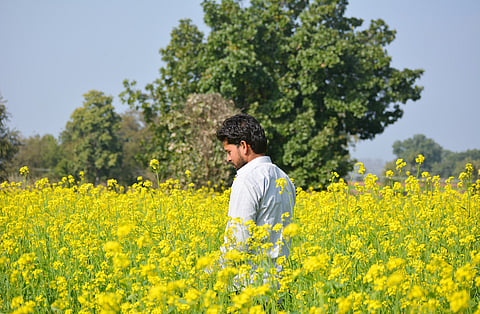
Indian farms are multifunctional landscapes, not just monocultures. Mustard, especially, is overwhelmingly a small-holder crop, often grown as mixed or intercropped systems, alongside chickpea, lentil and other vegetables, rather than as a standalone monoculture. Even in monoculture farms, given that Indian landholdings are limited, these are often interspersed with grazing lands and other forested areas. When mustard is grown as a large monoculture, field bunds routinely carry their own vegetation such as grasses, legume crops, and sometimes trees, which function as biodiversity refugia within the farmed landscape. A herbicide that leaves mustard unharmed may still damage the companion crops and refugia growing in the same field.
There are other ecological concerns too. Off-farm movement of these herbicides through run-off or leaching and contamination of nearby groundwater and aquatic ecosystems is well documented. Its effects on non-target organisms like soil microbes, arthropods and earthworms are comparatively understudied. In a country with known overuse of pesticides and fertilisers above recommended doses, promotion of HT crops compounds the problem. Despite not being approved, HT cotton varieties have found their way to market and farms of central India; free market availability of HT mustard crops will make it more prevalent and increase the use of weedicides.
The framing of non-crop plants as pure adversaries or ‘weeds’ also undermines their role as important sources of nutrition and income for the same smallholder farmers. For example, Bathua (Chenopodium sp) — a common non-crop plant growing naturally in and around mustard fields across central and north India, is widely consumed as a leafy vegetable (as saag) and is an important source of vitamins and iron for these marginalised communities. Celosia sp., a common non-crop found in dryland farms, is a rich source of micronutrients and nutritionally comparable to spinach, which is often promoted as a superfood. Senna tora, another such non-crop plant, not only harbours pollinators and fixes atmospheric nitrogen, thereby enriching the soil, but also provides edible leaves and serves as a traditional ethnomedicinal plant. These non-crops become an important part of the traditional diet, which increases the dietary diversity of indigenous communities where malnourishment is often prevalent. Additionally, many non-crops are medicinal and have been used traditionally by these communities. Even those plants that are deemed weeds by farmers are carefully removed and often used as fodder and thus are especially valuable to smallholder farmers with livestock.
Non-crop plants also provide important forage for pollinators and adults of natural biocontrol agents, thus contributing to enhanced yield among crops. Non-crop flora growing in and around the farms are known to support a diverse array of native pollinators. Mustard itself substantially depends on bees for an optimal seed set. In fact, chemical-driven weed-clearing practice risks thinning out the floral diversity that sustains pollinator populations in and around these farms. Ironically, a variety like DMH-11, which was developed through cross-pollination, also promotes herbicide usage that negatively impacts natural pollinators and their refugia on the farm. Repeated reliance on a single herbicide accelerates the evolution of ‘superweeds’, a phenomenon well documented in glyphosate- and glufosinate-tolerant cropping systems globally. Even developers of the DMH-11 recently acknowledged this problem and cautioned against relying on herbicide tolerance alone. Further, with the toxicity and water contamination concerns associated with sustained, intensified herbicide use, the promised efficiency starts to look considerably less straightforward. Eliminating all non-crop plants wholesale in the name of yield efficiency quietly strips away a layer of food, fodder, nutritional, and ecological security that rarely features in cost-benefit calculations focused solely on oilseed output.
The Indian oilseed sector clearly needs better yields to fulfil the growing domestic demand. But solutions borrowed from the Global North monoculture agriculture system, where large uniform holdings and wage labour scarcity make HT crops genuinely useful, do not automatically translate to Indian conditions. Better agronomic practices to manage weed seed banks, coupled with approaches like the System of Mustard Intensification, are the need of the hour. For instance, studies show that the System of Mustard Intensification has shown substantial yield gains through better agronomy, suggesting that some of India’s oilseed problems may be less about frontiers of biotechnology but more about scaling up practices we already know work. Moreover, India has a diverse array of crops that produce edible oils such as coconut, groundnut, sunflower, sesame, safflower, and niger, which still have potential to fulfil the growing domestic demand for edible oils.
India’s agriculture is not a version of the American Midwest. Its problems and challenges are unique, which also provide unique opportunities. Fragmented landholdings, mixed cropping, local diversity-dependent nutrition, fodder economies, and labour-intensive rural livelihoods are specific to the Indian context, and solutions need to be built with these specifics in mind.
Prasanna N S is a plant biologist, Ravikanth G is a conservation geneticist, and Smitha Krishnan is a pollination biologist working across different landscapes in India. The views expressed in this article are those of the authors and do not reflect the views of their respective organisations
Views expressed are the authors’ own and don’t necessarily reflect those of Down To Earth