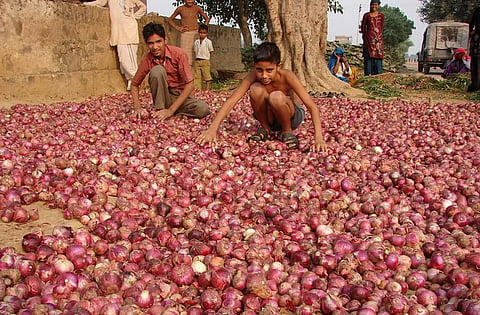


Farmers in several states are dumping onions, destroying potato crops and discarding tomatoes after mandi prices fell sharply despite rising food inflation.
Food inflation rose from 3.87% in March 2026 to 4.20% in April 2026, while consumers continued to pay elevated retail prices for onions, potatoes and tomatoes.
Government data shows the all-India average retail price of onion rose to ₹25.36 per kg on 12 May 2026, even as farmers in mandis were forced to sell onions for ₹5 to ₹7 per kg.
In Maharashtra, farmers received only about 43% of the retail onion price, highlighting the widening gap between what growers earn and what consumers pay.
Experts say the Price Stabilisation Fund could help stabilise prices, but onion procurement remains limited to only 1% to 2% of total production.
Reports from different parts of the country are once again making headlines. A farmer in Maharashtra reportedly received only Rs 1 for 25 bags of onions. Farmers in Nashik dumped onions on the road. In Uttar Pradesh, farmers unable to secure a fair price for their potatoes ran tractors over standing crops. In Karnataka, frustrated farmers emptied a truck loaded with tomatoes into an enclosure for sheep and goats.
At the same time, reports show that almost all crops are being sold below the minimum support price. These incidents have emerged even as the food price index recorded a rise in April.
Food inflation stood at 3.87 per cent in March 2026 and rose to 4.20 per cent in April 2026. Even in retail markets, consumers continue to buy potatoes and onions at elevated prices.
The same old reasons are being cited for farmers receiving low prices: bumper production, bad weather and a lack of cold storage facilities. These factors mean farmers are unable to get full prices for their produce.
But prices for consumers are not falling.
A report from the Price Monitoring Cell of the Department of Consumer Affairs, under the Union Ministry of Food and Consumer Affairs, shows that the all-India average retail price of onion on May 12, 2026 was Rs 25.36 per kg, up from Rs 23.63 a month earlier. On the same day last year, the retail price was Rs 27.07 per kg.
Similarly, the retail price of potato on 12 May 2026 was Rs 20.86 per kg, compared with Rs 19.06 per kg a month earlier. The price of tomato was Rs 34.85 per kg on 12 May, compared with Rs 25.28 per kg a month earlier.
In mandis, however, farmers are being forced to sell onions at Rs 5 to Rs 7 per kg.
For example, in Maharashtra’s Chhatrapati Sambhajinagar district, data from Agmarknet, under the Union Agriculture Ministry, shows a continuous decline in wholesale onion prices in the district’s major agricultural produce markets in the second week of May 2026.
The average wholesale price in the five major mandis of the district — Chhatrapati Sambhajinagar APMC, Gangapur, Lasur Station, Paithan and Vaijapur — was Rs 578.08 per quintal. This was much lower than Rs 688.37 per quintal the previous week and Rs 835.22 per quintal during the same period last year.
The wholesale price at Chhatrapati Sambhajinagar APMC was Rs 496.65 per quintal. Gangapur APMC saw the largest year-on-year decline, at 47.7 per cent, while prices at Paithan mandi fell by 25 per cent in a month.
Paithan is the area where farmers reportedly received Rs 1 for 25 bags of onions.
This raises the question: how much are farmers receiving compared with the price charged to consumers?
Taking Maharashtra as a whole, the average wholesale price of onions in the second week of May was Rs 933.30 per quintal. Data from the Department of Consumer Affairs shows that the average retail price of onions on 12 May 2026 was Rs 21.63 per kg.
This means farmers received only 43 per cent of the retail price.
In such a situation, there have long been demands for government intervention. Farmers have been demanding a minimum support price. Experts believe the Price Stabilisation Fund, or PSF, could provide relief to both farmers and consumers.
The central government launched the PSF in 2014-15. Its aim is to provide relief to farmers by purchasing onions during peak production and later making onions available to consumers at controlled prices during periods of shortage.
According to the report Documenting Onion Operations under PSF, prepared by the Consumer Affairs Ministry, only 9,000 metric tonnes of onion was procured under the PSF in 2015-16. This increased to 638,000 metric tonnes by 2023-24.
The result was that farmers’ share of every rupee paid by consumers increased from 45 per cent to 54 per cent. Farmers received prices 3 per cent to 19 per cent higher than market rates, and payment times decreased from seven to 10 days to three days.
At the consumer level, retail onion price volatility in Delhi decreased by 24 per cent.
But procurement under the PSF remains extremely small.
According to the study report, in 2023-24, only 6.38 lakh metric tonnes of onion were purchased under the PSF, while the country’s total onion production was more than 300 lakh metric tonnes. This means government procurement was limited to only 1 per cent to 2 per cent of total production.
The report recommends that the PSF be developed not just as a crisis management plan, but as a permanent market stabilisation mechanism.
It highlights the need for scientific storage, affordable sales in rural and semi-urban markets, expansion of the transport network and an increase in the number of procurement centres at the state level.
