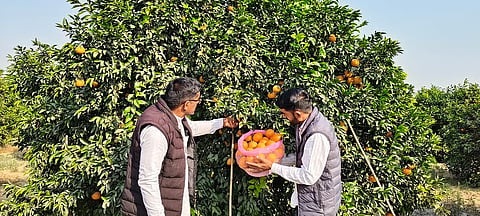


Rajasthan is hosting the Kinnow Mahakumbh in Sri Ganganagar to promote its flagship citrus crop
Farmers say price volatility, water shortages and weak market access continue to hurt incomes
Growers argue long-term reforms matter more than fairs for the survival of kinnow orchards
The Rajasthan government is organising a Kinnow Mahakumbh, a state-level farmers’ fair, in Sri Ganganagar on January 23, 24 and 25, 2026. In a district known nationally for kinnow production, the event is being presented as a boost for local farmers. But many growers say such initiatives will bring little lasting benefit unless long-standing problems around prices, water, research support and market access are addressed.
Kinnow cultivation has been practised in Sri Ganganagar district for several decades, and the area under orchards continues to expand. In 2015-16, kinnow was grown across 7,380 hectares. That figure has now risen to about 12,000 hectares.
An average yield of 150 to 170 kilogrammes per tree is considered ideal. However, in 2021-22 and 2022-23, yields dropped sharply to around 40 kgs per tree. This year, production is expected to recover to between 125 and 150 kgs. Officials from the Horticulture Department say that while there has been no steady decline in per-tree output, volatility has increased, making farmers’ incomes unpredictable.
Kinnow trees begin bearing fruit after about five years, but orchards older than ten years usually provide higher and more stable yields. Farmers with mature orchards can earn around Rs 1.5 lakh per hectare, officials say.
If a tree yields 150 kilograms of fruit and sells at Rs 22 per kilogram, income per tree reaches about Rs 3,300. In bumper years, orchards over ten years old can approach this level. But weather uncertainty, water shortages and disease frequently disrupt production.
In 2021-22 and 2022-23, when average yields fell to around 40 kilograms, income per tree dropped to about Rs 880. Farmers say that even when prices rise during low-production years, overall earnings still fall sharply. In bumper years, prices often crash, eroding profits again. The problem is that we never get both quantity and price at the same time, say farmers.
Production costs are also rising. While crop insurance assessments estimate the cost of maintaining kinnow orchards at Rs 70,896 per hectare, farmers say actual expenses are significantly higher.
This year, horticulture officials estimate kinnow production in Sri Ganganagar around 350,000 tonnes — about 25 to 30 per cent higher than last year.
Sri Ganganagar’s kinnows are valued for their sweetness and quality, with demand both within India and abroad. But farmers say poor export infrastructure prevents them from accessing wider markets.
In 2021, a special train service was launched to export kinnows to Bangladesh, but it was discontinued within the same year.
Dilip Godara, a farmer from Netewala village, says the closure of the service caused heavy losses. “Today, there is no effective system for exporting kinnow,” he said.
“When production falls because of bad weather or lack of irrigation, losses are unavoidable. But even when there is a bumper harvest, kinnows are sold cheaper than vegetables because we can’t access markets outside the state,” he added.
Water availability remains a major concern. Godara said canals are often closed just when orchards need irrigation most, sometimes without prior notice from the Irrigation Department.
Farmers say canal closures have been particularly frequent over the past two years.
At the same time, research and extension support has weakened. The Agricultural Research Centre in Sri Ganganagar once produced high-quality kinnow seedlings at affordable rates, say farmers. That work has largely stopped over the past 15 years.
After the establishment of the agricultural college, many scientists were reassigned to teaching duties, leaving little time for field research. As diseases spread in older orchards, farmers say on-site technical guidance has declined.
Currently, the district’s Horticulture Department nurseries meet only about 10 per cent of the demand for kinnow seedlings. Farmers are forced to buy the rest from private nurseries, paying Rs 100 to Rs 150 per plant, compared with Rs 50 to Rs 60 in government nurseries.
Extreme weather and disease have pushed some farmers to abandon orchards altogether. In 2022, government data shows that kinnow orchards suffered damage of 80 to 90 per cent. Farmers uprooted orchards across roughly 289 hectares in tehsils including Sri Ganganagar, Padampur, Suratgarh, Srikaranpur, Srivijaynagar, Ghadsana, Anupgarh and Raisinghnagar.
Farmers say such losses could be reduced if scientists conducted regular field inspections, offered technical advice and helped ensure prices that reflect production costs.
Shivprakash Saharan, a farmer from Sadulshahar, says the absence of a dedicated kinnow market is a major barrier.
“Just as Sri Ganganagar now has a separate carrot market, we also need a separate market for kinnow,” he said. “Without that, farmers will continue to face losses.”
Saharan also called for a kinnow-based food processing plant in the district. Products such as juice and pulp could enable large-scale procurement and reduce dependence on fresh fruit markets. He added that the potential for kinnow-based medicinal products should also be explored.
Arvind Godara, a farmer from Maderan village, said growers still rely on Punjab and Haryana for quality kinnow seedlings.
“If tissue-culture-based seedlings were made available in Sri Ganganagar at reasonable rates, farmers would benefit greatly,” he said, adding that facilities similar to those in neighbouring states are needed locally.
Farmers also say access to government support schemes is fragmented. Installing drip irrigation, solar plants, water tanks or fencing requires visits to multiple departments.
“If there was a single application system for all these facilities, it would save time and help farmers enormously,” Godara said.
As the Kinnow Mahakumbh approaches, many growers say fairs and exhibitions can help showcase produce — but only sustained investment in water management, research, markets and processing will determine whether kinnow farming in Sri Ganganagar becomes truly viable in the long run.