
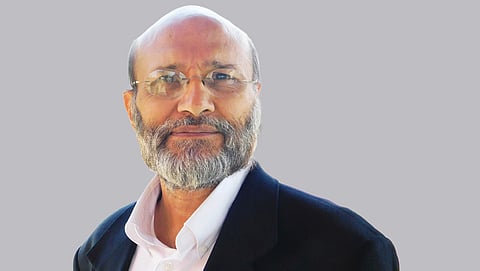
“Return of so many people to farming is a failure of labour market”

Santosh Mehrotra, one of India’s leading development economists, discusses his latest book, India Out of Work: Rethinking India’s Growth Story, co-authored with Jajati K Parida, and outlines what India must do to tackle its employment challenge. Excerpts:
Raju Sajwan (RS): How did you arrive at this estimate?
Santosh Mehrotra (SM): This is neither an assumption nor a conjecture. It is based on data from the Periodic Labour Force Survey (PLFS) and the earlier employment survey data of the National Sample Survey (NSS). These surveys provide the distribution of employment in percentage terms. Those percentages are then applied to the Government of India’s population projections to estimate the number of people working in different sectors. This is an established statistical methodology. The return of 80 million people to agriculture, however, should not be seen as a success of agriculture, but as a failure of the labour market. The normal pattern of economic development is that as incomes rise, workers move out of agriculture into industry and services. India had been steadily following this process for several decades. Therefore, such a large-scale return to agriculture in recent years indicates that something has gone wrong in the economy.
RS: Was COVID-19 responsible for this reversal?
SM: No, the problem had started earlier. The pace of movement out of agriculture began to slow after 2017-18. During COVID-19 pandemic, employment in industry, construction and services declined, forcing millions of people to return to villages. Agriculture became their last resort. COVID-19 was an immediate trigger, but the underlying problem is the economy’s inability to generate enough jobs. During COVID-19, agriculture did prevent people from going hungry, and that is its social role. But this should not be mistaken for an economic success. The amount of farmland did not increase, resources did not increase, and there was no extraordinary improvement in productivity. If more people depend on the same resources, income gets divided.
Around 45-46 per cent of the workforce is employed in agriculture, while the sector contributes only about 16 per cent to GDP. This means that a very large share of the population remains trapped in a relatively low-income sector. Unless this imbalance is corrected, both income and productivity will remain constrained. Workers always move towards better incomes. If they begin moving in the opposite direction, it means the rest of the economy is not performing as it should; industry, manufacturing and services were not creating sufficient opportunities. No one leaves better-paying jobs and better opportunities to return to farming voluntarily. When employment in industry, construction and services declines, agriculture acts as a safety net. That is why it is more appropriate to describe this phenomenon as reverse structural transformation.
RS: You have said that micro, small and medium enterprise (MSME) sector is crucial to addressing reverse structural transformation. Why?
SM: Because small and medium enterprises generate the largest share of employment in India. When this sector weakens, employment is the first casualty. In recent years, MSMEs have suffered several shocks. Their impact has not remained confined to urban areas; it has also affected villages because a large number of rural workers depend on these enterprises. If employment expands in non-farm sectors, these same people will be the first ones to leave agriculture again. So, the return of a large number of people to farming should not be viewed as a permanent structural change. It is a response to an employment crisis.
RS: What role do rural wages play in all this?
SM: When the supply of labour exceeds available work, downward pressure on wages is inevitable. Real rural wages [wages that have been adjusted for inflation] have remained almost stagnant for several years. One major reason is that the supply of labour has increased, while employment opportunities have not expanded at the same pace.
Periodic Labour Force Survey data are often criticised because rural households engage in multiple occupations.
Livelihoods in rural India are no longer confined to farming alone. A person may simultaneously engage in farming, construction work and a small business. PLFS records the principal activity of an individual. Therefore, while interpreting the data, it is important to recognise that rural employment has become multidimensional. Rural construction, small industries, transport, trade and the informal service sector have become major sources of employment. If we look only at agricultural data, we will miss the larger picture.
RS: What is the biggest policy challenge before India?
SM: India’s challenge is to provide people with better non-farm employment. This cannot happen without strengthening industry, particularly labour-intensive manufacturing and MSME sector, which should then generate sufficient employment. In the long run, as in every developed economy, the share of the workforce employed in agriculture should decline to 20-25 per cent. Otherwise, agriculture will remain the last refuge for people, and that is not a healthy sign for any economy.
This interview is part of the cover story “Back to crisis again”, originally published in the July 16-31, 2026 print edition of Down To Earth
