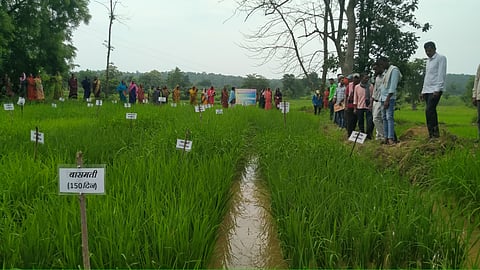


Villages in Kasdol block of Chhattisgarh’s Balodabazar-Bhatapara district once grappled with scarce irrigation, poor connectivity, and little awareness of government schemes. Most families relied on daily wage labour for their livelihood. Local non-profit Kalp Samaj Sevi Sanstha (KSSS) began working here in 2016. A baseline survey across 21 villages revealed fragile livelihoods, heavy debt dependence on moneylenders, and near absence of women in decision-making spaces. Yet the communities also possessed deep traditional agricultural knowledge and strong social bonds. What unfolded over the next decade was far more than an agricultural intervention. It was a social transformation grounded in seed sovereignty.
Initially, KSSS focused on building social foundations. It facilitated the formation of 21 Self-Help Groups (SHGs), one in each village, along with Village Development Committees led by women. Mahila Gram Sabhas created dedicated spaces for women to deliberate on local issues such as water access, food security, entitlements and to participate in governance processes. Linking SHGs to banks reduced dependence on exploitative credit and strengthened collective savings. Nutrition became the next entry point. In 2017, household kitchen gardens—small 20×20 and 30×30 feet plots began supplying seasonal vegetables. For many families, it meant improved diets and lower food expenses.
In 2018, Kalp Samaj piloted organic paddy cultivation in Bitkuli village. Farmers experimented with line sowing, mechanical weeders and Jeevamrit, a fermented microbial solution used in natural farming. Yields were slightly lower than conventional chemical cultivation. But cultivation costs dropped sharply. Soil health visibly improved. Farmers began to see that low-input agriculture could make economic sense.
The decisive shift came in 2019, when KSSS collaborated with SWISSAID India. Until then, seed revival efforts were scattered and demonstration based. The partnership introduced structure. The intervention focused on conserving indigenous varieties, participatory varietal selection, decentralised seed production plots, and standardised seed processing and documentation. Systematic data recording replaced anecdotal observation.
Four traditional paddy varieties were initially demonstrated alongside mixed crops such as arhar, black gram, green gram and urad. Soon, six desi rice varieties such as Safed Lochai, Ram Jeera, Madhuraj, Siji Sugandhit, Black Rice and Lohandi entered farmer networks. Between 2020 and 2022, farmers experimented with the System of Rice Intensification (SRI) on Jawaphool, a scented variety. Results were encouraging: high tillering, strong adaptation and renewed interest in indigenous seeds.
In 2023, a Crop Diversity Block (CDB) was established in Deotarai Gram Panchayat on the field of farmer Manuj Ram Pradhan. Twenty-five traditional rice varieties were cultivated in replicated plots. For the first time, farmers systematically observed and recorded crop data. Participatory varietal selection revealed distinct priorities. Women preferred short-duration varieties to ensure household food security. Men focused on grain quality and market value. These discussions shaped future multiplication decisions.
Seeds from the diversity block were shared with 20-25 farmers, initiating scaling at the community level. Even when a high-yielding non-traditional variety briefly entered the system, farmers discontinued it, reaffirming their commitment to indigenous seed sovereignty. By 2024, three additional CDBs were established. Seed production of varieties like Jholar, Desi Dubraj, Madhuraj and Bore Chari reached five quintals, distributed among 55 farmers. By 2025, three farmers were maintaining 32 desi varieties in diversity blocks, while 39 farmers cultivated traditional rice across 8.53 acres.
A similar arc of transformation unfolded in Atarra, Uttar Pradesh, where Jaivik Gram Farmer Producer Organisation (FPO) had been informally experimenting with traditional seeds since 2015. For years, the work remained experience-based and scattered. That changed about three years ago when the FPO collaborated with WASSAN. Participatory training, beginning with exposure visits and technical sessions brought clarity to seed diversity management, organic production practices and data documentation. Community Diversity Blocks were established for paddy and wheat, beginning with ten desi paddy varieties. The impact was visible.
Varieties such as Kalanamak and Mahachinnawar performed strongly in yield, grain quality and market price. Farmer participation grew from cultivation across 4-5 hectares to nearly 50 hectares within two years. Around 50 farmers are now engaged, compared to just a handful earlier.
In wheat, fifteen traditional varieties, including two check varieties such as Lok-1 and C-306 were evaluated. The check varieties were included to enable a comparative study with the traditional ones. Among the traditional varieties, Bansi, Paigambari, and Black Wheat performed significantly well, matching the performance of Lok-1 and C-306, which are now being widely multiplied. The shift was not just in the area under cultivation; it was in perception. Traditional seeds were no longer viewed as low-yielding but recognized as viable and profitable alternatives.
Jaivik Gram FPO expanded its work beyond seed revival into an integrated farming model. On demonstration plots, farmers can see organic input preparation, fruit and vegetable cultivation, medicinal plants, livestock integration, fish rearing and water recharge structures working as one system. The aim is to reduce dependence on single-crop economies and external inputs while ensuring year-round food, fodder and income security. The initiative has now spread to nearly twenty-five villages. Farmers cite peer learning and consistent technical support as critical drivers.
Both Kasdol and Atarra tell a similar story. Technical guidance, handholding support and institutional facilitation plays a crucial role. But what truly drove change was community ownership. Women who once hesitated to attend meetings now maintain records, lead crop diversity blocks and train others. Farmers who relied on external markets and hybrid seeds are conserving, multiplying and exchanging their own native varieties. Seed sovereignty in these regions is about reducing input costs, strengthening soil health, restoring agrobiodiversity and reclaiming decision-making power.
The next steps are ambitious. Communities in Kasdol envision establishing a local seed bank and engaging youth in conservation efforts. In Atarra, the FPO is consolidating seed networks and strengthening market linkages for traditional varieties. These are small geographies in India’s vast agricultural landscape. Yet they offer a powerful lesson: resilience grows when communities control their seeds.
In an era of climate uncertainty and rising input costs, the revival of indigenous varieties is a path towards cultural preservation, climate adaptation, economic and social empowerment of farmers, rooted in the soil.
Jayanta Kumar Padhiary works as a Program Officer - Seed System for Watershed Support Services and Activities Network (WASSAN), Hyderabad.
M. Leelavathi works as a Program Officer - Seed System for Watershed Support Services and Activities Network (WASSAN), Hyderabad.
Abhijit Mohanty works as a Programme Manager - Knowledge Building for Watershed Support Services and Activities Network (WASSAN), Bhubaneswar.
Satanik Sil is a postgraduate student at Ramakrishna Mission Vivekananda Educational and Research Institute, specialising in Agriculture, Rural and Tribal Development. He completed his internship at Watershed Support Services and Activities Network (WASSAN), Hyderabad.
Views expressed are the authors’ own and don’t necessarily reflect those of Down To Earth