
Subscribe

Western Odisha has long learnt to live with uncertainty.
Nuapada district, once part of the undivided Kalahandi district and bordering Chhattisgarh, is among Odisha's most drought-prone regions. Much of its agriculture depends on the monsoon, while irrigation remains limited, especially in the uplands where many smallholder and Adivasi communities cultivate their fields. Recurrent droughts, crop failures and agrarian distress have shaped both livelihoods and local memory for generations.
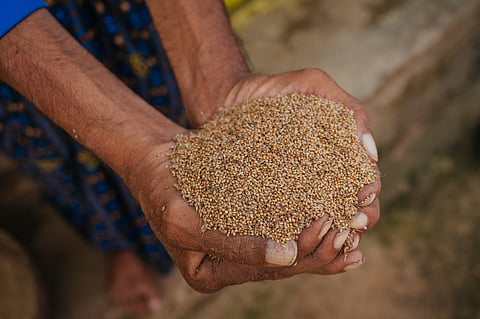
In this dry landscape grows Gurji, a traditional landrace of little millet (Panicum sumatrense). The tiny grain matures early, requires very little water and thrives on poor, rocky uplands where paddy often fails. Rich in fibre and minerals, Gurji has long been cooked as porridge, pitha and other traditional dishes. Once a staple in many households, it is now cultivated in only few villages, overshadowed by rice and other commercial crops.
Yet the grain survives through a story.
Across villages in the erstwhile princely state of Khariar, elders still recount a folk tale about how Gurji first entered people’s lives. One such version was narrated to us by local historian Jaysingh Chinna, who has documented the region’s oral traditions over the years. Like many oral narratives, the story preserves something deeper than historical fact: a memory of how people learnt by closely observing nature.
Long before roads entered the forests of Khariar, the local king was known for his magnificent horses. Every morning, before attending his royal court, he rode deep into the forests on his favourite white stallion. While the horses grazed, he wandered through the woodland, admiring the landscape that sustained his kingdom.
One summer, after weeks without rain, the king travelled farther than usual.
Streams had shrunk to narrow channels. Dry leaves crunched beneath his feet. Even the forest seemed unusually quiet.
Resting beneath a towering sal tree, the king noticed an unusual sight.
His horses had gathered around a slender wild plant topped with tiny golden seed heads, feeding on it eagerly.
He rose to take a closer look.
He plucked a seed head, rubbed the grains between his palms, blew away the husk and tasted them. The tiny seeds were mildly sweet with a pleasant nutty flavour unlike anything grown in his kingdom.
He collected the seeds and ordered them to be cultivated in the royal stables. The grain proved to be excellent fodder. The horses remained healthy and strong, and before long it was being grown across the kingdom to feed the royal cavalry.
Years later, another crisis arrived.
The monsoon failed. Rice fields cracked beneath the scorching sun. Ponds dried up, harvests collapsed and hunger spread across the villages.
According to the folktale, an elderly keeper of the royal stables reminded the king about the hardy grain his horses had once discovered.
“Your Majesty,” he said, “this grain has survived every drought. Perhaps it can also sustain your people.”
The king ordered the seeds to be distributed among farmers.
The crop flourished on dry uplands where rice could no longer survive, and before long the once-barren fields shimmered with golden seed heads.
Families roasted the grains over earthen hearths, pounded them into flour using wooden mortars and prepared porridge, pitha and other nourishing dishes. Gurji, once valued as fodder for the king’s horses, became an important source of food during years of scarcity.
Because the grains were tiny and matured quickly, people gradually came to call the crop Gurji.
The folklore has another telling as well. During one of our conversations, the erstwhile king of Khariar, Dr. Jitamitra Prasad Singh Deo, recalled that rulers often rewarded people who served the kingdom with seeds of useful crops. Gurji, he suggested, may have spread from village to village through such acts of royal patronage. While this account cannot be historically verified, it reflects how seeds and farming knowledge often travelled through relationships of trust, exchange and community.
Kingdoms have disappeared, but the story has endured.
Across Nuapada and neighbouring districts, elders continue to narrate the tale of the king’s horses and the little grain that outlived drought. During Nuakhai, western Odisha’s harvest festival, families prepare Gurji pitha from the new harvest and offer it to their deities and ancestors before sharing it with relatives and neighbours.
The folklore survives because the landscape that gave rise to it still exists. Much of western Odisha continues to depend on rainfed farming, and increasingly erratic monsoons remain a challenge for farmers. As climate change intensifies droughts and rainfall variability, hardy traditional crops such as Gurji are once again drawing attention for their ability to thrive with little water.
Whether the tale is entirely historical or lovingly shaped through generations of storytelling matters less than the wisdom it carries. Long before scientists spoke of climate-resilient agriculture or agrobiodiversity conservation, communities in western Odisha had already learnt to observe forests, wildlife and seasons. Their knowledge travelled through stories and seeds. Perhaps that is why people in Khariar still smile when they repeat the old saying: “The horses found Gurji first, but it was meant to feed us all.”
Note: This account is based on oral traditions from the Khariar region of western Odisha, including a version narrated by local historian Jaysingh Chinna. Like many folk narratives, it has been transmitted across generations in oral form and cannot be independently verified through historical records.
Susanta Sekhar Choudhury works as a Programme Manager - Seed for Watershed Support Services and Activities Network (WASSAN), Bhubaneswar.
Pritesh Sundar Roy works as a Programme Officer - Seed for Watershed Support Services and Activities Network (WASSAN), Bhubaneswar.
Abhijit Mohanty works as a Programme Manager-Knowledge Building, WASSAN, Bhubaneswar.
Bikash Das works as a Programme Officer - Seed for Watershed Support Services and Activities Network (WASSAN), Bhubaneswar.
Views expressed are the authors’ own and don’t necessarily reflect those of Down To Earth