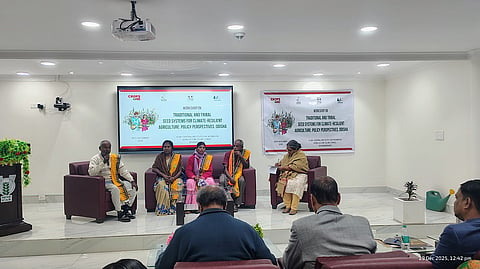


At the ICAR–Central Institute for Women in Agriculture (CIWA) in Bhubaneswar, a one-day workshop on Traditional Seed Systems for Climate-Resilient Agriculture: Policy Perspectives, Odisha brought together policymakers, scientists, civil society groups and most importantly custodian farmers who continue to conserve indigenous seeds.
Organised by the Watershed Support Services and Activities Network (WASSAN) under the Crops4HD programme supported by SwissAid, the workshop underscored a growing consensus: Odisha’s future food security depend more on recognising what farmers already know.
Odisha’s agriculture is overwhelmingly rainfed and increasingly battered by climate extremes—cyclones along the coast, floods in river basins, prolonged dry spells in western districts and rising temperatures across the state. While formal seed systems have expanded, they focus on a narrow basket of crops and varieties, often ill-suited to these volatile conditions.
“Climate change is already threatening major cereals like rice and wheat,” said Susanta Sekhar Choudhury, Programme Manager–Seed Systems at WASSAN. “Traditional varieties have survived droughts, floods and pests for generations. Ignoring them is not just risky, it’s irresponsible.”
Yet these climate-resilient landraces, conserved through informal systems such as community seed banks and farmer networks, remain largely invisible in policy frameworks.
For farmers like Bhagabati Muduli from Laxmipur block in Koraput district, traditional seeds are not an abstract idea but a daily reality.
“I grow traditional ragi, little millet and paddy because they survive even when the rains fail,” she said. “But government seeds come late, and our seeds don’t get support. If seeds don’t reach us on time, how will we farm?”
In Mayurbhanj, farmer Karmi Besra has conserved more than seven traditional paddy varieties for over a decade. But she worries the knowledge may die with her generation.
“Young people are leaving farming because there is no money in it,” she said. “Pulses we used to grow have vanished. If the government gives MSP for traditional crops and supports community seed banks, farmers will stay.”
Similar concerns echoed across districts. In Malkangiri’s MV-6 village, Kartik Mandal spoke of the decline of mixed cropping systems involving traditional rice varieties like Lal Dhan and Kandul (arhar).
“Hybrid seeds need fertilisers and pesticides we can’t afford,” he said. “Our traditional rice tastes better, needs fewer inputs, and even sells at a premium. Look at Gobindobhog, people pay Rs 120 per kilo.”
Duryadhan Bhenia, a farmer from Kalyansinghpur block in Rayagada, observed the rapid disappearance of traditional millets and rice varieties such as Para Dhan and Asamchudi. He called for soil testing, promotion of organic inputs, crop rotation, and stronger support for natural farming, linking traditional diets to better health outcomes among older generations.
Experts at the workshop acknowledged that while Odisha has made some progress, such as releasing four traditional finger millet varieties, systemic gaps persist.
“Farmers’ seeds have no formal recognition,” said K Prusti, Director of the Odisha State Seed and Organic Products Certification Agency (OSSOPCA). “We must respect farmers’ knowledge, but also ensure genetic purity. That balance is missing in current regulations.”
K S Varaprasad, former Director of ICAR–IIOR and Chairperson of Odisha’s Working Group on Seed Systems, pointed out that industrial agriculture has created new problems.
“In areas of intensive chemical farming, we are seeing serious health issues,” he said. “Food grown under chemical regimes is often nutritionally inferior. Agriculture must be both profitable and healthy, or youth will abandon it completely.”
Under the Shree Anna Abhiyan, WASSAN has documented and evaluated several promising landraces, including Malyabanta Mami, Laxmipur Kalia and Kundra Bati, which has been released by the state. But scaling such efforts requires institutional backing.
C Lavanya, retired scientist, ICAR, highlighted gaps in research on the characteristics and climate resilience of traditional seeds. She emphasised collaboration between research institutions and local communities to document landraces, maintain diversity, define genetic purity standards, and explore market potential.
Many speakers emphasised that community seed banks could be the backbone of resilient agriculture, if supported properly.
“Seed banks must be promoted in mission mode,” said Akshaya Kumar Panda of the M.S. Swaminathan Research Foundation. “Timely access to quality seed is important.”
Farmers have already shown how this can work. Subhas Mahanto of Jashipur block, Mayurbhanj, widely known as Mandia Maa (Millet Mother), began with just 250 grams of seed.
“Using neem and karanj leaves, I now conserve over 20 varieties of millets, paddy and vegetables,” she said. “Seeds should come from healthy mother plants, that’s what elders taught us.”
In Sambalpur, an FPO-managed seed bank follows a simple rule, explained Arjun Singh: “Farmers return double the seed after harvest. That’s how the bank survives.”
Beyond fields and institutions, farmers highlighted indigenous storage practices that modern systems have ignored.
“In our homes, maize and garlic are hung in the kitchen so smoke keeps pests away,” said Geetanjali Naik from Jharsuguda. “It’s cheap, effective and healthy.”
Dambrudhar Muduli from Koraput recalled how earlier generations conserved nearly 35 seed varieties. “Seeds were stored in earthen pots or cow sheds. Germination was high. Now, no one values this knowledge.”
Sabarmatee of Sambhav NGO argued that revival must begin at the household level. “Every family should conserve at least one indigenous seed,” she said. “Teach children. Organise seed melas (fairs). Make seeds visible again.”
A recurring concern was that without markets, conservation will not sustain itself.
“Traditional crops must be remunerative,” said Krushna Bhumia from Malkangiri. “Otherwise, farmers cannot continue.”
Niranjan Panda, Dean (Research) at OUAT, stressed branding and market development. “Look at Koraput coffee,” he said, “Indigenous crops also need identity and value.”
Pritesh Sundar Roy of WASSAN added that policies must go beyond millets. “Support livestock integration, document tribal recipes, improve storage infrastructure and train custodian farmers. Otherwise, youth will not see farming as a future.”
As the workshop concluded, one message stood out: traditional seed systems are not relics, they are living, adaptive knowledge systems.
“Farmers must be treated as equal partners,” said Dr Varaprasad. “Integrated farming, multiple cropping, agroforestry and livestock are not alternatives, they are the foundation of sustainable agriculture.”
For Odisha’s farmers, the seeds are already in their hands. Whether policy will catch up may determine how well the state weathers the next climate shock.
Abhijit Mohanty is a Bhubaneswar-based independent journalist
Views expressed are the author’s own and do not necessarily reflect those of Down To Earth