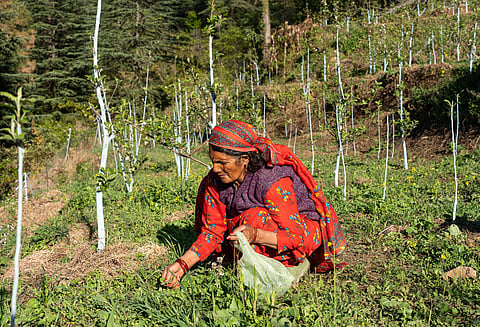


India’s food security faces a hidden risk: an ageing farming workforce in a young country.
With average farmers aged 50-55 and only a tiny share of rural youth aspiring to farm, intergenerational transfer is weakening.
Low profitability, tiny landholdings and unstable prices push youth to cities, raising doubts about who will grow India’s food in coming decades.
India’s food-security debate has long focused on a familiar set of questions: How much food are we producing? Are our foodgrain stocks sufficient? Will the monsoon support the next harvest? But there is another question that deserves far greater attention: who will grow India’s food in the future?
India is one of the world’s youngest major economies, with a median age of around 29 years. Yet the people engaged in agriculture are considerably older. Various studies have placed the average age of Indian farmers at around 50-55 years. This creates a striking demographic paradox. A young country is increasingly dependent on an ageing agricultural workforce. While this may not immediately threaten food production, it raises an uncomfortable question about the long-term sustainability of India’s food system.
For generations, farming was passed from parents to children as both an occupation and a way of life. That intergenerational transfer is now weakening. Rural youth are increasingly looking towards cities, formal employment and non-farm occupations. The reasons are not difficult to understand. Farming is exposed to weather uncertainty, fluctuating market prices, rising input costs, fragmented landholdings and uncertain returns. For a young person standing at the beginning of a career, agriculture can appear less like an opportunity and more like a gamble.
The aspiration gap among rural youth is particularly revealing. A study cited in Down To Earth discussing India’s agrarian distress found that only 1.2 per cent of surveyed rural youth aspired to become farmers. Such a low aspiration towards farming should concern a country whose food security still depends heavily on millions of cultivators. It is not that young people do not value agriculture. Rather, many do not see traditional farming as a viable pathway to a secure and aspirational future.
Youth migration, therefore, should not simply be viewed as a rural social problem. In many cases, it is a rational economic decision. When agriculture offers uncertain earnings and urban employment offers the possibility of a regular wage, migration becomes an understandable choice. Research on rural youth migration has identified low profitability, stagnant productivity and inadequate remuneration as important factors pushing young people away from agriculture. In one study, 67.43 per cent of youth identified the lack of remunerative prices arising from unorganised markets as a major push factor behind migration.
The structural characteristics of Indian agriculture make this problem even more complicated. According to the National Statistical Office’s Situation Assessment Survey of Agricultural Households, 70.4 per cent of agricultural households operate less than one hectare of land. Small holdings can make it difficult to achieve economies of scale, invest in modern technology or withstand production and price shocks. For a young person, inheriting a small and fragmented holding may not necessarily represent an attractive economic opportunity.
Farm household incomes have increased over time, but the absolute level remains modest. The average monthly income of an agricultural household increased from Rs 6,426 in 2012-13 to Rs 10,218 in 2018-19. The increase is important, but so is the context in which it must be understood. Agriculture competes with a rapidly expanding non-farm economy, and young people increasingly compare the uncertain returns from cultivation with the more predictable earnings available elsewhere.
The problem, therefore, is not simply that Indian farmers are getting older. An older farmer can possess decades of knowledge about soil, weather, crops, livestock and local farming systems. Such knowledge is invaluable. The deeper concern is what happens when there is no younger generation willing to inherit, adapt and build upon that knowledge.
An ageing agricultural workforce could have consequences beyond the farm household. Agriculture may face increasing labour shortages, greater dependence on mechanisation and changes in cropping patterns. Marginal holdings could be increasingly leased out, consolidated or even left uncultivated where farming becomes economically unviable. Labour-intensive sectors such as horticulture and livestock could be particularly affected. Over time, these changes could influence not only rural livelihoods but also the availability and affordability of food.
This is where the issue becomes a food-security concern. Food security is usually understood in terms of food availability, access and affordability. But behind every tonne of grain, every litre of milk and every kilogram of vegetables lies a farmer and a workforce. India can invest in irrigation, seeds, fertilisers, agricultural research and digital technologies, but none of these can substitute for the people who ultimately produce food.
India’s demographic dividend makes this contradiction even more striking. The country has a large young population, but agriculture is struggling to attract that very generation. The question should not be whether young people are leaving villages. Migration can be a pathway to better opportunities and higher household incomes, and it should not be treated as something that must simply be stopped. The more important question is whether agriculture offers enough economic opportunity for young people to choose it voluntarily.
This requires changing the way we think about the future farmer. The answer is not to persuade every young person to return to traditional cultivation. Instead, agriculture must become an ecosystem of modern and profitable opportunities. A young person may not want to cultivate a small plot using conventional methods, but that same person may be willing to run a precision-farming enterprise, a farm machinery service, a dairy unit, a food-processing business, a storage facility, an agri-logistics enterprise or a digital agricultural service.
This is where initiatives such as the Indian Council of Agricultural Research’s Attracting and Retaining Youth in Agriculture programme assume importance. By encouraging rural youth to develop enterprises in agriculture and allied sectors, such initiatives recognise that the future of rural employment cannot depend solely on traditional crop cultivation. But such interventions need to go beyond isolated projects. Young agricultural entrepreneurs need access to finance, markets, technology, infrastructure, skills and reliable value chains.
Most importantly, young people need to see agriculture as a profession with dignity and upward mobility. A farmer should not have to choose between farming and prosperity. If agriculture is to retain its next generation, it must offer opportunities to earn, innovate and grow. India’s agricultural policy has historically concentrated on increasing production, protecting farmers from price risks and ensuring food availability. Those priorities remain essential. But the country’s food-security strategy now needs another dimension: generational sustainability.
The Green Revolution answered one of India’s most pressing questions of the twentieth century—how to produce enough food for a growing population. The agricultural challenge of the twenty-first century may be more complicated. India must produce enough food while dealing with climate change, shrinking natural resources, fragmented holdings and changing consumer demand. And behind all these challenges lies a fundamental human question: will there be enough young people willing to farm?
India does not need to romanticise farming to retain its youth. It needs to make farming economically rational. The future of Indian agriculture will ultimately depend not only on better seeds, smarter machines or more resilient crops, but also on whether a young Indian can look at agriculture and see a future worth choosing.
Because when we talk about India’s food security in the decades ahead, perhaps the most important question is not how much food will India produce? It is simply this: Who will grow it?
Views expressed are the authors’ own and don’t necessarily reflect those of Down To Earth