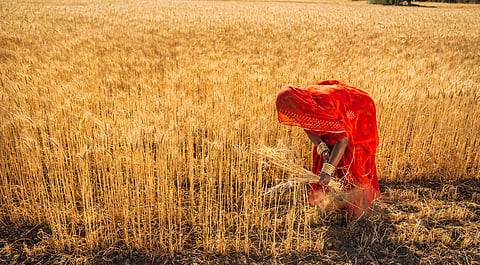


The Union Budget 2026-27 has placed a strategic bet on the agricultural sector by prioritising agri-tech — with significant funds mobilisation towards AI-driven advisory services, precision farming systems, and tech-enabled resource efficiency. While experts have welcomed the move as a step toward technology-led, outcome-driven agriculture growth aiming for enhancing productivity and farm incomes; yet, a crucial question remains: what will be its social implications, particularly for women farmers, and where do they stand in this unfolding transformation?
In recent years, digitalisation has moved to the centre of India’s agricultural policy imagination. Initiatives such as Digital Agricultural Mission or agri-based tech firms are being projected as a panacea to transform the sector through real-time crop monitoring, satellite-enabled weather alerts, targeted pest and nutrient management, or data-driven yields analytics. However, beneath this “techno-optimist” narrative lies a side that is often overlooked or does not attract adequate attention, creating a persistent blind spot: the structural “invisibilisation” of women farmers, whether smallholders, landless, Dalit, Adivasi or any other systemically marginalised agrarian labourers.
Despite constituting the backbone of India’s agrarian economy, women remain structurally marginalised within it. While nearly 85 per cent of rural women are engaged in agriculture, their labour continues to be undervalued and poorly recognised in official accounting systems. This produces a striking paradox: high participation but minimal visibility.
This marginalisation is rooted in a deeply gendered and male-centric agrarian terrain. Barely 13 per cent women have formal land-asset ownership, which directly restricts their access to institutional credit, subsidies, crop insurance and government support schemes. As a result a significant proportion of women remain heavily concentrated in “unpaid family labour” — a trend that has reportedly risen sharply over the past decade. This exclusion from asset ownership and formal farmer identity thus translates into limited bargaining power within households, weakens the role in decision-making, restricts their ability to access markets independently and their rightful place in programme policies which are often designed around the male member of a household as the default beneficiary.
The emerging digital architecture risks reproducing this very inequality in a new form. Most agri-tech services, digital welfare schemes are routed through formal land records, Aadhar-based registrations, and institutional databases. In effect, when digital ecosystems are built on datasets that do not formally recognise women as farmers, they are pushed further outside the system, meaning that even if households adopt agri-tech services, women may remain excluded from its direct access, control and benefits over the use of the technologies. This risks reinforcing existing hierarchies by privileging land-owning, male-connected networks — reproducing women’s invisibility within the very infrastructure meant to modernise agriculture.
Prevalence of gender digital divide further sharpens this risk. Most digital platforms require regular mobile and stable internet access, and the ability to navigate digital interfaces. Yet, women’s access to these resources remains uneven. According to the report of Foundation of Agrarian Studies, only 36 per cent of rural women have internet access compared to 64 per cent men, this even sharper within Scheduled Tribes, where female internet access is just 29 per cent. Most women also lack independent smartphone access within their households, with devices often controlled by the male member. Digital literacy remains a critical barrier. Using the ability to access the internet for informational purposes as an indicator of digital literacy, the report notes that an overall 58.2 per cent women are unable to use the internet for information purposes while among Scheduled Castes women, this rises further to 63.4 per cent.
Moreover, low proficiency in performing even basic ICT tasks such as sending messages, ability to make online transactions or reporting cyber fraud further deepen these barriers, especially given women’s lower levels of formal education in rural settings. This is not an isolated phenomenon but the outcome of decades of structural disenfranchisement, restrictive social norms, and institutional neglect that have historically constrained women’s access to formal schooling and limited exposure of skill developing opportunities which is still nascent. As a result, the new wave of digital tools which are often complex and interface-heavy may be difficult for them to learn and to leverage efficiently.
Nonetheless, to make them understand the tools and impart meaningful knowledge needs skillful training, extension services and capacity building programmes. Yet only a limited share of such support is directed towards women farmers, even when training opportunities exist, training sessions are often held in locations that are either hard for women to access or their participation is often constrained by patriarchal gatekeeping. Many women farmers require household permission to attend sessions, face social resistance for attending public learning spaces and struggle to balance domestic responsibilities with participation in training programmes — factors that further restrict their mobility and reduce their exposure to emerging technologies.
Field-level evidence and interviews reflect this situation. A majority of women farmers expressed strong feelings of alienation and discomfort while engaging with the digital platforms. Furthermore, many also reported the sense of distance and mistrust due to the platforms’ lack of alignment with women-centric needs, priorities and grievances. Specific case studies like DeHaat, an agri-tech start-up — less than 20 per cent women farmers were found to be utilising its advisory and insurance services and even women participation in meetings and platform-related conversations remained limited — clearly highlighting persistent gaps, where digital technologies not only failing to reach women farmers but also failing to earn their trust and engagement.
While the promise of technology is real and does hold transformative potential, and the existing limitation may not lie in “digitalisation” per se, but in the techno-optimist imagination. If the techno-optimist vision of digitalising agriculture — framed through the rhetoric of efficiency, deep technologies, innovation, scale and data-driven agri-value chains optimisation — it often remains detached from the ground realities of Indian agriculture, especially the socio-cultural conditions of women farmers.
Indian agriculture is not merely an economic space where productivity can be technologically engineered. It is a heterogenous social system intricately connected with gender, caste, patriarchy and entrenched power relations. Without accounting for these structural and socio-cultural preconditions, digital agriculture will be insufficient to transform rural livelihoods in real terms. Instead, it risks reproducing the existing inequalities in a new form.
If the government’s vision of digitalised agriculture is to be genuinely transformative, it must demand a fundamental reimagining through the lens of “social justice” and “intersectional inclusion”. This requires moving beyond surface-level inclusion indicators and limited pilot-level project success; it instead calls for a far deeper and more critical engagement with the question of who is actually being included and whose realities shape the design of digital agriculture systems. This calls for ensuring that those at the farthest margins are not only recognised but that their lived experiences must inform the policymakers and their realities become central to the design of India’s emerging digital agricultural architecture. Without this, the growing digitalisation will remain skewed towards those who already have institutional recognition, who are already in control and who already sit at the top of decision making and power relations hierarchy.
Ultimately, for the government’s vision of transforming agriculture through digital technology to be deemed successful, it must be truly inclusive in practice, rooted in equity, participation, fair distribution, and meeting certain pre-requisites such as digital literacy, proficiency, and women-centric support systems. Without addressing the lived realities and correcting existing structural imbalances, India’s agri-tech revolution risks being another tale of growth without justice, where innovation advances but women agricultural workers remain the missing link in the very future agriculture is trying to prioritise.
Mahesh Ganguly, Teaching Assistant and Research Fellow, based at IIT Bombay focusing on energy transition, public health, alternative technologies, and South Asian policy issues.
Saloni Khandelwal, completed her post-graduation from Centre for Political Studies, JNU.
Views expressed are the authors’ own and don’t necessarily reflect those of Down To Earth