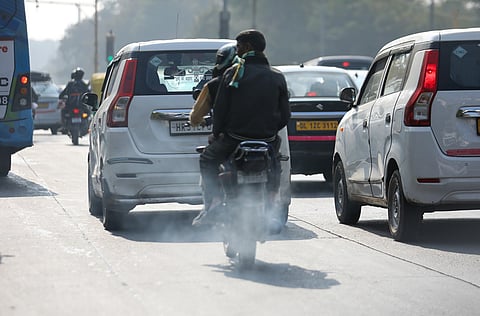


Amidst West Asian tensions, Strait of Hormuz supply disruptions, and oil price volatility, Prime Minister Narendra Modi has framed this moment as a catalyst for India’s energy independence. He advocated for mass EV adoption and a shift to public transit, calling for industry action and public support to mainstream these choices.
The recent surge in petrol and diesel prices has triggered significant consumer anxiety, exposing the financial fragility of oil-dependent households. This is the “moment” to transform austerity advisories into a decisive roadmap. The current oil crisis challenges India’s strategy of treating internal combustion engine (ICE) vehicles—including biofuels and hybrids—as acceptable “bridge technologies”. Persistent ICE reliance compromises public health and creates an economic liability, leaving the economy, citizens, and climate targets vulnerable.
The Prime Minister’s call must end the policy “fence-sitting” on electric mobility that weakens zero-emissions levers. The 2026 oil crisis has stripped away the illusion of a leisurely, phased energy transition. It is time to decouple mobility from combustible liquids and shift to domestically generated electrons.
This needs a spotlight on the key policy levers that are progressively weakening.
In light of recent austerity measures, announced by the Prime Minister, the Bureau of Energy Efficiency must immediately reform the Corporate Average Fuel Efficiency (CAFÉ) III norms. Slated for 2027–2032, the draft has faced intense scrutiny for regulatory concessions that critics argue prioritize “paper compliance” over genuine energy and emissions savings. While the headline target—reducing fleet emissions from 113 g/km to 70 g/km—appears strict, the underlying framework contains loopholes that significantly dilute its impact.
The latest draft proposes a “flatter compliance curve,” a sliding scale that determines emission limits based on vehicle weight. In a strict system, limits remain tight as weight increases to force innovation. However, this flatter curve lowers the “passing grade” for all classes, granting the widest margin to those facing the toughest challenges.
By raising the reference weight from 1,170 kg to 1,229 kg, the entire target line shifts upward. Since small cars sit far below this average, this math provides big margin, allowing manufacturers to avoid strict targets. This prevents sticker shock for buyers by keeping small cars cheap without requiring significant innovation. Large SUVs (typically 1,400 kg-1,800 kg) also benefit; because the line moved up, their allowed limits increase, reducing the pressure to innovate and allowing OEMs to sell older, less efficient engines without facing heavy fines. Overall, it weakens the pathway to accelerate zero emissions transition needed for energy security, public health and low carbon growth path.
Super credit loopholes: The norms are further diluted by “super credits,” which allow one Electric Vehicle (EV) to be counted as multiple units (e.g., a multiplier of 3) in fleet calculations. This enables OEMs to offset numerous high-emission SUVs with a few EV sales, achieving mathematical compliance without a structural shift. With super credits for flex-fuel vehicles manufacturers can earn high multipliers for simply producing the hardware regardless of its use as the infrastructure for high-blend ethanol is nearly non-existent.
Additionally, OEMs can claim credits for established “off-cycle” technologies like start-stop systems and regenerative braking—features critics argue should be phased out as they don’t address core tailpipe emissions. Furthermore, treating strong hybrids, flex-fuel, and CNG as “clean” pathways dilutes the push for zero-emission mobility. These fossil-fuel-dependent technologies risk a “technology lock-in” that delays full electrification.
Weakening these criteria slows EV uptake. Because incremental petrol improvements are cheaper than building dedicated EV platforms, these norms encourage minor efficiency gains over structural transformation. Consequently, passenger car electrification—currently at 4-5 per cent—is likely to remain low, preventing India from reaching the critical mass needed for a self-sustaining EV ecosystem.
Furthermore, replacing annual monitoring with three-year blocks allows OEMs to delay upgrades until the end of the period, stalling steady progress.
Diluting CAFÉ III is difficult to justify given that India imports 80-85 per cent of its crude oil. Electrification is the decisive tool to decouple the transport sector from global oil volatility and protect the Rupee. Reducing the fuel import bill is vital, as fuel accounts for nearly 70 per cent of a heavy-duty vehicle’s lifetime cost.
Moreover, instead of annual monitoring, compliance is checked in three-year blocks. This allows OEMs to perform poorly initially and delay technological upgrades until the end of the block, stalling steady progress.
The 70 gCO2/km target is meaningless if “paper compliance” allows industry stagnation and drastically reduces the potential scale for electrification and fuel and emissions savings. To ensure real-world progress, the Bureau of Energy Efficiency must steepen compliance curves and adopt a 1:1 counting system. Eliminating super-credits for hybrids and biofuels, alongside replacing three-year blocks with annual monitoring, is essential to maintain manufacturer pressure and ensure a steady zero-emission transition.
The push for crop-based biofuels in transport is creating vulnerabilities in food security, industrial supply chains, and environmental sustainability. While India’s ethanol blending program achieved a 20 per cent national blend (E20) in 2025, this rapid scaling has generated systemic pressures.
Prioritising transport fuel has diverted ethanol from the industrial sector, which depends on it for chemical and pharmaceutical manufacturing. Industries are increasingly forced to import industrial-grade ethanol. Furthermore, maize is now the primary feedstock, competing directly with food and livestock feed. This competition is increasing prices and worsening nutritional insecurity while adding to the agricultural water stress.
Additionally, ethanol is less energy-dense than petrol; higher blends can significantly reduce fuel efficiency, forcing vehicles to consume more fuel to cover the same distance.
This needs strategic redirection of ethanol from road transport to sectors where electrification is not yet viable. Sustainable Aviation Fuel, alcohol-based maritime fuels and industrial feedstock offer practical pathways for reducing pressure on the road transport sector for more balanced energy transition.
Despite requiring critical mineral imports, EVs offer a more resilient long-term energy solution than oil or biofuels. EVs decouple transport from global oil volatility. Modern EV drivetrains typically convert 85-90 per cent of the electrical energy drawn from the battery directly into motion. But ICE vehicles manage to convert up to 30-40 per cent of the energy in the fuel tanks into forward motion. Domestic power from local resources ensures mobility even if crude imports are severely disrupted.
While mineral-intensive initially, EVs eliminate the recurring daily need for imported fluids. Once manufactured, EV “fuel” is generated domestically, shielding against shocks threatening India’s oil-dependent transport ecosystem. India is evolving into a manufacturing center for motors and battery packs. By relying on allies like Australia and Chile, India can manage supply chains more predictably than the volatile global oil market.
The AdBlue and urea crisis: Modern ICE vehicles, particularly diesel versions, rely on an import-heavy “secondary supply chain” of technical-grade urea (TGU). Under BS-VI standards, heavy-duty diesels and SUVs require Diesel Exhaust Fluid (AdBlue). India imports 50-60 per cent of its TGU, lacking high-purity automotive-grade capacity. This creates a vulnerability: BS-VI interlocks stop vehicles if DEF tanks are empty. Reliance on West Asian hubs has already caused supply uncertainties, risking a potential logistics collapse during disruptions.
Vulnerability in lubricants and additives: Beyond crude oil, modern ICE engines demand sophisticated high-purity chemicals and premium synthetic oils. According to Mordor Intelligence, BS-VI engines require high-performance lubricants, yet India remains import-dependent for Group III and IV base oils—essential building blocks for synthetics. This exposes the domestic sector to currency fluctuations and freight spikes. Conversely, EV powertrains eliminate crankcase lubrication, reducing fluid demand. While the EV industry needs thermal-management fluids for batteries, shifting to EVs replaces recurring, import-heavy maintenance cycles with domestic stability, shielding fleets from geopolitical shocks.
Stronger state-level EV 2.0 policies for bottom-up pressure: This has to drive regional action. The Delhi EV policy is a step forward in setting more targeted action. However, to achieve a self-sustaining ecosystem, these policies must evolve to a firm mandate for EV sales and procurement across all vehicle segments and define zero emission vehicles as those without ICE. By integrating mandated fleet conversions with the aggressive upscaling of charging infrastructure and Transit-Oriented Development, states can permanently reduce long-term energy vulnerabilities.
The Prime Minister urges relying on metro, buses, and carpooling to lower import bills. NITI Aayog and the IEA emphasize that reducing oil dependence requires aggressive electrification and a “modal shift” toward public transit. Prioritising transit, walking, and cycling remains a primary lever for energy security.
Urban infrastructure funds should be redirected from car-centric projects toward affordable public transport, walking, cycling, and last-mile connectivity to permanently shift commuting behaviour. Subnational measures such as congestion charges, road tolls, and parking management and pricing are needed as the priority strategy. The IEA states that ambitious policy pathways integrating modal shifts and electrification could reduce India’s transport energy demand by 30 per cent by 2050 compared to current trajectories. This could save approximately 70 million tonnes of oil equivalent, about 80 per cent of the sector's current energy requirements.
Cities need Transit-Oriented Development (TOD) to integrate high-density living with urban rail, accessibility, and micro-mobility — walking and cycling. The expanding mass rapid transit networks in megacities and the PM-eBus Sewa scheme—aiming to deploy electric buses across 169 cities—present a significant opportunity to transform urban mobility.
Prime Minister Modi’s advisory on austerity must turn the guidance to a binding government mandate for a decisive roadmap for India’s zero-emissions transition.
