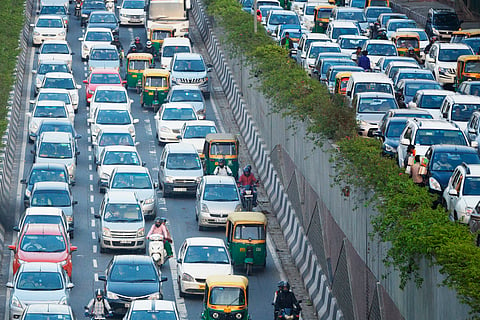


India’s clean-air and electric vehicle policies depend heavily on VAHAN, the national vehicle registration dashboard used to track the country’s rapidly growing vehicle fleet.
CSE’s analysis found recurring gaps and anomalies in the public VAHAN dashboard, including missing emission norms, unknown fuel types, electric vehicles assigned Bharat Stage norms and post-mandate registrations of older Bharat Stage vehicles.
The data gaps matter because vehicle fuel type, emission norm, age and category are central to emissions inventories, clean-air planning, EV policy and transport modelling.
Strengthening VAHAN will require stronger validation at the registration stage, richer vehicle-level fields, scrappage tracking, stable per-vehicle identifiers and timestamped public data releases.
India’s motorisation is accelerating so quickly that an accurate count of the country’s vehicle fleet is central to effective transport, clean-air and climate policy.
The VAHAN dashboard is the single most important resource for tracking that motorisation nationally. Anyone working on transport and mobility in India knows the weight it carries in policy decisions for the sector. Because errors there compound through every analysis, model and policy decision built on this data, its quality is worth examining.
What is the VAHAN database?
VAHAN’s journey began in 2008, when the Union Ministry of Road Transport and Highways (MoRTH) piloted VAHAN 1.0 in three states to digitise basic Regional Transport Office registries and move state records away from paper. What started as a modest computerisation project has grown steadily into the vast, data-rich system that anchors India’s vehicle registration records today. Alongside this growth, the dashboard itself changed from an internal reporting tool into a public analytics resource.
VAHAN is a registration database, not a sales database. It is important to distinguish between the two because registration figures can diverge from sales figures because of delays between purchase and registration, or because a vehicle may be bought in one state but registered in another.
Structurally, every Regional Transport Office feeds its records into one central database maintained jointly by the MoRTH and the National Informatics Centre (NIC). But how that feed actually works day to day, whether uploads happen in real time or in batches, and what validation is applied before a record is accepted are less publicly documented. These are questions better put to the ministry and the NIC directly than assumed.
The anomalies in the database, such as electric vehicles assigned Bharat Stage emission norms and Bharat Stage registrations appearing after their cut-off dates, are not offered here as confirmed errors. They are patterns, recurring across states and years, that warrant closer examination by the MoRTH, the NIC and the states themselves. Their persistence points to the need for continuous data validation, stronger quality checks throughout the registration process and greater capacity-building at Regional Transport Offices.
VAHAN, after all, is still evolving. As its data, structure and public accessibility continue to improve, assessment by Delhi based think tank Centre for Science and Environment (CSE) should be read as a snapshot of where things stand now, not a final verdict.
CSE examined the publicly accessible VAHAN dashboard, not the complete backend database maintained by Regional Transport Offices. However, there is real scope to strengthen the dashboard further with more granular, vehicle-level data that could sharpen error detection, fleet tracking and emissions modelling.
India’s transport policy has rarely been this ambitious. States are racing each other on electric vehicle targets, the country has moved to Bharat Stage VI emission norms and is already drafting Bharat Stage VII, and clean-air action plans increasingly hinge on knowing exactly what is on the road.
All of this rests on one assumption: that the fleet can be counted, and counted correctly. It cannot, not yet. That makes VAHAN’s data quality a climate and public-health question, not a technical footnote.
The MoRTH’ single national database is the platform’s core strength. Instead of separate state-level systems, every Regional Transport Office feeds records into one shared backend, so a vehicle registered in Karnataka can be verified by a traffic officer in Haryana without any manual data-sharing between states.
Built on that same database, the public VAHAN dashboard turns those records into queryable national and state-level analytics, allowing anyone to pull emission norm, fuel-type and registration figures without filing a Right to Information request or coordinating state by state.
That is the value one national, interoperable dataset creates.
None of it is in question. What is in question is what happens to the data once it enters the system.
Vehicle registration records are expected to be consistent, complete and standardised across states. However, CSE’s analysis of the database reveals persistent anomalies and gaps.
The starting point is the emission-norm field. Millions of non-electric vehicles simply have no emission norm recorded at all, which means no emission factor can be assigned to them under any framework. Tamil Nadu alone carries more than 43 lakh such records over the past decade, Kerala over 30 lakh and Maharashtra over 22.4 lakh.
Fuel and vehicle-type combinations that should be improbable also show up routinely. Heavy passenger and goods vehicles registered as petrol-powered appear in the data, with Karnataka topping that list. Such records do not necessarily represent actual vehicles, but may reflect coding errors, incorrect fuel mapping or data-entry inconsistencies.
Electric vehicles fare no better. A third pattern shows electric vehicles assigned Bharat Stage combustion norms, a category that should not apply to them at all. Haryana logged 24,463 such records, Karnataka 14,487 and Uttar Pradesh around 13,040 over the decade. The mismatch runs the other way too, with e-rickshaws turning up under petrol, diesel, CNG or ‘not applicable’ fuel types. Bihar carried about 13,154 such cases between 2016-17 and 2025-26.
The single largest anomaly across the dataset is what can be called post-mandate persistence: vehicles registered with a Bharat Stage norm that should have stopped being issued by the date of registration. India’s Bharat Stage VI mandate took effect on April 1, 2020, and the Supreme Court allowed only a limited COVID-related clearance period. This means no new vehicle should legally carry a Bharat Stage IV, Bharat Stage III or older norm from that date onward.
Yet the data shows Bharat Stage IV registrations continuing in every single state and Union Territory examined, in many cases stretching all the way to 2025-26, five full years past the cut-off.
Thirty-four of India’s 36 states and Union Territories registered at least one Bharat Stage IV vehicle in 2022-23 or later, adding up to 24,004 such registrations nationally. Telangana led with 7,055, followed by Madhya Pradesh with 3,787 and Manipur with 3,713.
Uttar Pradesh recorded the highest number of Bharat Stage II vehicles registered after the 2017-18 cut-off, with 3,96,531 registrations. Most of these were two-wheelers, at 3,25,831, followed by agricultural tractors, at 39,568. Some registrations continued even in 2024-25, seven years after the norm was discontinued.
Karnataka had the highest number of Bharat Stage IV vehicles registered after the 2020-21 cut-off, with 2,70,558 vehicles. These were mainly two-wheelers, at 1,85,072, and cars, at 31,863. The state also recorded 5,101 three-wheelers, the highest such count in the country.
In Madhya Pradesh, 2,24,999 Bharat Stage III vehicles were registered after the deadline. Interestingly, 97 per cent of these, or 2,18,162, were agricultural tractors, suggesting that the issue is mainly related to tractor registrations rather than passenger vehicles.
Smaller states throw up their own oddities. Mizoram’s 954 post-cut-off Bharat Stage I registrations are entirely passenger vehicles: 784 cars and 170 cabs, with not a single two-wheeler among them. Puducherry’s 2,463 post-deadline Bharat Stage II registrations include 1,575 cars against 846 two-wheelers, making it one of the rare places where cars outnumber two-wheelers in this particular anomaly.
At the cleaner end, Ladakh recorded just 232 post-mandate registrations over the decade, 228 of them Bharat Stage IV vehicles from the one-time COVID clearance period in 2020-21, and only four under Bharat Stage I, Bharat Stage II or Bharat Stage III. Lakshadweep did better still, with just four post-mandate registrations of any kind in 10 years.
The final and most basic gap is that more than 10.4 lakh records nationally have no fuel assigned, which means no emission factor can be assigned there either. Telangana accounts for the largest share, at 1.91 lakh, followed by Andhra Pradesh with 1.70 lakh, Maharashtra with 1.37 lakh and Karnataka with 1.36 lakh. Together, these four states make up more than half the national total. Bihar, with 94,698; Chhattisgarh, with 67,870; and Odisha, with 56,526, follow well behind. Most other states report this in the low thousands or hundreds.
Individually, each of these reads as a clerical slip. Together, they mean that for millions of vehicles, the most basic fact on record, what it burns and how clean it is, is either wrong or missing entirely.
Not every problem with VAHAN is a data-entry error. Some are built into how the database is designed, and those are arguably harder to fix because cleaning up records will not touch them.
The first is that VAHAN is a live, constantly updated system with no versioning or snapshot mechanism. There is no stable, timestamped extract that two researchers can independently pull and expect to match. A dataset downloaded in June will not reconcile with the same query run in December, because registrations, transfers and corrections keep altering the underlying numbers in place.
For a database meant to anchor reproducible, evidence-based policy analysis, the absence of an archived, versioned release is not a cosmetic gap. It means no finding drawn from VAHAN can be independently verified after the fact.
The second is granularity. Buses and trucks are recorded as single undifferentiated categories, with no sub-classification by gross vehicle weight or chassis specification. Emission factors for commercial vehicles vary sharply by tonnage class. A light commercial vehicle and a heavy multi-axle truck are not remotely comparable polluters per kilometre. Yet VAHAN’s category structure cannot distinguish between them. Any emissions inventory or climate model built on this data has to fall back on national average assumptions for an entire vehicle segment, precisely the kind of averaging that hides where the real pollution is coming from.
The third gap sits inside the car segment itself. VAHAN does not differentiate between hatchbacks, sedans and SUVs. Body type drives fuel economy, weight and drag in ways that matter directly for Corporate Average Fuel Efficiency compliance tracking and real-world consumption modelling, especially as SUVs take a growing share of new car sales. Without that field, regulators monitoring fuel-efficiency norms are working one level of detail below what the policy itself is trying to control for.
The fourth is arguably the most consequential: VAHAN records registrations, not the vehicles actually on the road. There is no mechanism to track scrappage, retirement or de-registration at scale, so vehicles that have been junked, exported or simply abandoned remain in the database indefinitely. Every fleet size and composition estimate drawn from VAHAN is therefore a count of everything ever registered, not a count of what is actually driving. This inflates on-road stock figures and, by extension, any emissions inventory built on top of them.
Most of these gaps share one root: VAHAN logs registration events, not vehicles it follows for life. Germany’s Central Vehicle Register ties each vehicle to a permanent vehicle identification number. Specifications, ownership and recall history all hang on that one anchor, from first registration to scrappage. India’s VAHAN 4.0 already has the central architecture. The missing piece is a stable per-vehicle identifier and real-time updates to keep it current.
Fixing VAHAN means holding two sets of owners accountable, not just the ministry. The MoRTH and the NIC own the architecture: schema, categories and validation logic. States and Regional Transport Offices own data entry, where post-mandate registrations and fuel mismatches originate.
Four fixes follow.
First, validate at entry. Regional Transport Offices should enforce, and the MoRTH and the NIC should code, checks that reject illegal emission norms and mismatched fuel types before a record is accepted.
Second, assign one identity to each vehicle. The MoRTH and the NIC should create a vehicle identification number-style identifier linking registration, pollution under control, fitness and inspection history for life.
Third, standardise coding and enable real-time updates. The ministry and the NIC should set the standards, and states should comply, so anomalies are flagged as they happen, not years later.
Fourth, add richer fields and versioned releases. This means tonnage and chassis classes, body-type tags, scrappage tracking and timestamped snapshots.
Fixing VAHAN is not housekeeping. The gaps are large enough to swallow entire vehicle categories in entire states. You cannot clean the vehicles you cannot count. Closing those gaps is the precondition for knowing whether any of the reform is working.
Siya Mattoo is intern with clean air and sustainability mobility programme, CSE