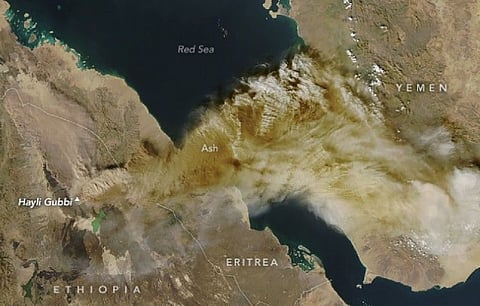


The recent major eruption of the Hayli Gubbi volcano in Ethiopia did not increase the dangerous levels of air pollution plaguing South Asia, an analysis by the International Centre for Integrated Mountain Development (ICIMOD) has found.
Rather, the pollution choking cities from Lahore to Dhaka is homegrown and stems from local and regional sources and weather patterns, a statement by ICIMOD noted.
The Hayli Gubbi volcanic eruption released sulphur dioxide (SO2). It is a hazardous air pollutant with severe effects on health and the environment.
However, the gas plume travelled high in the atmosphere and passed over South Asia without mixing down to ground level, satellite tracking by ICIMOD showed.
“While we tracked the volcanic plume moving eastwards across parts of Asia, our data clearly shows it moved at high altitude,” said Ashish Tiwari, Air Lead at ICIMOD. “It had little to no impact on the severe pollution already present at ground level across South Asia.”
Scientists from ICIMOD used satellite measurements of Aerosol Optical Depth (AOD), a key indicator of how many particles are in the air column to support this finding. The data showed no significant spike in pollution following the eruption.
“The pollution levels were already high before the eruption and remained constantly high after it,” explained Abhishek Kumar Upadhyay, Energy and Emission Specialist at ICIMOD. The volcano did not add to the public health crisis happening on our streets.”
During the same period, major South Asian cities including Islamabad, Lahore, Delhi, Kathmandu, Thimphu, and Dhaka experienced dangerous peaks in PM2.5, the tiny particles most harmful to health.
According to experts, a combination of calm winds, cool temperatures, and emissions from transport, industry, agriculture, and domestic sources is to blame.
“Calm weather creates a ‘lid’ over the region, trapping pollution from local sources close to the ground,” said Arshini Saikia, Air Quality Modelling Analyst at ICIMOD. “Our October data shows an increase in PM2.5, PM10, and carbon monoxide, all linked to human activity.”
These findings reinforce the critical importance of local and national action. Countries like Nepal and Bhutan have recently launched their National Clean Air Action Plans, focusing on reducing emissions to protect public health.
