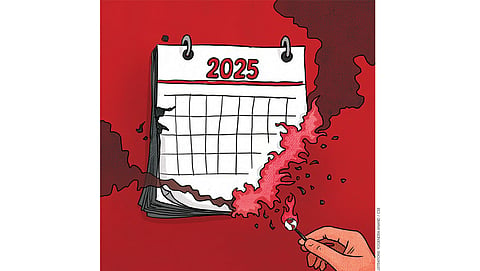


The world boiled over in 2025. It has been a year like no other—a year of accelerated daily turmoil marked by explosive geopolitics and out-of-shape global weather. Every day, a new record was broken; every day, a new development disrupted the old order. The question is if this disorder will give rise to a brave new world. To understand this, we need to uncover the green shoots emerging in our world today and nurture them into a new dawn. But how do we do it? This, then, is our continued question as we step into 2026. But first, let us recap a few trends of yesterday.
Climate change is real, and the data shows that rising temperatures are now breaching the safety guardrail and risk spiralling out of control: According to the European Union (EU)’s climate change service, Copernicus, global temperatures in November 2025 were 1.54oC above pre-industrial levels; 2025 will go down as the second warmest year on record. Taking the average of the past three years, the world will exceed 1.5oC for the first time—signalling that we are breaching the safety guardrail. The World Meteorological Organization has reported that carbon dioxide levels in the atmosphere have reached a record high—rising from 420.4 parts per million (ppm) in 2023 to 423.9 in 2024. According to the agency, this trend signals new threats of rising temperatures and more extreme weather events.
"The Global Tipping Points" report, prepared by 160 scientists from across the world, finds that coral reefs in tropical warm oceans are now crossing their thermal tipping point—in other words, coral bleaching and die-off could well be irreversible.
The report further warns that the planet is on the brink of similar tipping points in the Amazon rainforests, the Eurasian boreal forests and the collapse of the major ocean currents, which would completely throw out of gear global weather systems. Once such critical thresholds are breached, the damage is not only irreversible but could be amplified by self-perpetuating feedback loops—akin to a creature eating itself to death.
The US government’s agency, the National Oceanic and Atmospheric Administration (NOAA), has found that the Arctic has experienced its warmest and wettest year on record, leading to rapid melt of permafrost. Scientists warn that these changes in the “refrigerator for the planet” portend serious and far-reaching ramifications for the global weather patterns and ocean systems. It is already clear that the weakening of the Arctic jet stream is a major driver of the extreme weather events that the world has seen—and this trend is expected to accelerate.
All this suggests that in 2025, the world has entered a new age of the unknown. Scientific models can predict climate impacts with some certainty only close to 1.5oC warming, and now these impacts appear to be arriving earlier than expected. This unpredictable future should worry us, simply because we have nothing to fall back upon—there is no textbook or historical precedent to guide us through what lies ahead.
What is now clear is that this temperature overshoot can only be reversed if there is drastic and immediate global reductions in greenhouse gas emissions, or if the world can “magically” remove the already released CO2 from the atmosphere. The carbon dioxide removal (CDR) option is now fast gaining traction. It includes nature-based CDR, such as expanding tree cover to sequester CO2; adopting agricultural practices that improve soil carbon storage; or enhancing the ocean’s capacity to absorb CO2 through marine plants. CDR also includes geo-engineering solutions to remove CO2 from the atmosphere. Much is being discussed, but the bottom-line is that our world, in 2025 has entered an age of uncertainty; an age of the unknown.
What is now clear is that this temperature overshoot can only be reversed if there is drastic and immediate global reductions in greenhouse gas emissions, or if the world can “magically” remove the already released CO2 from the atmosphere
This temperature increase is showing up in terms of extreme weather events that are devastating the livelihoods of millions, They are erasing the development dividend, forcing financially overstretched governments to reinvest in reconstruction rather than much needed development and adding to global economic distress and human misery: Down To Earth’s annual assessment of extreme weather events, based on the daily data from the India Metrological Department, finds that in 2025, as much as 99 per cent of days saw extreme weather events—the highest in four years. Almost every part of the country was hit, not once but many times, by record temperatures, intense rainfall, floods and cloudbursts. The economic costs are mounting as infrastructure collapses—roads, bridges, schools and houses all need reconstruction. It also brings huge misery to people who are rapidly losing their ability to cope and rebuild lives in the face of repeated climate ambush.
This is not limited to India. As the year drew to a close, ferocious cyclones ripped apart multiple countries—from Indonesia to Sri Lanka. Lives and property have been lost. These countries now suffer both a human tragedy and economic shock. The International Monetary Fund’s (IMF’s) statutory “India Country Report” released in November 2025 on the prospects for India’s economy warns of growing risks to growth because of climate change. According to this assessment “rising temperatures, increased rainfall variability, and intensified extreme weather events damage infrastructure, increase inflationary pressures, cause water and food shortages, worsen health outcomes, and reduce economic growth.” India’s investment in both decarbonisation as well as reconstruction would add to its debt burden, and this, says the IMF report, has a high risk to sovereign stress. Climate change in 2025 has shown up in the balance sheets of countries and it threatens to add even more negatives.

Vulnerable and fragile regions like the Himalayas hold a mirror of the times to come, as extreme weather batters the region and the damage is compounded by mindless mismanagement of the environment: During June-August 2025, three Himalayan states/Union Territory - Uttarakhand, Himachal Pradesh and Jammu and Kashmir - experienced exceptionally heavy rainfall and cloudbursts. All this meant that the slopes of moraine—the Himalayas are the youngest mountain range of the world—literally came down like a pack of cards. Downstream, Punjab got submerged by the floodwaters from the Himalayas as well as the 400 per cent more rainfall that the state received than its monthly average in August. But this scale of loss was exacerbated by the recklessness of growth as we are practicing currently.
The fact is, climate change is the consequence of emissions that we have burnt into the atmosphere for our economic growth and human greed. We are making things worse, deliberately and willfully, because of the way we do development. We build on floodplains; we fail to plan for drainage; we encroach upon fragile mountain ecosystems; we build houses, roads and hydropower units without regard for the fact that these regions are highly seismically active; that these are the world’s youngest mountain ranges; and that their slopes are inherently prone to landslides.
In 2025, we have learnt—whether we choose to acknowledge it or not—that we are living in the age of climate change. We are living through catastrophic times that will bring even mighty mountains to their knees. The time for human arrogance, denial and mindlessness is over.
Countries, particularly in the industrialised north, are finding it difficult to scale up low-carbon solutions within their existing economic models. The low-hanging fruit of emissions reduction, through switching to natural gas from coal or via efficiency improvements, has largely been exhausted
Even as science confirms and nature’s devastation shows up on national balance sheets, the world is paradoxically witnessing clear signs of reversal in the political commitment needed to take urgent climate action: In January 2025, Donald Trump was sworn in as the 47th President of the US, and he has made it absolutely clear that his country will revert to fossil fuels as its preferred energy source. The US has walked out of the Paris Climate Agreement and is now invested in dismantling regulations that were steering the country towards green energy and electric vehicles. However, let’s be clear that it is not just the US leading this retreat. There is a broader global hesitancy and there are reasons for it.
Countries, particularly in the industrialised north, are finding it difficult to scale up low-carbon solutions within their existing economic models. The low-hanging fruit of emissions reduction, through switching to natural gas from coal or via efficiency improvements, has largely been exhausted. Now emission reduction strategies involve substantially higher costs. At a time when conservative governments are gaining ground, these strategies are becoming difficult to push through. The geopolitics of green-technology supply chains is emerging as a major constraint. China controls most of the rare minerals ecosystem—from mining to processing—and also dominates the business and manufacturing of green technologies, from batteries to solar panels to electric vehicles.
Even as I write this, in the twilight of 2025 and the approaching light of 2026, the EU has reneged on its commitment to ban the internal combustion engine from 2035. The fact is, its automakers have found it tough to compete with the Chinese made electric vehicles, which are not only cheaper but often technologically superior. This handicap pushes away green transition.
This battle of world control is now down to the petro-states verses the electro-states. The complication arises out of the fact that there is near complete domination of one country, China, in the raw materials, processing, manufacturing for electro-states transition. This is an unprecedented situation and the question remains: how will it resolve itself in the year ahead.
Action against climate change is now being discredited as the agenda of the left-wing and fuelling the discontent of the middle-class over economic insecurity: Today, large numbers of ordinary middle- and working-class people, both in the rich and to-be-rich countries, feel cheated and left behind by the globalised economy. In their minds, the problem is framed as an “invasion” of immigrants, whom they see as taking away livelihoods. Governments are seen as weak, allowing this to happen with impunity. It is then linked to the rising cost of living, declining real wages and the perceived burden of the green transition. Windmills, which generate cleaner power and at lower cost than conventional systems, are blamed for driving down standards of living. Let us also be clear that there is deep resentment in the western world—which has led the economic growth and was the architect of the free-trade globalisation regime. This discontent is then driving a shift towards political parties that dismiss or downplay climate change, much like US President Trump.
This politicisation of climate change forces society to takes sides. It makes the issue toxic and makes it about the elite verses the rest. Worse, it demonises science and experts and portrays them as out of touch with the painful realities of ordinary people. This, when we know that environment and development are two sides of the same coin and that climate change is real and we need to act, and act fast and decisively.
The good news is that 2025 demonstrated that green technologies work and can be scaled up to even displace conventional energy in electricity generation: In 2025, for the first time globally, renewable energy overtook coal as the primary source of electricity during the first nine months of the year. In its report, “Global Energy Recap for 2025”, energy think tank Ember notes that solar power has seen rapid growth, doubling over the past three years and adding more electricity than any other source during this period.
More than half of this increase in solar generation came from a single country: China. Wind and solar generated more than a third of Brazil’s electricity in August 2025; solar and wind together supplied more than half of UK’s electricity in September 2025, and similarly in June 2025, solar supplied as much as 22 per cent of electricity across the EU. In addition, Ember reports, battery costs are on the decline, and with affordable storage, solar and wind power can now compete with new coal-based power plants.
In India, the Rajasthan State Electricity Regulation Commission has, in a landmark judgement, rejected a proposal to set up a new coal power plant, arguing that solar power was equally feasible and price-competitive.
The big question for 2026 and beyond is no longer the feasibility of green technologies, but how they will be integrated into electricity systems? The intermittency of this technology means it works only when the sun shines and the wind blows. This requires either large-scale storage solutions or back-up sources to supply electricity during the missing hours.
With vast parts of the world still unconnected to national grids, a key question is whether these regions can leapfrog to clean distributed electricity with batteries for storage. Pakistan, which faces cripplingly high energy costs, has removed import duty on Chinese solar panels and lithium batteries. International energy analysts estimate that by 2024, Pakistan installed 25 GW of net-metered distributed solar, compared to 50 GW of installed grid power, and imported 1.25 GW of lithium batteries to support off-grid systems. At this pace, Pakistan could meet 100 per cent of its daytime electricity demand and 25 per cent of its night-time demand through solar by 2030. But reports indicate this transition is adding to costs of the distribution companies (discom), prompting pushback and a policy review. It is not clear where this will go.
This is the central energy question of our age: how will new energy systems displace, replace or retrofit the existing fossil-fuel-based grid, and what must we do differently? This is the space to watch out for.
The global trade order is built on the premise of the consumption of societies that create markets and economic wealth. It is the sheer size of its consuming classes that puts the US at the lead and gives it the heft to rework tariffs and agreements
Project globalisation is now on the line, and the question is how it will be reworked so that it can work for both people and the planet: The global trading system is in disarray. It is impossible to predict the outcome of this reset in the world trade order, which is extremely complex in its interrelationships and has established itself as the only game in town for any country’s economic growth and prosperity.
Project globalisation was built on the foundation that the cost of manufacturing was high in this world; labour was expensive and the cost of environmental regulations was prohibitive. This was the time when the already industrialised countries were feeling the pain of local air and water pollution—from acid rain to toxins in rivers. They were facing huge public outrages and so, the classic “not-in-my-backyard” (NIMBY) principle came to be applied in the name of global trade.
Renowned US economist Larry Summers, who in 1992 was with the World Bank and went on to become the president of Harvard University, wrote in an internal memo “there is an economic logic to dump toxic waste in the lowest wage country”. The British magazine, Economist put it bluntly—“'let them eat pollution' says Summers”. The argument was brilliant; it would be cheaper to do business in the lowest-wage countries with minimal regulations. The richer you are, wrote Summers, the more you want your environment to be clean and so the costs are higher. Public concern about toxic agents that have one-in-a-million chance to cause prostate cancer would be high in countries where people survive to get prostate cancer, as compared to countries where under-five mortality is 200 per 1,000 people. Harsh words, that Summers tried to squirm out of, but what he said was the absolute driver for economic and trade globalisation.
The World Trade Organization (WTO) was born in 1995, and in 2001 China joined this body. There has been no looking back since. Global manufacturing moved lock, stock, and barrel from the industrialised world to countries like China and then to Vietnam, Bangladesh and Cambodia. It has been a game of finding the bottom: as costs of regulation and labour increase, so does the flight of industry in search of new greener pastures. We see this in India as well—as soon as the pollution regulator cracks the whip, industry moves out to “dark” unauthorised settlement areas. In this free-market world, the cost of labour and environment has to be discounted to stay competitive.
In the 25-odd years of this global trade order, there are now new losers and new winners. In the early 1990s, when Arthur Dunkel’s draft proposal for WTO was being pushed, developing world was up in arms. There were protests in India, for instance, against the idea of unfettered global trade, as it would destroy livelihoods of the poorest, particularly farmers who faced the prospect of cheap food being dumped from the industrialised mega farms of the West. By 1999, when the ministers met at Seattle, US to celebrate the new world order, there was widespread and growing anger against “untamed globalisation”. Protesters also came from the richer world, which was seeing the flight of manufacturing and pain of unemployment.
The global trade order is built on the premise of the consumption of societies that create markets and economic wealth. It is the sheer size of its consuming classes that puts the US at the lead and gives it the heft to rework tariffs and agreements. The country—home to only 4 per cent of the world’s population—gorges on household goods. According to data, the US accounts for roughly 30 per cent of global household consumption—it consumes double or more of what it produces, and hence faces a trade deficit. But it is also because of this gargantuan demand that countries are queuing up in submission. They desperately need and want a share of the US market—for everything from coffee to clothes to electronics and more.
As a result of this climate change has been the other big casualty. The fact is, emissions in the West never really reduced; they just moved to new production sites. This is also where economy, climate change and politics intersect. When the world moved towards interconnected economies it was believed that it would lead to a prosperous and safer world order; countries would not attack as they would be driven by the self-interest of cooperation. But the real reason for moving the industry was to reduce the costs of labour and environmental safeguards. It was too expensive to manufacture if these costs had to be paid. This meant that production moved and so did emissions. We know that from the carbon dioxide balance sheet of countries as China became the world’s manufacturer. After joining WTO, China’s share of global CO2 emissions rose from 5 per cent in 1990 to 21 per cent in 2019.
But all the flaws, faults and failures of this global free trade system were papered over; the winners made sure of this. Western companies moved to lower income countries and made profits; consumers (all of us) were happy because of cheaper goods. In all this, the service and technology sectors boomed; banks and financial markets made money and with poor income distribution policies, disparities sharpened. Now, it is here with a bang. Of course, the global trading system has us all hooked. The low-wage countries have economically benefitted from global trade. In this interconnected world of trade, service and finance, disengagement will come at huge costs.
Now, there is a further complication. The global disengagement is also connected to the much needed green transition. The production of all things green is still cheaper in the “other” side of the world, China in particular. China has also invested greatly in the green technology business—the long game has been played with great design and intent. The question is if this will now derail the momentum for a low-carbon economy or will it accelerate green transition led, this time by China.
A new green economy must be grounded in societal principles of globalisation: Focus on increasing the distribution of wealth within a country so that consumption is not about the wealth of a few, but about the well-being of the majority. The fact is, when money reaches the hands of the poorest, they become “consumers” of goods. We also need localisation of the economy—in other words, enable local production by the masses, not mass production for the locals (to paraphrase our favourite national hero, Mahatma Gandhi). Together, these principles should form the foundation of a modern, self-reliant economy. Growth from the bottom up builds resilient communities, who can then withstand climate shocks. The question now is: Can we build that new green future that sustains local production and livelihoods, but not by consuming the planet?
Many households in our world still use biomass to cook food because they are poor. These air pollutants, which are killing poor people, are also contaminating the airshed they share with the rich. So, if we want clean air, we will have to get the rich out of their polluting vehicles, but we will also have to ensure that the poor households get options to move out of dirty fuels
A blueprint for the New Green World must put people at the centre, so that growth is inclusive and affordable, and that sustainability and climate mitigation are outcomes: Our globalised world is inter-connected and inter-dependent and we must recognise this. We have learnt through our lived and practiced experience in India that sustainable development is not possible if it is not equitable. Growth has to be affordable and inclusive for it to be sustainable. But all this will not happen, unless we articulate that the environmental challenge is not technocratic but political. We cannot neuter the politics of access, justice and rights and hope to fix the environment or indeed development.
India, like many other countries, has to ensure growth. This means providing millions with employment, healthcare, education and housing, and increasing energy supply. This has to be our development priority. But development will require taking action that meets the needs of all. So this calls for a change in strategy. We cannot afford a capital- and resource- intensive pathway that adds to environmental degradation and inequity in society. We have learnt over the past decades that we cannot adopt the western-country approach to first pollute and then clean up. We just do not have the financial wherewithal to keep repairing the damage. We have to reinvent growth and this is what many policies in India have done: they have built inclusive sustainability as an outcome of their development policy.
This is the unique opportunity for countries like India—not to pit development against climate action but to subsume it within policies designed for growth. But this also means that we need to rework growth strategies so that they are inclusive and affordable and so sustainable.
And if we achieve this, we need to hit a sweet spot—our actions to reduce local pollution and to drive green livelihoods will also reduce greenhouse gas emissions. In this way, our Nationally Determined Contribution (NDC), which puts together the package of actions to reduce emissions, would be based on co-benefits; development, if done right, will also address the urgent crisis of climate change. We know that it is in our interest to achieve this twin goal.
Take the health crisis of air pollution plaguing many of the cities of the Global South. In Delhi, which has the infamous tag of one of the world’s most polluted cities, less than 20 per cent own or drive in cars to work. But these vehicle owners take 90 per cent of the road space. The question is if the demand of just 20 per cent is leading to huge congestion and pollution, where and how can the city find the road and air space for all? This is where the environmentalism of the poor kicks in. The fact is, if the rich are to breathe clean air, we need to rework mobility for all. We cannot think of adding a few buses, trams, or metros; we need to transform mobility so that it works for the rich and the poor. This means combining affordability and convenience and safety.
The agenda is to redesign mobility because personal vehicles, however clean, take up road space and add to pollution and congestion and greenhouse gas emissions. The western world has taken the path to subsidise and electrify personal vehicles, which is leading to disruption in industries as they strive to rework supply chains and re-deploy labour for electric cars. We have the opportunity to think of another route—one that reinvents mobility so that we can move people and not cars. This means investing in electric buses and affordable transport like para-transit and two-wheelers. In this way, India’s NDC must be about up scaling and integrating low-carbon public transport, and not just counting electric cars. The policy is driven by cleaning up local air but has the added benefit of combating climate change.
This is also the case with energy. Many households in our world still use biomass to cook food because they are poor. These air pollutants, which are killing poor people, are also contaminating the airshed they share with the rich. So, if we want clean air, we will have to get the rich out of their polluting vehicles, but we will also have to ensure that the poor households get options to move out of dirty fuels. Their energy transition to clean fuel is important for clean air. This is why without inclusive growth, we cannot have sustainability.
It is the same with the hard-to-abate industries. We know from experience that our industry will invest in technology that saves costs and increases competitiveness. The cement industry, for instance, switched to using fly ash, not to decarbonise but to use waste as raw material, substitute limestone, and reduce costs of energy. The future of low-carbon industrialisation lies in similar win-win solutions, such as the reuse of waste materials from iron ore slag to biomass to refuse-derived fuel from municipal garbage—all designed to reduce the use of coal and other fossil fuels and to improve efficiency.
The most contentious is the question of the clean energy transition. A country like India’s imperative is to provide electricity to millions for livelihood security. Even today, large numbers of households in the country are burdened by excruciating energy poverty; electricity supply is either unreliable, unavailable or is expensive. People do not have the luxury of switching on lights and women still cook with dirty biomass. Industry is similarly hit, and this is when the cost of energy determines competitiveness. This is also why Indian industry prefers its own electricity generation systems—captive power—using fuels like coal. So, we need strategies for more energy, clean energy, and affordable energy. If we get this transition right, we can move towards low-carbon growth, which will work for us and reduce the emissions that are leading the world towards catastrophe.
Today, 70 per cent of the world’s population has still not secured development in terms of energy or other essentials needed for their well-being. Meanwhile, the world has practically run out of the carbon budget to limit warming to below the guardrail of 1.5oC above the pre-industrial period
Our plan for green industrialisation must prioritise local economic resilience and distributed resource management: We must re-engineer the idea and design of a green economy. We must combine the need for economic resilience with the opportunity for cleaner, more efficient and more distributed resource management.
We must also invest in local resources that can be used for local livelihoods. If we do this, we can sequester carbon in trees and in soil, build resilience in society, withstand extreme weather shocks and also stem migration. We cannot afford an economy that is driven only by the gross domestic product (GDP), which extracts and exports produce, and not by gross nature product (GNP) that invests in natural resources for livelihoods, locally.
Today our world is being battered by extreme weather events because of climate change. It is also equally clear that the burden of these devastations is disproportionate—they hit the poor in the poorest countries hardest. Climate finance is not just payment or reparations needed to mitigate and adapt to these disproportionate impacts of climate change. It is also about providing finances for the transition that these countries still need, to develop. They need to develop differently, so that they can grow without adding as much to the stock of emissions that will further jeopardise our common existence.
This is why climate justice—as enshrined in the 1992 UN Framework Convention on Climate Change (UNFCCC)—matters so much. It was agreed that countries responsible for the stock of emissions in the atmosphere (historical polluters) would need to reduce emissions. It was also agreed that the rest of the world, which had the right to development, would be provided with the finance and technology to grow sustainably. However, over the past 33 years, the world has convened countless conferences only with the intention of diluting and erasing this principle. But the issue of equity, like the changing climate, will not go away.
Today, 70 per cent of the world’s population has still not secured development in terms of energy or other essentials needed for their well-being. Meanwhile, the world has practically run out of the carbon budget to limit warming to below the guardrail of 1.5oC above the pre-industrial period. It is also clear now that what is being provided as climate finance is a fraction of what is needed for securing a different development future in our world. So, we need to find the money and we need to do this fast.
But this is not all. We also need to discuss structural issues that underpin the vast inequities in the world, which make it certain that countries in the global South cannot afford the price of adaptation or mitigation. We know that the quantum of money called climate finance is inadequate. We know that there is no agreed definition of what the world means by climate finance, and this allows for much creative accounting. But what we do not know, or discuss, is that whatever is being given in the name of climate finance is not concessional—roughly 5 per cent is grants, and the rest is loans or equity.
The most vulnerable countries, which also need funding for climate mitigation, have a crushingly high debt burden—the money they pay in annual interest is as high as 16 per cent of their governmental revenue in 2023
It is no surprise that what is termed as climate finance is not going to the countries that need it the most. It is no surprise because these funds go where there is opportunity to make money; where there is (at least perceived) less risk in the financial market stability; and so where the cost of finance is lower. The cost of finance (interest rates) to, say, set up a solar plant, would be 2-5 per cent in Europe; 12-14 per cent in Brazil; and as high as 20 per cent in some African countries. This would make the plant unfeasible in African countries.
Worse, if this money goes to Africa in the form of loans—as it invariably does, with high interest rates—it would only add to their problem of repayment of loans. Countries cannot afford to default on a loan as that makes their credit ratings worse. But climate change will make it worse because the most vulnerable countries are also the ones with high debt burden.
Every climate change disaster takes these countries to greater indebtedness as they borrow to survive and rebuild. These same countries are then stamped with poor credit ratings, which make their cost of borrowing and capital even higher. It is critical that there is an assessment of the bias of the global rating system, which determines these rates of credit. As a result, the most vulnerable countries, which also need funding for climate mitigation, have a crushingly high debt burden—the money they pay in annual interest is as high as 16 per cent of their governmental revenue in 2023. The tagline for the IMF’s “2025 World Economic Outlook” report captures the mood: “global economy in flux, prospects remain dim.” But its real kicker comes from its data that shows that for post-2000, for the very first time the world’s poorest and most vulnerable countries are paying more to service debt than they are getting as official development assistance.
So, we can no longer talk about small changes, or about short-changing the poor. This is critical if the transition to the cleaner and more secure world has to succeed.
Then there is the question of global trade. The current system as we know has been designed to get cheaper goods and products. This has meant that countries extract more to earn the same revenue—it discounts the cost of environment, labour and even land. Farmers cannot invest in improving their land and water resources as they are driven by making ends meet—worse, in this system design they get a small percentage of the value of the final produce. For instance, in the current trading model, countries face higher tariffs on commodities and produce—like coffee or cocoa—when they have added value to it. It is estimated that farmers in Africa earn less than 6 per cent of the total revenue of the finished good of chocolate. This needs to change.
So now that this globalisation model is being re-worked, there is an opportunity to rethink these rules, allowing a distributed, locally led production system to form the basis of green industrialisation through the localisation of the economy. This would, then, be the foundation of modern economic growth—resilient communities capable of withstanding climate shocks. Resilient local economies can build new green futures. This approach also places more money in the hands of the poorest, who can then invest in improving their environment and invest in the great leapfrog to clean energy systems without going through the fossil fuel route.
This is the big agenda in this big churn, which aims for a tomorrow that is more resilient, more inclusive and more sustainable. We are at the beginning of the epoch of climate change, and the world has already moved into a different today. We must plan for a different tomorrow. We cannot remain prisoners of yesterday. We must become vanguards of a new dawn—a promise grounded in the lessons and mistakes of our generation. Otherwise, we risk squandering away coming decades into nothingness—a vortex of spiralling climate change impacts. This is what we must change.
This was first published in the State of India’s Environment 2026