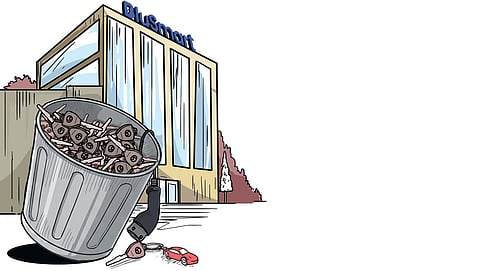


The narrative that has settled around the collapse of electric ride-hailing cab company BluSmart Mobility is wrong in the conclusion many are drawing from it: that the electric cab model is broken. It is not. What failed in BluSmart’s case was a company’s financial architecture, governance structure and one set of promoters’ honesty. As per Securities and Exchange Board’s (SEBI’s) interim order dated April 15, 2025, BluSmart’s co-founders, Anmol Singh Jaggi and Puneet Singh Jaggi—who also ran EV-leasing firm Gensol Engineering, which owned most BluSmart vehicles—had allegedly diverted Rs 262 crore in loans meant to purchase 6,400 electric vehicles (EVs) towards a luxury apartment, foreign trips and transfers to relatives.
New players have rushed in to fill the market vacuum left behind by BluSmart. By May 2025, Evera Cabs, operated by Delhi-based Prakriti Mobility, had taken possession of 220 former BluSmart cabs, with plans to acquire up to 1,000 EVs in total. Evera CEO Nimish Trivedi reportedly said that the company—previously operating from Terminal 3 of Delhi’s Indira Gandhi International Airport—aims to expand to Terminal 1. Chennai-based Refex Green Mobility—a subsidiary of the diversified Refex Group—has entered Delhi-National Capital Region (NCR) with a plan to deploy over 400 EVs in three months. Operating under the brand Refex Mobility, it runs 1,400 company-owned EVs in Chennai, Bengaluru, Hyderabad and Mumbai, serving over 70 corporate clients.
Before asking what went wrong with BluSmart, it is worth being precise about what went right. BluSmart’s EVs completed over 300 million km of fare-generating trips in Delhi-NCR and Bengaluru. Its fleet ran reliably enough for the company to earn carbon credit accreditation from Verra, the global non-profit standard-setter, becoming the first Indian mobility firm to do so. Its customer satisfaction metrics outperformed conventional ride-hailing platforms. Its charging network—35 dedicated hubs across Delhi-NCR and Bengaluru—showed that fleet-scale EV charging is operationally achievable in India. Running costs were materially lower than comparable compressed natural gas (CNG) vehicles and maintenance was less frequent. If investors, policy-makers and the public conclude that the failure means electric fleet operations do not work, the next set of operators will find capital more expensive, regulation more hesitant and public trust harder to rebuild...
This column was originally published in the July 16-31, 2026 print edition of Down To Earth
