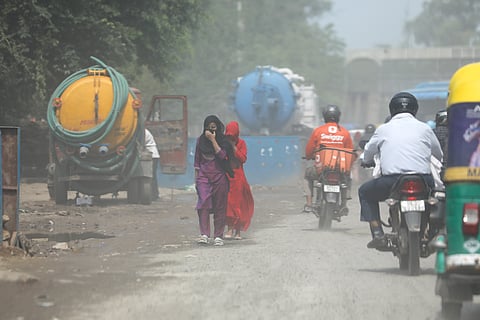


A faster shift to zero-emission vehicles could prevent 8.8 million premature deaths globally by 2050, an ICCT study says.
Road transport pollution is linked to about 90,000 premature deaths and 15,300 new childhood asthma cases in India each year.
Delhi-NCR faces a disproportionate burden, accounting for 23% of India’s road transport-linked childhood asthma cases despite having about 5% of the population.
Heavy-duty vehicles, including trucks and buses, account for most tailpipe nitrogen oxide and PM2.5 emissions from India’s road transport sector.
This article has been updated.
A faster shift to zero-emission transport could prevent nearly 8.8 million premature deaths globally between 2024 and 2050, according to a new study by non-profit research organisation International Council on Clean Transportation.
The report, Health benefits of zero-emission transport through 2050, says India alone could prevent 1.7 million premature deaths over the same period if all new vehicles sold are zero-emission by 2045. The paper modelled a pathway in which all new vehicles sold are zero-emission by 2045 and examined the likely impact on air quality, premature deaths and childhood asthma.
Road transport pollution is linked to about 90,000 premature deaths and 15,300 new childhood asthma cases in India every year, the study estimated. This is equivalent to one premature death every six minutes and one new childhood asthma case every 34 minutes in 2024, it said.
Globally, the report warns that premature deaths linked to road transport pollution are projected to rise by 74 per cent by 2050, despite decreases in most road transport air pollutants. This would mean an increase from one death every 45 seconds to one every 26 seconds. The rise is driven by growing vehicle activity in regions with weaker emission controls and an ageing global population that is more vulnerable to air pollution.
Under an ambitious zero-emission pathway, however, the report says premature deaths could fall by 63 per cent and new paediatric asthma cases by 80 per cent from 2024 levels by 2050. Cumulatively, this could prevent nearly 8.8 million premature deaths and 1.7 million new paediatric asthma cases globally between 2024 and 2050.
India accounts for 13 per cent of global premature deaths attributable to road transport emissions, according to the report.
Delhi and the National Capital Region (NCR) were identified as major hotspots. In 2024, the NCR accounted for 8,100 premature deaths linked to road transport pollution, or 9 per cent of India’s total. It also accounted for 3,500 new paediatric asthma cases, or 23 per cent of the national total, despite having about 5 per cent of India’s population.
Within the NCR, Delhi recorded 2,800 premature deaths and 1,500 new paediatric asthma cases attributable to road transport pollution in 2024.
Children in high-exposure urban regions faced repeated contact with traffic-related pollution during daily travel and routine activities, the study said.
In heavily polluted parts of the NCR, road transport alone exceeded the World Health Organization’s annual nitrogen dioxide guideline of 10 microgrammes per cubic metre for all sources combined, the study said. In Delhi, population-weighted exposure to road transport-related PM2.5 reached 13 micrograms per cubic metre in 2024, more than 2.5 times the WHO guideline for total PM2.5 exposure from all sources.
The role of heavy-duty vehicles was also underlined by the report. Trucks and buses make up a smaller share of India’s vehicle fleet, but accounted for 79 per cent of tailpipe nitrogen oxide emissions and 64 per cent of tailpipe PM2.5 emissions from road transport in 2024.
Amit Bhatt, India managing director at ICCT, in a press note, said electrification was the only way to eliminate tailpipe emissions entirely. India would need to accelerate the adoption of low- and zero-emission vehicles, phase out older high-emitting vehicles and strengthen transport policies beyond the national capital to achieve lasting public health gains, the report said.