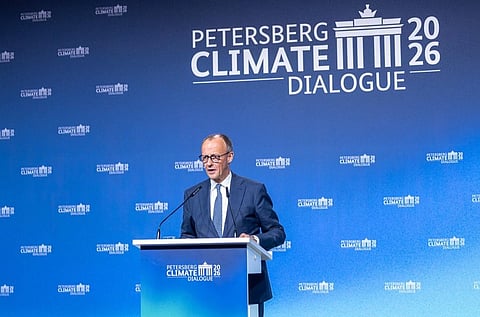


As the world reckons with the energy shock caused by the US-Israel war against Iran, ministers and high-level officials from over 30 countries converged in Berlin, Germany, for the 17th Petersberg Climate Dialogue. Held between April 21 and 22, this was the first major climate ministerial of 2026 in the lead up to the 31st Conference of Parties (COP31) to the United Nations Framework Convention on Climate Change in Antalya, Türkiye later this year. It was organised by the Government of Germany, alongside the COP31 Presidency of Türkiye and the COP31 Presidency of Negotiations Australia.
The annual Dialogue has been organised by Germany since 2010 and serves as an informal meeting space for Parties to discuss issues outside formal negotiating settings and prepare the ground for COP negotiations. This year’s focus was on implementing the Paris Agreement, international climate finance and geopolitical resilience.
Germany’s Federal Environment Minister Carsten Schneider, speaking on the opening day of the Petersberg Dialogue, highlighted how the ongoing crisis in West Asia has exposed the vulnerabilities of fossil-based energy and spotlighted the need to transition towards sustainable energy sources. He lauded the progress made globally in shifting towards solar and wind power and stressed on the fact that increased electrification of mobility and heating using renewable sources is the next frontier. This, he underscored, would be an important focus for Germany at COP31.
In a similar vein, European Commissioner Wopke Hoekstra spoke about the EU’s fossil fuel imports bill reaching half a billion euros a day, and the need for Europe to ensure that climate, competitiveness and energy independence can go hand in hand. Hoekstra also stressed that electricity represents only 23 per cent of the final energy consumption in Europe, and that their shared objective should be to center electrification in the climate and clean energy agenda.
On the second day of the Dialogue, German Chancellor Friedrich Merz reaffirmed Germany’s support for global climate action, arguing that, “we need a climate policy that is multilateral, that is ambitious and that is effective.” Merz further underlined the link between climate action and economic growth, warning that support for climate policy must not hinder Germany’s industrial base. However, on climate finance, he failed to make new commitments for the Global South—already facing shrinking financial support from the Global North.
Fatih Birol, Executive Director of the International Energy Agency (IEA), warned that the West Asia crisis and the closure of the Strait of Hormuz had triggered the biggest energy crisis in history, but unlike previous crises, the alternative to fossil fuels is now available. He added that renewables accounted for a record 75 per cent of new power generation capacity the previous year, with only 25 per cent attributed to fossil fuels. Investing in renewables and energy efficiency would be the key to strengthen energy security.
As a precursor to COP31, the Petersberg Climate Dialogue highlighted both early momentum on climate commitments as well as gaps in implementation. Civil society has highlighted how discussions around energy security carried limited focus on international cooperation and trade or how COP31 can serve as a platform to respond to the crisis. Further, while talks around expanding renewables and electrification of the economy are encouraging, investment flows in renewables remain uneven globally and closing this gap will be crucial.
As countries prepare for COP31, effective multilateral climate action will depend on whether these conversations translate into coordinated action rather than remaining signals of intent.