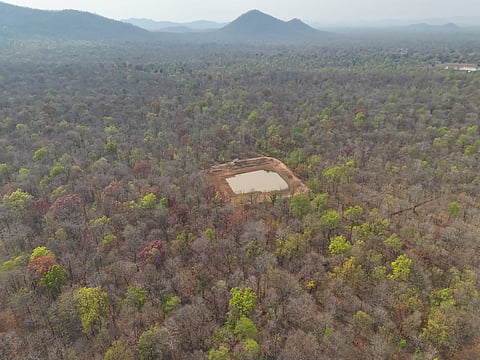


A camera trap in Chhattisgarh’s Udanti-Sitanadi Tiger Reserve has recorded elephants and calves using a small mountain Jhiriya waterhole at about 3,000ft.
The reserve has developed more than 800 Jhiriya water points and 34 solar-powered pumping systems to support wildlife during dry periods.
Forest officials say keeping water available inside forests can reduce animal movement into villages and farmland, lowering the risk of conflict.
The approach shows how traditional water systems can become practical climate adaptation tools in increasingly hot and water-stressed landscapes.
A camera trap deep inside Chhattisgarh’s Udanti-Sitanadi Tiger Reserve has captured a herd of elephants, with calves, drinking and splashing in a small mountain waterhole at about 3,000 feet.
The footage from the Kulhadighat Range is striking because of what it shows in peak summer: a functioning water source in a forest landscape where heat, drying streams and erratic rainfall are becoming growing conservation challenges.
The waterhole is known locally as a Jhiriya — a traditional source created by digging into sandy layers that store subsurface water. Such water points have long supported forest communities and wildlife, but officials say they are now becoming increasingly important as climate stress alters water availability in forests.
Udanti-Sitanadi Tiger Reserve has developed more than 800 Jhiriya water points across the landscape. It has also installed 34 solar-powered pumping systems to ensure year-round water availability in critical wildlife habitats.
Forest officials say the aim is simple: if animals find water and forage inside forests, they are less likely to move into villages and farmland.
As India experiences longer heatwaves, irregular rainfall and prolonged dry spells, water scarcity is becoming a major factor in wildlife movement.
When streams and natural pools dry up, animals are forced to travel farther in search of water. This often brings elephants and other wildlife closer to settlements, increasing the risk of crop damage, injury and conflict between people and animals.
The issue is particularly important in Udanti-Sitanadi, where more than 100 villages lie within and around the reserve. Elephants, tigers, leopards, wild buffalo, deer and several other species share the landscape with people whose livelihoods are also closely tied to forests.
Maintaining water sources inside forest areas therefore serves two purposes. It supports wildlife through the hottest months and reduces pressure on village water sources and agricultural land.
But these water points are also vulnerable. Forest officials recently detained seven alleged poachers from neighbouring Odisha who were allegedly attempting to poison Jhiriya water sources in the reserve.
Officials said such an attempt, if successful, could have had severe consequences for elephants, carnivores, herbivores and other species that depend on these scarce summer water points.
The incident underlines a less visible challenge in wildlife conservation. In increasingly water-stressed landscapes, each functioning water source becomes ecologically critical — and a potential target for poisoning or illegal hunting.
Protecting water points is therefore as important as creating them.
The Jhiriya system also points to a wider lesson for climate adaptation in forests.
Not all resilience measures require large dams, reservoirs or heavy infrastructure. In some landscapes, officials and communities are turning back to traditional knowledge, natural hydrology and low-cost restoration methods that work with local ecological conditions.
A Jhiriya does not hold water like a large pond. Instead, it taps into moisture stored below sandy layers, allowing water to remain available even when surface sources shrink.
In a warming world, such small interventions can matter. They can help wildlife remain within forest habitats, reduce the risk of conflict and support biodiversity through periods of heat and drought.
