
Subscribe

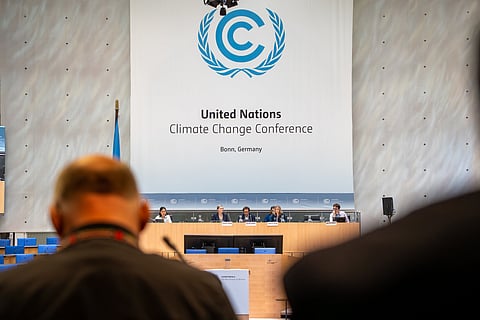
The first Veredas Dialogue was held at the Bonn climate talks on 9-10 June, focusing on climate finance flows, adaptation finance and international investment barriers.
The dialogue follows the Sharm el-Sheikh Dialogue and examines how global finance can align with low-emission and climate-resilient development.
Countries discussed national policy tools such as carbon pricing, development banks, green taxonomies, climate budgeting and subsidy reform.
Adaptation finance was a major focus, with discussions on climate-risk insurance, disaster-risk financing and the need to make resilience more investable.
Developing countries and vulnerable economies face high financing costs, debt constraints and credit-rating barriers, participants said.
The first Veredas Dialogue meeting at the mid-year Bonn Climate Change Conference (SB64) focused on a highly contested question in global climate negotiations: How to align financial systems with climate goals without diluting developed countries’ obligation to fund climate action in poorer nations.
Held in Germany on June 9-10, 2026, the Dialogue was launched under the Brazilian Presidency of the 30th Conference of the Parties (COP30) to the United Nations Framework Convention on Climate Change (UNFCCC) as a successor to the Sharm el-Sheikh Dialogue, which ran from 2023 to 2025.
It focuses on Article 2.1(c) of the Paris Agreement, which calls for finance flows to be made consistent with low-emission and climate-resilient development.
The Dialogue is built on agreed safeguards: it must be nationally determined, facilitative, and non-prescriptive, ensuring that greening global finance does not diminish the provision and mobilisation of climate finance from developed countries under Article 9.
The first meeting of the Veredas Dialogue was spread out over three thematic sessions, where delegates discussed national implementation through policy instruments, financial systems for climate resilience, and the international dimensions of aligning global finance.
The opening session centered on nationally determined implementation and policy frameworks that align both public and private finance with climate goals.
Egypt presented its NWFE platform (Nexus on Water, Food, and Energy), which successfully brings together national priorities to attract international capital. Norway shared its experience with carbon pricing as a cornerstone economic tool. By pricing 85 per cent of its emissions, Norway shifts market incentives toward low-carbon choices while using the accrued revenue to reduce income taxes for lower-income households—a redistributive model that helps maintain public consensus.
Furthermore, National Development Banks were identified as key actors for implementation. For instance, the Brazilian Development Bank and the West African Development Bank use guarantees and concessional resources to lower the high upfront costs of the energy transition, effectively bridging the gap between perceived and actual investment risk.
Another major issue was the "underpricing" of climate costs and the urgent need to strengthen the business case for adaptation. Rwanda showcased a model for aligning climate finance with climate resilience by integrating climate considerations directly into its fiscal frameworks and national budgeting. This approach includes making public investments climate-sensitive, implementing a disaster risk financing strategy, and integrating resilience into its long-term (2050) development strategy.
The Bank of Greece highlighted the necessity of integrating climate risk into the core business of financial institutions, specifically focusing on the insurance sector's role in adaptation.
A critical element identified to increase adaptation financing was subsidising insurance. Participants discussed how insurance companies can act as both investors and risk managers, designing products like parametric insurance to provide immediate liquidity to affected communities. However, for this to be inclusive, governments must play a pro-active role in providing incentives and de-risking the private sector.
To track progress without creating additional reporting burdens, countries shared innovative, non-punitive monitoring frameworks. Switzerland presented its climate alignment test, an open-source tool for institutional investors which allows the government to see sector-wide progress toward net-zero goals without naming and shaming individual firms.
Türkiye has integrated climate goals into its public finance management through a green taxonomy and performance-based budgeting. This system identifies expenditures that either align with or contradict environmental objectives, ensuring top-level political ownership of green investments.
Uganda shared its progress in establishing a dedicated Climate Finance Unit within its Ministry of Finance. This unit has been instrumental in conducting integrated assessments of finance flows and tracking a $26.5 billion commitment gap that must be filled by 2030 to meet its national goals.
Similarly, Colombia presented a roadmap to identify and redirect agriculture subsidies that accidentally drive deforestation, aiming to shift these flows toward climate-resilient agricultural credit.
Another point of disussion was the systemic barriers that create a "transition paradox": wherein countries with the least historical responsibility for emissions often face the highest financing costs.
It was stressed that current prudential frameworks and biased credit ratings often punish vulnerable nations, with perceived risks far exceeding actual default rates. Barbados shared its efforts in overcoming these barriers through the Bridgetown Initiative, specifically using debt-for-nature and debt-for-climate swaps to generate long-term savings for its Environmental Sustainability Fund.
From the private sector perspective, it was noted that institutional investors can often be averse to investing in emerging markets. To address this challenge, Multilateral Development Banks (MDBs) must utilise their balance sheets more effectively to provide guarantees and "first-loss" capital, as political ambition alone is not enough to raise the necessary capital from private markets.
With the first Veredas Dialogue concluding in Bonn, attention is now turning to the upcoming Xingu Finance Talks, which are intended to facilitate a cooperative exchange between ministers, state-linked financial institutions, academia and the private sector on solutions to persistent climate finance challenges.
The upcoming Xingu Talks will focus on two pillars: fiscal space for climate action under debt constraints, and achieving an affordable cost of capital through scaled-up guarantees. Strategically timed to align with IMF and World Bank meetings, the talks aim to build high-level political momentum that feeds back into the Veredas Dialogue's annual report to the CMA.
As Sally Box, Chief Negotiator for COP31, noted during the closing session, the progress made in these dialogues is an important foundation for consensus and real-world outcomes. By moving towards "real cases from real economies," the Veredas Dialogue seeks to ensure that the global financial architecture is reformed to support, rather than hinder, a just and resilient transition.