
Subscribe

The 18th BRICS Summit, underway in New Delhi, has issued a Declaration which covers a wide range of climate issues — from clean technology to forests — and reaffirms the group’s commitment to the multilateral regime: the UNFCCC and the Paris Agreement.
“The BRICS nations comprise a diverse mix of developing and emerging countries with growing energy needs, industrialisation aspirations and multiple development challenges — it is unlikely that we will hear a fossil fuel phase-out declaration any time soon,” Avantika Goswami, programme manager of the Climate Change and Green Economy unit at Centre for Science and Environment (CSE), said in a statement by the New Delhi-based think tank.
The Declaration calls for “just, orderly, equitable, and inclusive energy transitions” foregrounding diversified energy sources and resilient value chains. As in previous declarations, the continued role of fossil fuels in energy systems reiterates BRICS’ position on prioritising energy security within the transition.
Goswami added: “However, BRICS’ rapidly growing adoption of clean technologies like solar energy and electric vehicles positions the bloc well to aim higher and aspire for a faster transition rather than lock in vast amounts of fossil fuel infrastructure. BRICS nations are already generating more than half of the world’s solar power. Doubling down on scaling up renewable energy and economy-wide decarbonisation is the need of the hour — not only to cut emissions, but also to shield from volatility and supply disruptions like those precipitated by the Hormuz crisis.”
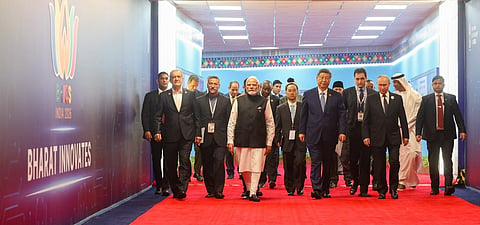
Hosted by the Government of India, the Summit has seen leaders from major emerging economies such as China, Iran, Indonesia, UAE and Ethiopia — as well as Russia (which is a member of the grouping) — in attendance. It has been held at a crucial moment when the Global South leadership on climate ambition tailored to national circumstances, clean technology and innovation, and industrial strength is more evident than ever before.
The Summit Declaration addresses a number of barriers to scaling up climate action: high debt burdens, unequal governance of Bretton Woods Institutions, and climate funding gaps, especially for adaptation.
On trade, the bloc has reiterated its objection to climate-linked trade measures, expressing opposition to unilateral, punitive, discriminatory and protectionist measures, explicitly naming carbon border adjustment mechanisms.
“The opposition to unilateral climate-linked trade measures must be seen alongside the call for a broader and equitable cooperation between developing countries in global higher value manufacturing,” said Trishant Dev, deputy programme manager, Climate Change and Green Economy unit, CSE.
The Declaration adopts a Terms of Reference and Action Plan for the BRICS photovoltaic industry working group, opens a workstream on low-emission hydrogen, sets principles for smart grids and storage, and commits to global value chain action plans aimed at helping developing countries move up the value chain. The Declaration also talks about fair competition in renewable energy markets.
“Taken together, the bloc appears to be organising around competitiveness and forwarding a shared agenda in clean technology manufacturing for the Global South,” Dev added.
The lack of lofty climate promises, therefore, does not necessarily signal a lack of ambition. Given that we are in mid-transition, BRICS countries have chosen to pursue the ambitious goal of shaping their green industrial futures and their position in global green value chains.
Goswami pointed out that “this, in some ways, could prove to be a more concrete commitment to decarbonisation than traditional emission-cutting goals. Who controls, produces and can access clean technologies and minerals needed for the transition will shape how quickly countries can switch from fossil-based to low-carbon infrastructure. The New Delhi Declaration shows that the BRICS countries have their eye on this larger goal.”
