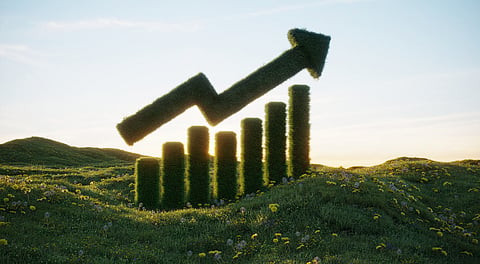


By 2026, the climate discourse will have reached an unpleasant point. Governments continue to establish aggressive goals, renewable energy capacity grows, and climate action remains a staple of global conferences. However, the climate does not respond in kind. Emissions are not falling fast enough, extreme weather is becoming more disruptive, and the promise of green growth appears to be slipping further away.
This expanding gap between intention and outcome is no longer due to a lack of awareness. This is a delivery failure.
The concept of green growth is based on a simple premise: clean energy, efficiency, and innovation can fuel economic growth while reducing emissions. In practice, green growth has struggled to advance beyond pilot projects and policy guidelines. Instead of replacing carbon-intensive systems, clean solutions are frequently placed on top of them, allowing fossil fuels to remain important.
On paper, the figures appear promising. Solar and wind installations are shattering records. Electric vehicles are growing market share. Most countries currently have some kind of net-zero aim. However, these gains coexist with persistent realities.
Fossil fuels continue to dominate the world energy supply. Coal consumption is high, especially in economies under pressure to fulfill rising electrical demand. Oil and gas investments have not fallen as projected; in many cases, they have returned in response to geopolitical instability and price fluctuations.
The end outcome is stagnation disguised as transition. Emissions have flattened in certain areas, but they are not falling as quickly as climate science predicts. Green growth has stalled not due to a lack of technical solutions, but because it competes with political and economic agendas that are rarely long-term.
One reason green growth is slowing down is that climate policy is now based on a series of crises. Governments are dealing with a lot of problems at once, including inflation, debt, war, hunger, and bad weather. In this situation, short-term fixes are more important than long-term changes.
Energy transitions need clear policy signals, patient involvement, and cooperation between institutions. But many countries have to make decisions based on what happens. New fossil fuel projects can go ahead to make up for current shortages, but long-term climate commitments are still on the table. Every one of these decisions makes infrastructure more locked in and slows down real decarbonisation.
Instead of being a basis for making economic decisions, climate policy becomes something to be dealt with along with other problems.
Climate funding remains a big constraint. While financing sources have grown, they are still far short of what is needed, particularly for adaptation. Much of the available funding is concentrated in mitigation projects with high potential returns, which are frequently located in middle-income countries. Regions with the highest climate threats receive the least assistance.
For underdeveloped countries, the difficulty is capacity, not unwillingness. Debt repayments, catastrophe recovery, and welfare commitments have all put a strain on public finances. Climate investments must compete with fundamental development requirements such as healthcare, housing, and education.
Without dependable and concessional financing, green growth becomes conditional—it is theoretically conceivable but impossible to implement.
Several of these paradoxes may be seen in India’s climate trajectory. The country has rapidly grown renewable energy and established long-term climate targets. At the same time, power demand continues to climb, employment pressures remain severe, and climate impacts worsen.
Heatwaves are currently disrupting labour productivity. Floods harm infrastructure and crops. Monsoons that are erratic put a burden on food systems. Each shock requires the state to devote resources to emergency response, leaving less fiscal space for long-term change.
Decentralised energy solutions, which have the potential to increase resilience in energy-poor places, receive significantly less attention than large-scale grid projects. As a result, the advantages of the energy transition are not evenly dispersed.
A more serious problem is the idea that economic growth can be separated from the use of energy and materials. Some countries have reduced emissions in relation to GDP, but complete global decoupling is still out of reach.
Mining, buying land, using water, and long supply chains are all things that renewable energy systems need. Mining important minerals often moves the costs of doing business to poor areas. The green economy could bring back exploitative practices in a new form if there aren’t strong rules and protections for communities.
Green development, as it stands now, doesn’t deal with tough problems like consumerism, fairness, and the limits of the environment.
While mitigation dominates climate debate, adaptation is chronically underfunded. However, adaptation is the most obvious manifestation of climate failure.
Cities face flooding and heat hardship. Farmers face altering rainfall patterns and falling harvests. Informal communities face the brunt of climate shocks with little safety. Adaptation necessitates local planning, institutional capability, and ongoing investment in locations where support is limited.
Ignoring adaptation raises susceptibility while also undermining mitigation. Communities that have been devastated by climate change are less equipped to support long-term emissions reduction efforts.
Most of the technologies needed to fight climate change are already here. Renewable energy is cheap. Most people know what efficiency measures are. Storage and grid solutions are getting better all the time.
Good governance is what is missing. Climate targets are announced without clear implementation plans. Policies are spread out across different ministries. Uncertainty in the rules makes it hard to invest. Election cycles favour taking action over getting ready for problems. People see climate policy as an environmental issue rather than a main development issue. Because of this, ambition and implementation are still separate.
If green growth is to stay credible, it must be redefined. Growth based solely on GDP, as climate damage and inequality rise, is unsustainable. Installed capacity does not guarantee success if emissions remain high and communities remain vulnerable.
A more honest approach would focus on outcomes: actual carbon reductions, livelihood protection, resilience building, and inequality reduction. Climate policy should be integrated into development planning rather than added to it.
This also necessitates accepting limitations. Not every growth path is consistent with climate stability. Transportation, urbanisation, energy use, and consumer decisions will determine whether green growth becomes a reality or just a rhetorical concept.
The climate action gap in 2026 reflects underlying structural pressures in the global economy. Technology alone will not overcome these contradictions. What is necessary is political courage, egalitarian collaboration, and governance that can think beyond crisis management.
Climate change is no longer a future issue. It is an existing constraint. The question is whether policy can catch up to this reality before the costs become irreversible.
Anusreeta Dutta is a columnist and climate researcher with experience in political analysis, ESG research, and energy policy
Views expressed are the author’s own and don’t necessarily reflect those of Down To Earth