

Declining snowfall and changing weather patterns are disrupting traditional Bakarwal migration in Kashmir
Many nomadic families are now staying back through winter, abandoning centuries-old seasonal movement
Warmer, drier winters and weaker western disturbances are altering snowfall and pasture cycles
While staying reduces migration costs, it exposes families to new risks from sudden extreme weather
Experts warn the shift could erode cultural identity and strain livelihoods without policy support
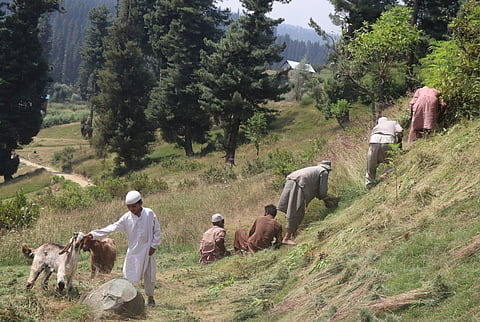
A cluster of around 30 makeshift tents lines the banks of a tributary of Rambi Ara nullah in south Kashmir’s Pulwama district, about 40 kilometre from Srinagar. Abdul, along with his wife, five sons and three daughters, lives in this cluster. This is the fifth consecutive year that these nomadic Bakarwal families have camped here. They originally hail from Nowshera in Rajouri.
For centuries, the rhythm of their lives was dictated by snowfall. That rhythm is now being disrupted.
With snowfall declining and migration routes growing more treacherous, these families have chosen to stay in Kashmir, abandoning a tradition that has defined their identity for generations.
The Intergovernmental Panel on Climate Change’s (IPCC) Sixth Assessment Report (2021) states that Himalayan regions such as Kashmir are warming at roughly twice the global average rate. Kashmir’s average temperature has increased by approximately 1.2 degrees Celsius (°C) over the past century, compared with a global mean rise of around 0.7°C over the same period.
The snowfall that once anchored the Bakarwals’ migration calendar is diminishing. A 2025 peer-reviewed study examining five decades of data found significant declines in snow water equivalent and snow cover across Jammu and Kashmir. Snowfall across the north-western Himalayas decreased by 25 per cent in the five years preceding 2025 compared with the 40-year average.
The primary driver is the weakening of western disturbances — low-pressure weather systems originating over the Mediterranean that bring Kashmir its winter precipitation. Most western disturbances in recent winters have either been weak or have passed north of Jammu and Kashmir, according to Mukhtar Ahmad, director of the Meteorological Department in Srinagar.
Over the past 10 to 15 years, climate change has significantly altered precipitation patterns in the region, Professor Muhammad Sultan Bhat of the Department of Geography and Disaster Management at the University of Kashmir, told this reporter.
“Kashmir, part of the north-western Himalayas, receives 60-70 per cent of its precipitation from western disturbances and 30-35 per cent from the monsoon,” he said. “But rising temperatures are reducing the moisture these systems carry and shifting precipitation from snow to rain.”
“This change is critical because snow acts as natural storage. With less snowfall, snow reserves are depleting, affecting the hydrological system. It begins with meteorological drought, leading to reduced stream flow, then agricultural stress, and eventually socio-economic impacts,” he explained.
Snow persistence across the Hindu Kush-Himalayan region reached its lowest level in 23 years during the winter of 2024-25, with snow cover below the long-term average for four of the past five winters, according to the International Centre for Integrated Mountain Development’s (ICIMOD) 2025 Snow Update Report.
On the Karewas — elevated plateaus near Newa and Parigam in Kashmir — Papa Khan, 70, and his wife Kokla Begum, 60, have been living with around 19 families for the past two years.
“Less snowfall has allowed us to live here,” Kokla Begum said. “I love Kashmir. There is enough grazing land for our livestock.”
Her son-in-law, Mukhtar Ahmad, described an arrangement that has quietly become common: Bakarwal families pitching their tents within apple orchards through the winter months, keeping watch over the trees and protecting fruit stores against theft or damage, in exchange for shelter and permission to graze their animals.
According to veteran tribal researcher Javaid Rahi, this is a form of improvised adaptation — nomadic communities inserting themselves into the valley’s agricultural economy to survive a season they once avoided. Similar informal winter settlements can be found in Dhara Harwan in Srinagar, and in Imam Sahib, Shopian, Chotipora, Shirmal, Hawl and Tral in Pulwama and Shopian districts.
Naseeb Ali, a 40-year-old shepherd, sets out the economic reality. The annual migration — hiring trucks to transport families, livestock and belongings across the mountains, along with food and fodder costs — can cost around Rs 40,000.
“That money, we can use here to buy feed for our livestock and food for ourselves and just stay. Why take the risk of the road?” he said.
The risks of staying, however, remain. In January this year, around eight Bakarwal families in Pulwama’s Abhama area were trapped by sudden overnight snowfall and had to be rescued by locals and Jammu and Kashmir Police.
Fazal Hussain, 35, one of those rescued, said his family had stayed through winter for two years. “The snow was less than usual, but suddenly one night heavy snowfall hit and we were trapped,” he said. Their young livestock also perished.
These decisions are shaped by lived experience — the observation that winters have grown milder and grasslands remain accessible for longer. But such experience cannot always account for sudden extreme weather events, which climate change is making more frequent.
The IPCC AR6 Synthesis Report (2023) notes that every 0.5°C increase in global warming leads to measurable rises in the frequency and intensity of extreme weather events.
Rahi points to a clear shift. “Every year, more families prefer to stay in Kashmir through winter. The winters are warmer and drier,” he said.
But he warns that this is not simply an adjustment. “It brings new risks — uncertain weather and lack of pasture. The decision to stop migrating reflects how climate change is quietly dismantling their way of life.”
For Kokla Begum, who has spent two winters on the Karewas, the land feels easier on her ageing body. But the cultural loss is evident.
“The children ask about the journey,” she said. “They have not seen Rajouri.”
For younger Bakarwals growing up without migration, their identity as nomads — and the knowledge of mountain passes, streams and grazing routes — is already beginning to fade.
Tribal welfare officials and researchers estimate that in recent winters, between 20 per cent and 30 per cent of Bakarwal families who traditionally migrated have stayed back in Kashmir, though no official government count tracks this shift.
As these families cluster in informal settlements, they face new challenges — lack of toilets, running water and waste disposal — raising health concerns for both the communities and nearby residents.
Rahi said policy has yet to catch up. “The government has not recognised that these families are no longer moving,” he said. “Their welfare systems are built for migration. They now need to be adapted for settlement.”
The tents remain pitched. The flocks still graze. But the ancient pulse of migration — once as certain as winter itself — is fading. Not by choice, but by a slow atmospheric shift that no community calendar was designed to withstand.
Arjumand Wani is a mentee at Climate Change Media Hub at Asian College of Journalism (ACJ), Chennai.