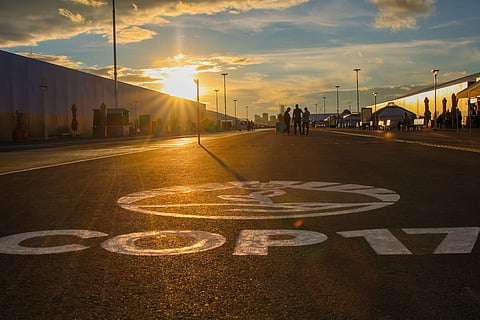


At COP17 in Ulaanbaatar, governments again failed to agree on a global drought framework, despite worsening droughts and a $278 billion annual resilience finance gap.
A small group of countries, led by the US, blocked both binding and voluntary instruments over sovereignty, budget and bureaucracy concerns.
Drought was, however, elevated as a permanent standalone agenda item for COP18 and beyond.
Drought is worsening, but even after the end of two weeks of intense negotiations at the 17th Conference of Parties (COP17) of the United Nations Convention to Combat Desertification (UNCCD) in Ulaanbaatar, countries could not come to an agreement on a global drought framework they had been negotiating for two years, to shift drought management from crisis response to prevention.
The decision to establish a global drought framework, was gavelled in the closing plenary that ran into the wee hours of August 29, 2026, as all options (whether a legally binding or voluntary protocol or some other mechanism) remain bracketed and unresolved, essentially where they stood at the last COP in Saudi Arabia’s Riyadh two years ago.
A global drought framework, whether a legally binding protocol or a voluntary one, was aimed at formally shifting countries from reactive to proactive drought management: helping every party develop, update and implement a national drought plan, rather than treat drought purely as a crisis to respond to once it hits.
It would have set up shared early-warning and monitoring systems capable of tracking not just rainfall but soil moisture, vulnerability and risk exposure; established channels for countries to pool scientific and socio-economic data on drought.
And it would have also created a formal mechanism for mobilising and directing finance toward drought resilience, at a moment when the UNCCD estimates a $278 billion annual gap between what’s needed for land restoration and drought resilience and what’s actually being invested.
Negotiators landed on a decision for all parties to continue discussions on the framework at COP18, which will be hosted in Egypt’s Sharm El-Sheikh, building on the progress made both at COP16 and at this session in Ulaanbaatar, with the stated aim of eventually adopting a decision on the proactive management of drought at all levels.
“The outcome was a disappointment,” Aristide Taleng Faha, a delegate from Cameroon, told Down To Earth (DTE).
He noted that the same pattern played out at COP16 in Riyadh and now again in Ulaanbaatar, with no clear sign COP18 in Egypt will end differently.
“Incredibly, governments have failed to agree on an approach to tackling drought despite the ever-growing list of drought disasters around the world. Just this year, Europe has suffered a historic drought, while a strengthening El Nino could fuel devastating droughts from southern Africa to Amazonia. We believed that the world’s worsening droughts would force the world’s governments to act. We were wrong,” said Richard Lee, Head of Communications, Wetlands International, here at COP17.
The one concrete, structural decision that happened though was to make drought a standalone agenda item at COP18 and at every ordinary session after that, guaranteeing it a permanent place on the agenda rather than an ad-hoc treatment.
Droughts are increasing rapidly in frequency, duration, and global severity, with one in four people affected by drought in 2022-23. Yet at the heart of the deadlock was the objection by a small group of Parties, most vocally by the United States (US), not just to a legally binding protocol, but to a voluntary instrument as well.
The US had signalled this red line earlier in the talks, arguing that drought was fundamentally a domestic, bilateral or regional matter rather than one requiring a multilateral instrument.
Taleng Faha said that US’s stand is a risk to multilateralism and contrary to the convention’s founding principles, pointing to Article 3, which speaks of solidarity, collaboration and joint action.
A legally binding protocol would obligate governments to ratify it into national laws, integrating all national drought plans into a single framework for coordinated implementation at both the national and international level, including an obligation on developed countries to finance drought resilience efforts in developing countries.
A voluntary framework would have offered a lighter version of the same coordination, without binding obligations. But the US objected even to a voluntary instrument.
According to another negotiator, who did not wish to be named, the reasoning went beyond sovereignty concerns to money and bureaucracy.
“The US did not want to create any new governance structure around drought, voluntary or not, out of concern that doing so would expand the UNCCD secretariat’s mandate and, eventually, its budget, at a time when US has separately pushed for the secretariat’s budget to shrink rather than grow,” the negotiator said.
The broader objection was to any new bureaucracy requiring new bodies, new staff and new money, regardless of how it was framed.
Notably, this marked a reversal from the US position two years earlier at COP16, when it had also been open to some form of voluntary mechanism, before hardening its stance at COP17 to reject any instrument at all.
“Drought efforts are currently fragmented across multiple initiatives, and that consolidating them, with unified reporting, governance, indicators and resources, was the point of seeking one instrument rather than separate efforts,” said the negotiator.
Meanwhile, the one concrete outcome negotiators could agree on was making drought a standalone agenda item. Until now, drought had been bundled together with other thematic issues, including migration linked to desertification and sand and dust storms — discussed under a single basket.
Going forward, it will be taken up as its own dedicated item, with its own space on the agenda and its own time for discussion, rather than competing for attention within a broader cluster of topics.
“It is upgraded, giving it a high profile on the agenda, giving it more importance and more time for discussion,” one of the negotiators explained to DTE. “When we say drought, sand and dust storms, migration, we were keeping them on an equal footing, but now we are elevating drought, which is very good for the visibility of the issue and elevating its profile.”
In the closing plenary, several parties — including the European Union, Paraguay, the African Group and Cameroon — placed their concerns on record about the state of multilateralism at the convention and the failure to secure a drought decision.
Parties cautioned that any concessions made to save the conference and reach a package outcome were strictly limited to this session, and cannot be treated as a precedent or reference point for future COPs.
UNCCD Executive Secretary Yasmine Fouad, who has called this gathering “the COP of implementation,” argues that the missing decision on drought does not, by itself, hold back the money.
Talking at an exclusive interaction with a group of six journalists, including from DTE, on the final day of COP17, Fouad said, “We moved on drought because we knew that even if a decision on a protocol or not will not be gathered in this, I wanted to make sure that this will not hinder me to get the money to ensure that the countries that had developed their drought management plan would have the money.”
She pointed to two existing financing channels:
· Riyadh Global Drought Resilience Partnership, launched in COP16, and has attracted more than $12 billion in pledges
· Drought Resilience Investment Facility, which is designed to draw private capital into de-risking drought-related investment, that can keep flowing to countries with drought management plans, and aims to mobilise up to $400 million in public and private capital overall
She also confirmed that the drought discussion will pick up again at COP18, and framed the deferral itself as consistent with how the convention works: “We may not have the whole package, but definitely we’ll have progress until COP 18.”
Fouad was also candid about which side of the divide was responsible. Asked whether the postponement of contested items — including migration due to desertification and land degradation — might weaken the two climate and biodiversity COPs taking place later this year, she said no, because the party responsible for blocking progress is not a member of the biodiversity convention and has stepped back from the climate process, referring to the United States.