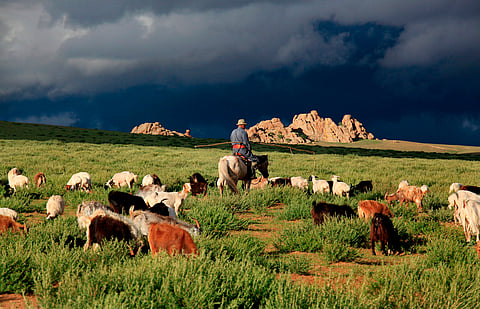


Rangelands, long sidelined in global policy, took centre stage at UNCCD COP17 in Ulaanbaatar, where delegates launched a US$1.2 billion Rangelands Flagship Initiative and broader US$1.3 billion land restoration finance package.
Backed by new economic analysis valuing rangeland ecosystem services at up to US$47 trillion annually, the conference signalled a decisive shift from promises to implementation.
Rangelands — the vast grasslands, savannas, shrublands and pastures where livestock and wildlife thrive — cover more than half of our earth surface, and for the first time ever, a United Nations Convention to Combat Desertification (UNCCD) conference put them at the very centre of the global land agenda.
When the 17th session of the Conference of the Parties (COP17) to the UNCCD closed in Ulaanbaatar on August 28, 2026, it left behind something that had never existed before in the Convention’s history: a dedicated, fully financed global push for the world’s rangelands.
The world’s rangelands cover 54 per cent of the Earth’s land surface, support around two billion people and are stewarded by some 500 million pastoralists, who move livestock across them in search of water and forage.
Yet despite their scale, rangelands have rarely been treated as a priority in international policy. They appear in the national climate plans of only 24 countries, compared with 181 for forests, and they have never before had a coordinated global investment initiative of their own.
That changed at COP17.
Hosted by Mongolia during the United Nations International Year of Rangelands and Pastoralists (IYRP), the conference launched the Rangelands Flagship Initiative, bringing together US$1.2 billion across 45 projects — the largest single mobilisation of finance for rangelands in the Convention’s history.
It was one part of a broader wave of announcements: governments, development banks, funds and companies also unveiled a US$1.3 billion portfolio of finance for land restoration and drought resilience spanning 23 countries on five continents, including US$644.5 million in new finance, of which US$216.4 million is already confirmed and moving into implementation.
New economic analysis presented in Ulaanbaatar estimated that rangelands generate somewhere between US$21-US$47 trillion in ecosystem services every year — up to nearly half of global GDP — through food production, water regulation, carbon storage and biodiversity.
Every dollar spent restoring degraded rangeland typically returns US$4 to US$6, and as much as US$36 when broader public benefits like water supply are factored in. Despite that case, rangelands remain chronically under-invested, and private finance still accounts for only around six per cent of global spending on land restoration.
“We came to Ulaanbaatar saying that COP17 must be a COP of implementation. We leave with more of the architecture needed to make that possible — political decisions, stronger science, innovative financing mechanisms, investment pipelines and partnerships that can move solutions to scale,” said UNCCD Executive Secretary Yasmine Fouad.
“But Ulaanbaatar will not be judged by what was announced inside this conference. Its legacy will be measured by what happens next: whether countries are better prepared for drought, whether degraded land and rangelands are restored, whether finance reaches viable projects, and whether the people who manage the land see a real difference in their lives,” she added.
Parties at the conference formally recognised pastoralists as essential stewards of rangeland ecosystems, pointing to the importance of transboundary mobility and the value of pastoralist knowledge — an acknowledgement that advocates have sought for years.
The Global Environment Facility is now backing coordination of the new initiative through a US$3.3 million investment in the UNCCD COP17 Legacy Project, on top of more than 50 rangeland and pastoralist-focused projects worth over US$300 million it has approved over the past four years.
For Mongolia, the conference was as much a statement of national identity as a diplomatic achievement. As the host of a COP dedicated to desertification, taking place during the IYRP, Mongolia used the presidency to press an idea rooted in its own landscape and history: that pastures are not marginal land, but a strategic ecosystem tying together food security, environmental health, the economy, biodiversity and the livelihoods of herders.
“In exercising the Presidency of the 17th Session of the Conference of the Parties to the United Nations Convention to Combat Desertification, Mongolia was guided by the principle of ‘from promises to implementation and from discussions to real work’,” said Battsetseg Batmunkh, Minister for Foreign Affairs of Mongolia and UNCCD COP17 President.
That principle produced Mongolia’s central policy legacy from the conference: the Steppe Plan, which secured backing from Parties, international organisations, the private sector and civil society.
Under it, the Mongolian government officially launched three international initiatives — the Rangelands Flagship Initiative, the Water-Land Nexus Initiative, and the Nature-based Solutions for Sustainable Infrastructure Initiative.
Calling the Steppe Plan a key policy legacy of COP17, Sandag-Ochir Tsend, Minister of Environment and Climate Change of Mongolia and Chair of the National Committee for the Organization of UNCCD COP17, said, “One of the conference’s most significant outcomes for Mongolia was securing support from Parties, international organisations, the private sector, and civil society for the Steppe Plan.”
Alongside the rangelands push, COP17 was also the stage for unveiling of Phase II of the International Drought Resilience Observatory (IDRO), developed through the UNCCD, together with International Drought Resilience Alliance (IDRA) and the Yale Center for Ecosystems in Architecture (Yale CEA).
IDRO is the first global observatory dedicated specifically to drought resilience, rather than drought monitoring alone. Its first version was unveiled as a pilot at COP16 and Ulaanbaatar launch marks its evolution into a full online platform.
At the centre of this platform is the world’s first Drought Resilience Index (DRI), a tool that lets countries and decision makers assess where vulnerabilities lie, prepare for and adapt to drought, and helping them move beyond tracking drought hazards toward acting before drought turns into disaster.
“As a Mediterranean country, Spain knows first-hand the economic, social and environmental costs of drought. Our experience has shown us that resilience cannot be built through isolated efforts. That is why Spain has invested in the development of IDRO and the Drought Resilience Index as part of the drive to proactively manage drought risk,” said María Jesús Rodríguez de Sancho, Spain’s Director General for Biodiversity, Forests and Desertification, whose country co-chairs IDRA alongside Senegal.