

Record London heat underscored need for urgent climate diplomacy, justice, adaptation and energy transition.
Leaders advanced electrification, methane cuts and fossil-fuel phase-out agenda ahead of COP31.
Unresolved finance, adaptation and just-transition disputes intensified pressure on Antalya climate talks.
As world leaders gathered at London Climate Action Week 2026, the city suffered under record heat, acting as a crucial backdrop to the most urgent diplomatic conversations of the year.
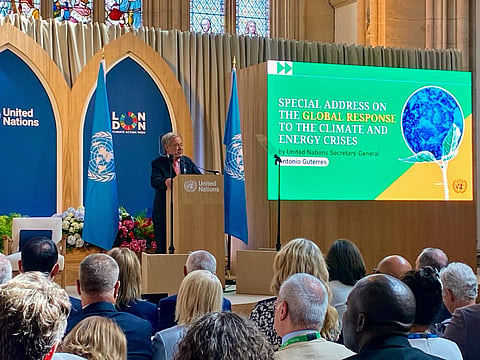
"London isn't just calling — it's cooking," UN Secretary-General António Guterres told a packed hall at LCAW on June 23, 2026, days after the UK recorded its first-ever 40°C reading. Guterres went further, setting out what he described as the only credible response to the overlapping crises: "A fast, fair transition to clean energy — and a surge in adaptation, resilience and climate justice for those already facing climate harm," he said in a special address delivered at the event.
In its eighth year, LCAW, Europe’s largest city-wide climate event, was held from June 20-28, 2026. Designed around the theme, “Cooperation in a fragmented world”, the event drew more than 75,000 global professionals, policymakers, business leaders, investors and climate advocates to over 1,000 events across the nine days.
LCAW did not arrive in a vacuum. It was preceded by a string of climate gatherings that began with COP30 in Belém, Brazil, which reopened the global debate on transitioning away from fossil fuels (TAFF) and pushed countries to submit sharper national climate plans.
That conversation moved outside the formal UN process in April, when Colombia and the Netherlands co-hosted the First Conference on Transitioning Away from Fossil Fuels in Santa Marta, gathering 57 countries and over 1,000 stakeholders to map practical fossil-fuel phase-out roadmaps.
In June, the G7 Summit in Evian, hosted by President Emmanuel Macron, sent a more muted signal: Communiqués avoided terms like “sustainability” entirely, with leaders’ attention dominated by Ukraine, Iran’s nuclear programme, and critical minerals. The UN climate talks in Bonn, which concluded on 18 June, barely 48 hours before LCAW opened, set the most immediate context.
In the 64th Subsidiary Bodies sessions, progress — albeit meagre — was made in advancing the 'Belém-Antalya Mechanism' for just transitions, a centralised framework intended to support workers and communities navigating the economic disruption of the shift away from fossil fuels.
The COP31 Presidency also introduced an ambitious new global electrification target. But climate finance remained a critical issue, with developing nations pressing for significantly greater adaptation support, and the Global Goal on Adaptation stalled in technical deadlock. Bonn ended with momentum in some areas and frustration in others, precisely the kind of unresolved tension that London was positioned to take into account.
At LCAW, Colombia’s Minister of Environment Irene Vélez Torres and the Netherlands’ Minister for Climate Policy Stientje van Veldhoven delivered the Santa Marta conference’s final outcome report to the COP30 Presidency, intended to feed directly into the COP30 roadmap on coal, oil and gas. This report recognised the need for an international mechanism to manage an equitable and just global phase-out.
Civil society responses were pointed. Oil Change International welcomed the report as a signal of political courage from governments willing to stand against fossil fuel interests but stressed that a just transition could not be achieved without tackling the international financial architecture, including debt cancellation and technology transfer, which keeps developing nations structurally dependent on fossil fuel revenues.
The week’s headline was the ‘Electrify Now’ initiative, a first-mover coalition spanning the European Commission, Brazil, Türkiye, Australia, Ethiopia, Canada, the United Kingdom, the Philippines, South Korea and the International Energy Agency. It is designed to advance the COP31 Presidency’s new target of lifting electricity’s share of final energy demand from roughly 20 per cent to 35 per cent by 2035.
Alongside it, the European Union, the United Kingdom and Canada jointly reaffirmed their commitment to cut methane emissions from the energy sector, building on the Global Methane Pledge. At a St James’s Palace convening hosted by Ed Miliband, Guterres called methane the “super super-pollutant”, and pressed for faster leak detection and an end to routine flaring, while COP31 President-Designate Kurum confirmed that Antalya would be an “implementation COP”, with methane reduction and the circular economy central to its agenda.
Beyond the headline negotiations, LCAW's 1,000-plus events ranged widely in theme, offering a broader picture of where climate thinking is heading. Water governance emerged as a recurring thread, with discussions shifting from recognising water's importance to the harder questions of financing, infrastructure, and governance needed to deliver resilience in practice, including a growing recognition of nature as infrastructure.
The intersection of nature and finance also featured prominently, with sessions exploring how biodiversity commitments can be integrated into climate finance flows. On the business side, conversations moved beyond broad net-zero pledges toward practical questions: Infrastructure development, permitting timelines, supply chain resilience, and the community partnerships that determine whether projects actually get built.
Organisers were also keen to counter a narrative of climate fatigue. LCAW opened under the banner “Don’t tell me climate action isn’t happening”, pointing to clean-technology investment that has grown sixfold since the Paris Agreement, reaching $2.4 trillion in 2025. Yet, that note of momentum sat awkwardly beside the week’s backdrop: Record-breaking heat across the UK, which organisers called “a live demonstration of the climate crisis playing out in real time”, and a wider mood of political pushback against climate policy in several European capitals.
LCAW’s closing message was less a victory lap than a handover note. With Bonn’s disputes unresolved and the G7 largely silent on climate, pressure on COP31, to be held in Antalya, Türkiye, has only grown. Guterres linked the moment’s overlapping shocks explicitly: Energy turmoil from the West Asian conflict that the International Energy Agency says rivals the 1970s oil crises, mounting debt pressure on developing economies, and a financial system that, he said, “is failing the countries that need support most”.
His warning that El Niño “risks blowing the house down” was aimed squarely at the negotiators who reconvene in Türkiye later this year, where the Belém-Antalya Mechanism, the electrification target, and stalled adaptation metrics — among other key tracks — are all expected back on the table.
For now, London has done what these intermediary weeks are designed to do: Keep pressure on the process and translate UN-level ambition into coalitions and announcements. The next stop is Climate Week NYC, hosted by the Climate Group from September 20-27, 2026, another waypoint in a year of accelerating diplomacy before governments reconvene at COP31 in Antalya in November. What London leaves behind is a reminder, delivered amid an unprecedented heatwave, of exactly what is at stake before that moment arrives.