

After years of flagging the issue as a customary reminder at global climate summits, India has forcefully brought the historical responsibility for greenhouse-gas emissions back to the negotiating table at the 31st UN climate change conference (COP31), taking place in Antalya, Türkiye, from November 9 to 20, 2026.
The intervention came on November 18, as the climate conference became increasingly consumed by a familiar dispute: the failure of developed countries to provide adequate financial support to developing nations.
In its national statement, delivered by environment, forest and climate change minister and head of the Indian delegation, Bhupender Yadav, India set out several specific demands. It urged the COP presidency to ensure that negotiations were guided by equity, climate justice and the principle of Common but Differentiated Responsibilities and Respective Capabilities (CBDR-RC), enshrined in the United Nations Framework Convention on Climate Change (UNFCCC).

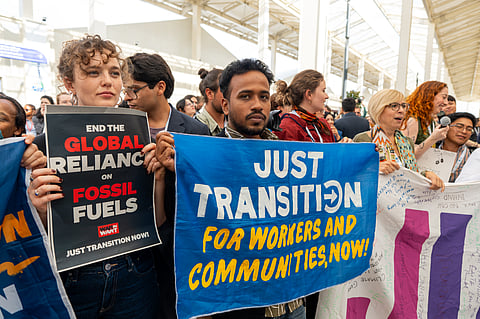
The 412-word statement outlined several demands. These included protecting the legitimate development rights of developing countries; treating the remaining global carbon budget as non-negotiable; ensuring that the Global Stocktake (GST) remained an instrument for informing parties, rather than imposing obligations on them; anchoring the Just Transition Mechanism firmly in equity; and preventing unilateral trade measures from penalising developing countries under the guise of climate action.
The last demand is a direct response to the EU's Carbon Border Adjustment Mechanism (CBAM), which seeks to impose a carbon cost on certain imported goods based on their emissions.
The statement also called on developed countries to meet their financial obligations. "The developed world must honestly and expeditiously discharge their climate-finance obligations," it said.
India has referred to historical responsibility in submissions at previous climate summits, but rarely with the emphasis evident in its latest statement.
The concept rests on a straightforward argument: countries that industrialised earliest, largely through the extensive burning of fossil fuels over the past two centuries, bear a greater responsibility for addressing climate change and supporting developing countries through finance and other means.
The principle has long been central to climate negotiations. However, the Paris Agreement marked a significant departure from the Kyoto Protocol, under which binding emission-reduction targets applied primarily to developed countries. Under the Paris framework, all countries, including India, undertook to reduce emissions through their respective climate commitments, taking into account their different national circumstances and capabilities.
India's latest statement sought to bring the question of historical responsibility back into sharper focus. "Science is based on 'cause and effect'. Our planet is warmer today. The cause is the industrialisation and economic growth of some, fuelled over two centuries by unabated greenhouse gas emissions," the statement said.
It went on to argue that expecting the Global South to bear the consequences of these historical emissions in the name of greater climate ambition would be unjustified. The Global South is a broad geopolitical and economic grouping that generally encompasses developing, industrialising and lower-income countries.
Yadav also argued that developing countries should not be forced to choose between climate action and their legitimate right to development, including access to decent living standards, healthcare and education. "Equitable access to the remaining, depleted, carbon budget is non-negotiable," the minister said.
Documents available with this correspondent show that India had raised historical responsibility at COP29 while representing the Like-Minded Developing Countries (LMDC) group. It had also referred to the issue at COP30, in an opening plenary statement delivered jointly on behalf of the BASIC (Brazil, South Africa, India and China) and LMDC groups, as well as at COP27. But the language and emphasis in the latest statement are notably sharper.
In his statement, Yadav also highlighted India's climate commitments under the leadership of Prime Minister Narendra Modi. He said the country had announced its next Nationally Determined Contribution (NDC), its action plan for reducing emissions, aligning it with the goal of achieving a sustainable "Viksit Bharat" (developed India) by 2047.
A senior Indian negotiator, speaking on condition of anonymity, subsequently said that although India had outlined its priorities, it was approaching the negotiations with an open mind.
"We were, and are, part of the solution, though our per capita emissions are extremely low," the negotiator said. The expert also pointed out that India accounts for about 17 per cent of the world's population but only 4-5 per cent of global cumulative emissions.
When asked about India's red lines, the negotiator replied: "I am not spilling the strategy with you. We are contributing in the negotiation in a positive manner."
India had earlier declined to join the electrification pledge strongly promoted by the COP31 presidency.
Experts regard climate finance as one of the most consequential issues before the summit, with the next two days expected to be critical in determining whether COP31 can deliver a meaningful outcome.
On the issue of climate finance, however, the Indian negotiator appeared considerably less sanguine.
Experts regard climate finance as one of the most consequential issues before the summit, with the next two days expected to be critical in determining whether COP31 can deliver a meaningful outcome.
A second Indian negotiator alleged that developed countries were resisting commitments on climate finance, particularly on the contentious question of adaptation funding, despite the issue having been included in the agenda.
"Developed countries are currently refusing to make any commitment on finance during negotiation, especially about the most contentious part of the adaptation finance despite earlier agreement on the agenda. They are raising all sort of questions from the benchmark of time and money volume basically to push back the discussion," the Indian negotiator claimed.
An African lead negotiator also accused developed countries of retreating from earlier commitments.
"The messages we have heard from developed countries is doubling from 2019 levels, but we read that decision from COP30 ... (as) tripling to what was promised in Glasgow," said Xolisa Ngwadla, special adviser to the chair of the Africa Group of Negotiators on Climate Change.
The reference is to the commitment to scale up adaptation finance for developing countries. The COP30 agreement in Belém called for a substantial increase in such funding, with the stated ambition of reaching at least US $120 billion annually by 2035.
The gap between the resources developing countries need to adapt to climate change and the finance actually made available remains substantial. This shortfall affects countries such as India as well as the world's least-developed nations, which are often particularly vulnerable to climate impacts.
India's closing message in its national statement sought to bring the discussion back to implementation. "Success at Antalya must be measured by implementation, resources reaching those who need them, and proven solutions being scaled up," it said.