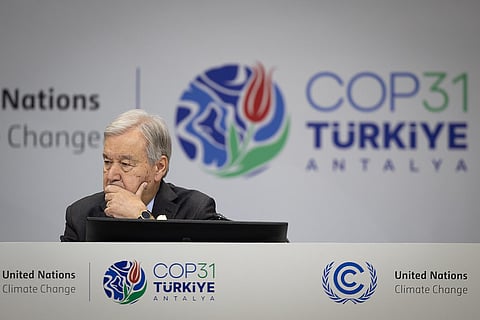


Developing countries at COP31 are pushing for a two-tier Just Transition Mechanism that provides finance, technology transfer and capacity-building support.
Finance remains a major sticking point, with developed countries favouring existing arrangements while developing nations demand additional, predictable and grant-based funding.
India and other developing countries have called for extending the Just Transition Work Programme beyond 2026, with disagreements persisting over food security, industrial transition and trade measures.
As negotiations enter their second week, countries must resolve differences over the mechanism's mandate, financing role and implementation.
Negotiations on the Just Transition Work Programme (JTWP) have begun at the 31st Conference of the Parties (COP31) to the United Nations Framework Convention on Climate Change in Antalya, Türkiye, building on a process that has evolved over the past year following the adoption of the Just Transition Mechanism (JTM) at COP30 in Belém, Brazil.
Deliberations have since continued under the JTWP, with questions raised during earlier consultations, particularly around institutional arrangements and the support required by developing countries, now moving to the negotiating table in Antalya.
Discussions centred on three broad ‘buckets’: Operationalising the JTM; reviewing the JTWP and deciding its future; and the outcomes of the fifth and sixth JTWP dialogues, which focused on food security, agriculture and oceans, and industrial transition and global value chains, respectively.
Operationalising the JTM emerged as the principal priority for most developing countries. The African Group of Negotiators (AGN), G77 and China, Least Developed Countries and Like-Minded Developing Countries (LMDCs) called for a party-driven, two-tier mechanism under the authority of the Conference of the Parties serving as the meeting of the Parties to the Paris Agreement, or the CMA.
The proposed mechanism would comprise a political oversight tier and a technical or implementation tier. Developing countries argued that its role must extend beyond coordination to providing practical support, including technical assistance, capacity-building, technology transfer and access to finance.
A central point of contention was the mechanism's financing role. The European Union (EU), Environmental Integrity Group (EIG) and Japan favoured leveraging existing financial arrangements to avoid duplication.
They argued that its role must extend beyond coordination, to providing practical support, including technical assistance, capacity-building, technology transfer and access to finance.
A central point of contention was the mechanism's financing role. The EU, Environmental Integrity Group (EIG) and Japan favoured leveraging existing financial arrangements to avoid duplication. Several developing countries however, argued that coordination of existing institutions would be insufficient without additional, predictable and grant-based finance. South Africa proposed a dedicated facility to improve the availability and quality of just transition finance.
There was broad support among developing countries for continuing the JTWP beyond 2026. India, the AGN and G77 and China supported a three-year extension, with a review at CMA11, while the Independent Association of Latin America and the Caribbean (AILAC) proposed a shorter extension to bridge the period until the JTM becomes operational.
The EU and UK emphasised the need to clarify the respective roles of the JTWP and JTM to avoid duplication. Developing countries, meanwhile, argue that the JTWP should retain its distinct role as a space for policy dialogue and experience-sharing, rather than have its mandate narrowed or become an additional source of reporting obligations.
Parties also debated how future dialogue topics should be selected. G77 and China called for a transparent, party-driven process reflecting the JTWP’s full mandate, including aspects such as international cooperation, means of implementation, capacity-building, adaptation and poverty eradication. The Alliance of Small Island States (AOSIS) and Norway proposed appointing developed- and developing-country co-chairs to guide future dialogues.
On the fifth dialogue, a notable disagreement emerged over terminology. India and the LMDCs, supported by G77 and China, opposed the term “food systems”, preferring “food production and food security”. The EU, however, insisted on retaining the former. AGN described food security as non-negotiable, calling for support for smallholder farmers, fishers and coastal communities, alongside sustainable blue economies.
On the sixth dialogue, developing countries called for greater local manufacturing, technology transfer and financial support. They highlighted the need for predictable, accessible, grant-based finance, invoking developed countries’ obligations under Article 9.1 of the Paris Agreement. Developed countries focused more on decarbonisation efforts in industry. India aligned with Global South positions, linking industrial transition to national development priorities, highlighting trade, finance and technology as enablers of manufacturing capacity and job creation.
A major sticking point was on the subject of unilateral trade measures. AGN, the Arab Group and LMDCs argued that these measures constrain industrialisation and market access. The EU and UK however, maintained that trade issues should instead be discussed in a different forum, through the Trade and Climate Dialogues.
At the end of Week 1, key priorities have emerged for the Global South, particularly around operationalising the JTM, including clarifying its mandate and modalities, and extending the JTWP beyond 2026.
The Co-Chairs of the JTWP have now prepared an informal note on the deliberations that have taken place thus far. This will be accompanied by a draft text for parties to deliberate on in the decisive second week.