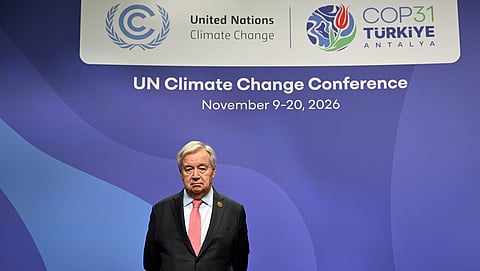


At COP31, UN Secretary-General António Guterres has urged countries to phase out unabated use of coal by 2040, cut oil and gas use by a third and reduce global greenhouse gas emissions by 6 per cent annually.
Guterres said current national climate plans deliver only about a third of the reductions required to keep the 1.5°C temperature goal within reach.
Climate finance remains inadequate, with developing countries needing an estimated $305 billion annually by 2035 for adaptation, according to UNEP.
World leaders called for faster climate action, a just transition away from fossil fuels, greater financial support for vulnerable countries and a stronger focus on implementing existing commitments.
United Nations Secretary-General António Guterres on November 11 called for unabated coal use to be phased out by 2040 and oil and gas consumption to be cut by a third. Governments, he said, must set credible roadmaps for a just transition away from fossil fuels. Global greenhouse gas emissions must fall by 6 per cent annually, he warned, highlighting that current national climate plans deliver only about a third of the reductions required to keep the 1.5°C temperature goal within reach.
Addressing the opening of the Antalya Leaders’ Summit at the 31st Conference of the Parties (COP31) to the United Nations Framework Convention on Climate Change (UNFCCC), Guterres said countries must accelerate emissions cuts, protect communities from climate impacts and ensure adequate finance for developing nations.
Guterres called for an end to new coal, oil and gas infrastructure, warning that further investment would jeopardise the 1.5°C goal. He accused fossil-fuel interests of delaying climate action by distorting scientific evidence and avoiding accountability. Governments must plan for a just transition, he said, or risk its consequences in the form of economic disruption and lost livelihoods.
He also called for universal coverage of early-warning systems and swift, accessible support for loss and damage when adaptation reaches its limits. Fossil-fuel companies that have profited from the industry must contribute to the costs of climate damage, he said.
On climate finance, Guterres urged developed countries to deliver the existing $300 billion a year for developing countries by 2035 and set out concrete plans and milestones to triple adaptation finance. The $300 billion target was agreed at COP29 in 2024, while the call to triple adaptation finance by 2035 formed part of the COP30 outcome in 2025.
His demands come amid a widening gap between the cost of adapting to climate change and the funding available. The United Nations Environment Programme's (UNEP) 2026 Adaptation Gap Report, released on November 4, estimated that developing countries would need about $305 billion a year by 2035 for adaptation. Even if the COP30 target of tripling international public adaptation finance is met, it would cover only 20-29 per cent of these requirements.
Australian Prime Minister Anthony Albanese highlighted the vulnerability of Pacific island countries, recalling a meeting with Melaleusi Socatea, a 13-year-old student from Tuvalu, during a pre-COP visit. The student aspired to become a doctor but feared for the future of her homeland. Albanese said Pacific communities were not asking for pity but for partnership and action.
He said projections of global warming had fallen from about 4°C before the Paris Agreement to 2.6°C under current estimates, although the world remained off track to limit warming to 1.5°C. Australia had doubled its renewable energy capacity in six years and installed more than 600,000 home batteries in the previous year, he added. COP31 must ensure that no country or community was held back or left behind.
Ethiopian Prime Minister Abiy Ahmed Ali called for climate finance to be made available in advance so that governments could respond swiftly to extreme weather. Ethiopia had planted more than 56 billion seedlings to restore degraded land, creating livelihoods and encouraging community participation, he said.
He also drew attention to the constraints imposed by debt, saying developing countries pay nearly $1 trillion in public debt. High borrowing costs limit their ability to invest in climate action. Reforming the lending practices of multilateral development banks is therefore essential, he said.
Brazilian President Luiz Inácio Lula da Silva urged countries to build on the momentum generated at COP30 in Belém. Climate change, he warned, has receded from international political discussions as geopolitical tensions, military spending and trade disputes take precedence. He called for progress on three roadmaps: mobilising US $1.3 trillion in climate finance, transitioning away from fossil fuels and ending deforestation. Lula also highlighted a 71 per cent reduction in deforestation in the Brazilian Amazon between 2022 and 2026.
Turkish President Recep Tayyip Erdoğan said COP31 should focus on implementation, moving countries beyond commitments towards tangible results. Renewable energy accounted for 60 per cent of Turkey's installed power capacity, he said, highlighting the country's 2050 net-zero target and its new climate law.
Erdoğan also announced a Climate Implementation BRIDGE initiative to connect local climate needs with concrete investments. He called for more accessible and predictable finance, technology and capacity-building support for least developed countries and small island developing states.