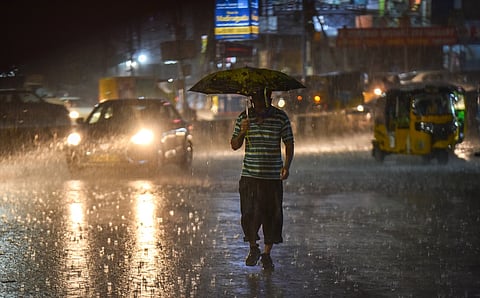


IMD issues heavy rainfall alert for several states as the monsoon intensifies, triggering flood and landslide concerns across northern India.
Delhi-NCR receives welcome showers, while Himachal Pradesh, Uttarakhand and Jammu & Kashmir battle severe rain, landslides and travel disruptions.
Red alert issued for Himachal Pradesh and Jammu & Kashmir as authorities suspend pilgrimages and intensify rescue operations amid relentless rainfall.
Heavy to very heavy rainfall expected over the next 48 hours, prompting authorities to urge residents and travellers to remain vigilant.
Rising river levels, blocked roads and widespread waterlogging disrupt normal life as active monsoon conditions persist across multiple Indian states.
The southwest monsoon has regained momentum across the country, prompting the India Meteorological Department (IMD) to issue heavy to very heavy rainfall warnings for several states over the next 48 hours. While widespread showers have brought much-needed relief from heat and humidity in the national capital and adjoining areas, relentless rainfall has disrupted normal life in the Himalayan states, raising the threat of landslides, flash floods and road closures.
Authorities have urged residents and travellers to remain vigilant as adverse weather conditions are expected to persist in many parts of northern, eastern and western India.
Delhi and the National Capital Region witnessed widespread rainfall on Tuesday morning, bringing a welcome break from the prolonged spell of humid weather. Cloudy skies and intermittent showers lowered temperatures, making outdoor conditions significantly more comfortable.
According to the IMD, light to moderate rain accompanied by thunderstorms and gusty winds reaching 40 to 50 kmph is likely to continue over the next two days. The maximum temperature is expected to remain between 30°C and 32°C, while the minimum temperature is likely to hover between 23°C and 25°C. Weather officials have advised commuters to remain cautious during periods of heavy rain due to the possibility of waterlogging and reduced visibility.
The situation remains critical in Uttarakhand, where continuous rainfall has triggered landslides and blocked major roads in several districts. Reports indicate that 98 roads have been closed, disrupting connectivity to numerous remote areas. Waterlogging has also affected several towns and villages, complicating relief and transportation efforts.
As a precautionary measure, authorities have temporarily suspended the Char Dham Yatra, citing the increased risk of landslides along pilgrimage routes. Officials stated that the pilgrimage would resume only after weather conditions improve and the routes are declared safe.
Neighbouring Himachal Pradesh is also experiencing severe weather. The IMD has issued a red alert for Chamba, Kangra, Mandi, Kullu and Sirmaur districts, warning of extremely heavy rainfall. Orange alerts remain in force for Una, Hamirpur and Shimla, while other districts continue under yellow alert. Local administrations have advised residents to avoid rivers, streams and unnecessary travel in vulnerable hill areas.
Jammu and Kashmir continues to battle the impact of incessant rainfall, with floods and landslides affecting several districts. According to official reports, 24 people have lost their lives over the past two days, while six others remain missing. Rescue and relief operations are underway in the affected regions despite challenging weather conditions.
The continuing rainfall has also disrupted religious pilgrimages. The Amarnath Yatra, the Mata Vaishno Devi pilgrimage, and pilgrimages to Shiv Khori in Reasi and Sarthal in Kishtwar have remained suspended for the second consecutive day. Authorities have appealed to devotees to postpone their travel until conditions become safer.
The IMD has forecast extremely heavy rainfall in parts of Himachal Pradesh and Jammu and Kashmir, where rainfall may exceed 204.5 mm in isolated locations. Heavy to very heavy rainfall ranging between 115.6 mm and 204.4 mm is expected in Assam and Meghalaya, Bihar, eastern Madhya Pradesh, Haryana, Chandigarh, Delhi, Punjab, Uttar Pradesh, Uttarakhand, Konkan and Goa, Madhya Maharashtra, Nagaland, Manipur, Mizoram and Tripura.
Meanwhile, Arunachal Pradesh, Chhattisgarh, Gujarat, Jharkhand, Odisha, Rajasthan, West Bengal, Sikkim and western Madhya Pradesh are also likely to receive heavy rainfall. Thunderstorms accompanied by strong winds are expected in parts of Andhra Pradesh, Telangana, Tamil Nadu, Karnataka, Bihar, Jharkhand and Madhya Pradesh.
Persistent rainfall has brought temperatures below normal across several regions. Despite the widespread cooling, Sri Ganganagar in Rajasthan recorded the country's highest maximum temperature of 42.9°C on July 20, while Boudh in Odisha registered the lowest minimum temperature among the plains at 18.8°C.
Several cities have received substantial rainfall over the past 24 hours. Kolkata's Dum Dum recorded 160 mm of rain, Malda received 130 mm, Prayagraj recorded 100 mm, while Katra in Jammu and Kashmir and Pendra Road in Chhattisgarh each received 80 mm. Nahan in Himachal Pradesh, Forbesganj in Bihar and Daman also reported significant rainfall.
The continuing downpour has led to rising river levels and waterlogging in several low-lying areas, with local administrations maintaining close surveillance of the evolving situation.
With the monsoon expected to remain active over the coming days, authorities have appealed to the public to exercise caution. People have been advised to avoid unnecessary travel during heavy rainfall, stay away from landslide-prone areas, and refrain from crossing flooded roads or swollen streams. Farmers have also been advised to ensure proper drainage in agricultural fields, avoid pesticide spraying during rainfall and protect harvested crops and livestock.
As weather conditions remain unpredictable across large parts of the country, officials have urged citizens to closely follow forecasts and advisories issued by the IMD and local administrations. Vigilance and timely precautions, they say, will be crucial in minimising the impact of the ongoing spell of severe monsoon weather.
