

· Western disturbance and monsoon activity bring thunderstorms, rain, and strong winds across North India, with IMD issuing multiple alerts.
· Sub-Himalayan West Bengal and Sikkim placed under orange alert for very heavy rainfall causing possible flooding and landslides.
· Eastern Uttar Pradesh and Jharkhand face severe heatwave conditions despite monsoon progress, with rising temperatures and health risks warned.
· Monsoon is advancing into Gujarat, Madhya Pradesh, Bihar, Jharkhand, Uttar Pradesh, and Uttarakhand over next three to four days.
· Strong winds over Arabian Sea and Bay of Bengal prompt advisory for fishermen to avoid venturing into rough seas.
India is witnessing a sharp contrast in weather conditions as the southwest monsoon continues its gradual advance while intense heat lingers over parts of the northern plains. The combined influence of an active western disturbance and strengthening monsoon currents has prompted the India Meteorological Department (IMD) to issue widespread alerts for thunderstorms, heavy rainfall, strong winds, and heatwave conditions across several states.
The rapidly changing weather pattern is expected to bring relief to many regions suffering from prolonged heat, even as some areas continue to experience soaring temperatures and dry conditions. Authorities have advised residents, farmers, and fishermen to remain vigilant and follow official weather advisories over the coming days.
According to the latest forecast, several parts of north India, including Haryana, Punjab, Delhi, Chandigarh, Himachal Pradesh, Jammu and Kashmir, Uttarakhand, and western Rajasthan, are likely to witness thunderstorms accompanied by light to moderate rainfall and gusty winds reaching speeds of 40 to 50 kmph. In parts of eastern Rajasthan, wind speeds may increase further, touching 60 kmph during intense weather activity.
Meteorologists have cautioned that lightning and strong winds could disrupt normal life, damage weak structures, and affect transportation in vulnerable areas.
The IMD has issued an Orange Alert for Sub-Himalayan West Bengal and Sikkim, where very heavy rainfall is expected. Rainfall between 115.6 mm and 204.4 mm could trigger localised flooding, landslides in hilly terrain, and disruptions to road connectivity.
Meanwhile, Yellow Alerts have been issued for Arunachal Pradesh, Assam, Meghalaya, Nagaland, Manipur, Mizoram, Tripura, Bihar, coastal Andhra Pradesh, coastal Karnataka, Konkan and Goa, Madhya Maharashtra, and Telangana. These regions are expected to receive heavy rainfall ranging from 64.5 mm to 115.5 mm, raising concerns over waterlogging in urban areas and rising river levels.
The southwest monsoon has continued its steady progress across the country. As of June 25, its northern limit extended through the Arabian Sea, Surat, Indore, Mandla, Daltonganj, and Motihari.
Weather experts believe atmospheric conditions will remain favourable over the next three to four days, allowing the monsoon to advance further into Gujarat, Madhya Pradesh, Jharkhand, Bihar, Uttar Pradesh, Uttarakhand, and the remaining parts of Chhattisgarh. The advancing rains are expected to accelerate kharif sowing operations while providing much-needed relief from persistent summer heat.
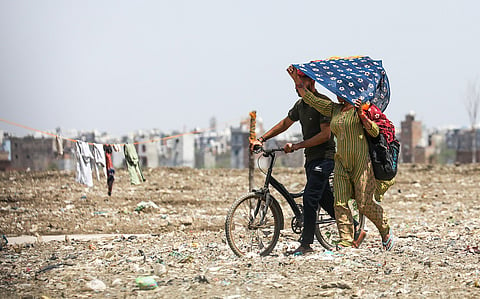
Despite increasing rainfall activity, heatwave conditions have not completely subsided. Eastern Uttar Pradesh remains under a severe heatwave warning, while parts of Jharkhand are also likely to experience intense heat over the next few days.
The IMD has advised people to avoid prolonged exposure to direct sunlight during afternoon hours, stay well hydrated, and take necessary precautions against heat-related illnesses. Temperature forecasts indicate that maximum temperatures across northwest India may rise by 2 to 3 degrees Celsius until June 28 before gradually declining by 3 to 5 degrees. Central India may also witness a temporary increase of 2 to 4 degrees before temperatures stabilise.
With weather conditions becoming increasingly unpredictable, farmers have been urged to ensure proper drainage in agricultural fields to prevent waterlogging. Harvested crops should be stored safely, while the application of fertilisers and pesticides should be postponed in areas expecting rainfall. Standing crops such as banana, maize, and sugarcane should be adequately supported to minimise damage from strong winds.
Fishermen have also been warned against venturing into the Arabian Sea and the Bay of Bengal, where wind speeds are expected to range between 40 and 65 kmph. Rough sea conditions could pose serious risks to fishing vessels and coastal communities.
Officials have appealed to the public to exercise caution during thunderstorms by avoiding open fields, tall trees, and electric poles. Residents in heavy rainfall zones should stay away from waterlogged roads and monitor official weather updates regularly.
As India enters a crucial phase of the monsoon season, the country continues to experience a striking mix of intense rainfall, powerful storms, and persistent heat. While the advancing monsoon promises relief for many regions and a positive outlook for agriculture, authorities stress that preparedness and timely precautions remain essential to minimise the impact of rapidly changing weather conditions.
