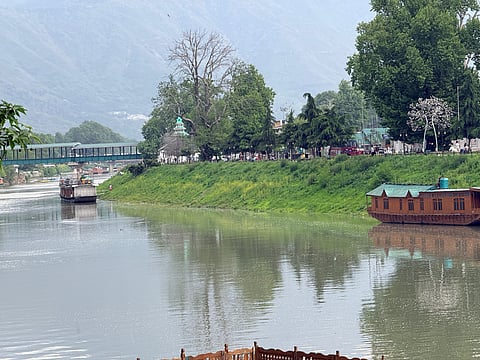


Snow cover across the Hindu Kush Himalayas fell nearly 28% below the long-term average between November 2025 and March 2026
Kashmir has recorded repeated years of below-normal precipitation, weakening springs, rivers and groundwater recharge
Experts warn that warmer winters are shifting snowfall to rain, threatening orchards, drinking water supplies and summer irrigation
Mohammad Ashraf Mir used to begin his mornings in his orchard. Now he begins them looking for water. The 35-year-old apple grower from Sopore, Kashmir’s apple town and home to Asia’s second-largest fruit market, lives in a valley once threaded with streams. Today his taps run dry for months. He buys bottled water for his family, something he never imagined in a place surrounded by rivers and snowmelt.
“The Jhelum River, Kashmir’s lifeline, was at an all-time low on many occasions,” he told Down to Earth (DTE). “Glaciers are losing their vitality due to prolonged dry spells.”
Water scarcity in Sopore has repeatedly driven residents to the streets, with protests in 2023 and 2025 against the Jal Shakti Department over the worsening crisis across several areas. People who once lived beside gushing streams are buying packaged water, an unprecedented sight in a region once defined by abundance.
Snow cover across the Hindu Kush Himalayan region fell 27.8 per cent below the long-term average between November 2025 and March 2026, the lowest in more than two decades, stated the recently released Snow Update Report 2026 by the International Centre for Integrated Mountain Development (ICIMOD).
This is the fourth consecutive year of below-normal snowpack. Of the 12 major river basins, ten are below normal. The Mekong, Tarim and Tibetan Plateau have recorded their lowest snow persistence in 24 years.
There’s a persistent trend of the seasonal snow reservoir shrinking year after year, said Sher Muhammad, lead author of the report released April 24, 2026, told DTE. “Ten out of twelve basins are below normal, and several have hit their lowest recorded persistence in two decades,” he said.
The Hindu Kush Himalayas sustain nearly two billion people. In basins such as the Helmand and Amu Darya, snowmelt accounts for more than 70 per cent of annual runoff, found the ICIMOD report. Reduced snow means less groundwater recharge and greater drought vulnerability downstream.
Only two basins recorded above-normal snow: the Ganges at +16.3 per cent and the Irrawaddy at +21.8 per cent — offering limited local relief but nowhere near enough to offset the wider trend, the report stated.
Kashmir sits within the Indus basin, where warming trends are more pronounced. The valley has recorded five consecutive years of below-normal precipitation. Weather analyst Faizan Arif tracked the pattern: a 20 per cent deficit in 2020, 28 per cent in 2021, 16 per cent in 2022, 7 per cent in 2023, and then 2024, the driest year in five decades. January alone saw a 91 per cent deficit.
From December 2025 to February 2026, Jammu and Kashmir recorded a 65 per cent precipitation deficit, the seventh consecutive deficient winter. February saw an 89 per cent shortfall, with the region receiving just 100.6 millimetres against a normal of 284.9 mm. Srinagar was down 64 per cent, Budgam 71 per cent, Shopian 82 per cent. “This is not a single bad year,” Arif said. “It is a sequence of deficit years steadily weakening the water balance.”
Across Kashmir, the impact is visible. In Anantnag, the Achabal Mughal Garden — built by Noor Jahan, wife of Emperor Jahangir — ran dry in winter 2025. It was the first time in its recorded history that the spring feeding the garden had failed.
The crisis is not only about less water. It is about water arriving differently. Hydrogeologist Rayees Ahmad Pir explains: snow accumulates and releases gradually, sustaining rivers and groundwater when most needed. Rain arrives and leaves quickly, running off before it can recharge aquifers.
“Even with normal snowfall, early melting lowers water availability during the critical period,” Pir told DTE. “Groundwater recharge is declining, springs are weakening, and rivers are showing higher winter flows but reduced lean-season discharge.” Rainfall patterns are becoming more erratic: fewer rainy days but higher intensity events that increase runoff while reducing infiltration.
Climate scientist Mutaharra A W Deva blames warming altering the Western Disturbances — the weather systems that historically delivered Kashmir’s winter snow. They now arrive warmer, , pushing precipitation into the form of rain especially at lower and mid-altitudes.
She frames the underlying shift in terms that go beyond hydrology. “Kashmir is moving from a snow-governed ecology to a temperature-driven one,” she said. “That changes everything about water security. Water in Kashmir is no longer patient. It arrives in haste and leaves in haste.”
Recent spring rain has temporarily stabilised river flows, but Deva warns against misreading this as recovery. “What appears as abundance today may well be the shadow of scarcity tomorrow.” Water analyst Ruhail Maqbool Sheikh adds that even where snow has fallen, weak layering means water is released too early. “Rivers like the Jhelum receive more water in early spring instead of summer, leading to lower availability during peak demand.”
Meanwhile, another issue is bubbling under the surface. Widespread groundwater quality issues may intensify as more households turn to groundwater when surface sources fail, according to Pir. “With increasing reliance on groundwater, future demand will rise significantly, putting these resources under considerable stress.”
The ICIMOD report warns: “Every dry spell will hit harder.” The J&K government has formed a committee to implement water metering in commercial establishments — a modest first step. ICIMOD calls for drought preparedness plans, real-time snow data in water management, and stronger transboundary cooperation.
Pir called for spring rejuvenation programmes, systematic monitoring of groundwater levels, artificial recharge structures, rainwater harvesting, and decentralised storage systems. He emphasised managing aquifer recharge as essential to improving both the quantity and quality of groundwater over the long term.