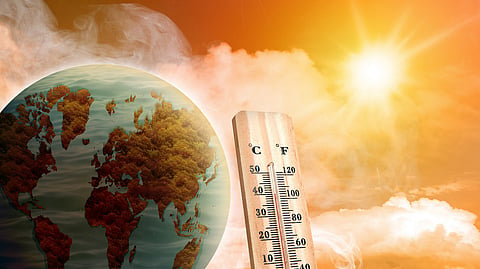


Global temperatures remained exceptionally high throughout 2025 despite the absence of warming natural cycles such as El Niño, highlighting the dominant role of fossil fuel-driven climate change in intensifying extreme weather, a new report revealed on December 30, 2025.
Heatwaves grew more severe, storms became wetter and stronger, and droughts and wildfires worsened, pushing millions of people—especially the poor and marginalised—close to the limits of adaptation.
Heatwaves have become measurably more intense since the Paris Agreement was signed in 2015, with some events now up to 10 times more likely than a decade ago. While measures to reduce vulnerability and exposure have saved lives in some cases, World Weather Attribution (WWA)’s annual report, Unequal evidence and impacts, limits to adaptation: Extreme Weather in 2025, warned that adaptation alone cannot keep pace with rising risks. Rapid and drastic reductions in fossil fuel use remain the most effective way to avoid the worst impacts of climate change.
The report examined how continued burning of coal, oil and gas has amplified extreme weather across regions and deepened social and scientific inequalities.
“Each year, the risks of climate change become less hypothetical and more brutal reality,” said Friederike Otto, professor in climate science at Imperial College London and co-founder of WWA. “Our report shows that despite efforts to cut carbon emissions, they have fallen short in preventing global temperature rise and the worst impacts. Decision-makers must face the reality that their continued reliance on fossil fuels is costing lives, billions in economic losses, and causing irreversible damage to communities worldwide.”
Despite La Niña conditions—typically associated with cooler global temperatures—2025 still ranked among the three hottest years on record, with the three-year global average temperature crossing the 1.5°C threshold for the first time. Since the Paris Agreement, global warming has increased by about 0.3°C, a rise scientists say has had outsized effects on extreme heat, rainfall and fire weather.
WWA identified 157 extreme weather events in 2025 that met its humanitarian impact criteria. Floods and heatwaves were the most frequent, with 49 events each, followed by storms (38), wildfires (11), droughts (7) and cold spells (3). Of the 22 events analysed in depth across Africa, the Americas, Asia, Europe and Oceania, 17 were found to be made more severe or more likely due to climate change.
Heatwaves were the deadliest events of the year. While most heat-related deaths remain unreported, one study estimated that a single summer heatwave killed 24,400 people in Europe. Attribution studies published in 2025 also showed that human-induced climate change intensified heatwaves in South Sudan, Burkina Faso, Norway, Sweden, Mexico, Argentina and England.
Storms and tropical cyclones caused widespread devastation, including multiple storms in Asia and Southeast Asia that killed more than 1,700 people and Hurricane Melissa in the Caribbean. World Weather Attribution found that climate change increased the likelihood and intensity of rainfall associated with these storms, while separate analysis showed all Atlantic hurricanes in the 2025 season were stronger due to warming oceans—changes that can translate into far greater damage.
Several regions, including central Africa, western Australia, central Brazil, Canada and large parts of the Middle East, experienced some of their driest years on record, triggering water shortages, crop failures and heightened wildfire risk. Studies of major wildfires in places such as Los Angeles and southern Spain found that climate change significantly increased the probability of extreme fire weather.
The report highlights deep inequalities in both impacts and evidence. Extreme weather consistently hit poor and marginalised communities hardest, while gaps in weather observations and limitations in climate models constrained scientists’ ability to fully assess many disasters in the Global South.
“2025 showed us that we are now in a persistent new era of dangerous, extreme weather,” said Theodore Keeping, researcher at Imperial College London. “The evidence of the severe, real impacts of climate change are clearer than ever, and it is essential that action is taken to stop fossil fuel emissions, and to help the world’s most vulnerable prepare for the devastating impacts of increasingly extreme weather.”
Another researcher, Sjoukje Philip of the Royal Netherlands Meteorological Institute (KNMI), said natural climate variability could not explain the scale of warming seen this year. “There is nothing in natural climate models that can explain why 2025 was this hot,” she said. “The continuous rise in greenhouse gas emissions has pushed our climate into a new, more extreme state, where even small increases in global temperatures now trigger disproportionately severe impacts.”
WWA concluded that while preparedness and adaptation remain essential, they are not enough on their own. Without a rapid transition away from fossil fuels, scientists warn that extreme weather will continue to intensify, pushing societies further beyond their capacity to cope in the years ahead.