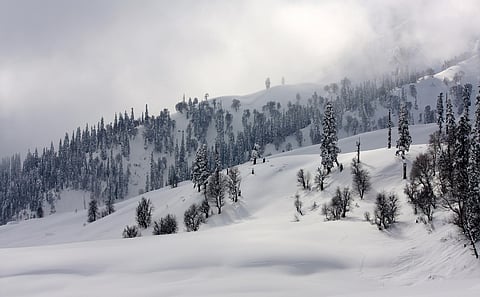


A new study entitled “Warming of the high-mountainous climate sensitive Jammu and Kashmir during the period 1980–2024” published in Scientific Reports (https://doi.org/10.1038/s41598-026-61302-2) has found that several high-altitude regions of Jammu and Kashmir have warmed by nearly 1°C over the past two decades, with mountain stations experiencing substantially faster warming than lower elevations. The findings raise fresh concerns over the future of Himalayan glaciers, snow-fed rivers, water security and climate resilience across northern India.
The study, conducted by Jayanarayanan Kuttippurath, GS Gopikrishnan and VM Pranav Chandran of the Centre for Ocean, River, Atmosphere and Land Sciences (CORAL), Indian Institute of Technology (IIT) Kharagpur, analysed ground-based observations and atmospheric reanalysis data spanning 1980-2024.
The researchers report a clear pattern of elevation-dependent warming, with temperatures increasing most rapidly at mountain stations such as Bhaderwah, Pahalgam and Gulmarg, while lower-elevation areas like Jammu showed comparatively weak or insignificant long-term warming. The study also found that night-time minimum temperatures are rising much faster than daytime maximum temperatures, particularly during the pre-monsoon season, signalling profound changes in the Himalayan climate system.

According to the study, annual mean temperatures increased by up to 0.3 °C per decade at some mid-elevation stations, while pre-monsoon night-time temperatures rose by as much as 0.6°C per decade. Statistical analyses indicate that changes in snow cover and surface reflectivity largely explain winter warming at higher elevations, whereas increasing atmospheric moisture and enhanced longwave radiation are driving the rapid rise in night-time temperatures throughout the year.
“The Himalaya is among the most climate-sensitive regions on Earth, and our results show that warming is not uniform across elevations,” said Kuttippurath. “The accelerated warming observed in mountain regions threatens glaciers, seasonal snow cover, freshwater availability and ecosystem stability, with consequences extending far beyond the Himalayas.” he added.
Lead author Gopikrishnan said the rapid increase in minimum temperatures is especially significant. “Warmer nights reduce natural cooling, accelerate snow and ice melt, and alter mountain hydrology. These long-term observations provide critical evidence for improving climate projections and adaptation planning in Himalayan regions.”
Kuttippurath added that the findings improve understanding of the physical processes behind mountain warming. “The interaction between altitude, snow-albedo feedback, atmospheric moisture and radiation creates distinct warming patterns across the complex Himalayan terrain. This knowledge is essential for developing science-based climate adaptation and disaster-risk reduction strategies.”
The researchers emphasise that continued warming could accelerate glacier retreat, reduce snow storage, alter river flows, increase the likelihood of climate-related hazards, and threaten livelihoods that depend on Himalayan water resources. They call for strengthened mountain climate monitoring, sustained observations and targeted adaptation policies to safeguard one of the world’s most vulnerable ecosystems.