

The Indian landmass was warmer on average by nearly 0.9°C during the previous decade (2015 to 2024) compared to the early 20th century (1901 to 1930). Warming has been uneven, with parts of north India warming as fast as 0.2°C per decade in the past three decades.
While warming over the Indian region is muted compared to the present global warming level of about 1.3°C, temperature extremes in India have been on the rise. Most parts of India, with the exception of Indo-Gangetic plains, have witnessed an increase in “warm days”—defined as days with maximum temperature exceeding the 90th percentile of daily maximum temperatures during the 1995-2014 periods—by up to 5 to 10 days per decade. This is particularly prominent over northeast, Thar-Rajasthan and peninsular India. Concurrently, the frequency of “warm nights”—defined as days with minimum temperature exceeding the 90th percentile of daily minimum temperatures during the 1995-2014 periods—is also on the rise especially over parts of Rajasthan and Gujarat.
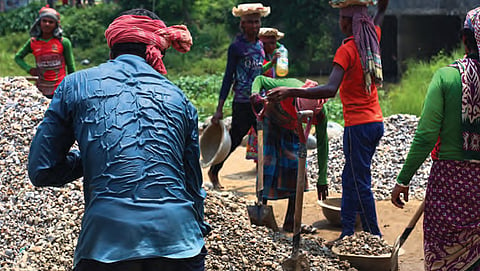
Consequently, the hottest day of the year in recent years is 1.5-2°C warmer compared to the 1950s over large regions of Western India and the northeast region. This means that regions that were experiencing maximum temperatures between higher 30s to lower 40s°C are now experiencing maximum temperatures exceeding 40°C during summertime. This has been accompanied by increased intensity, frequency and duration of heatwaves. The northwest region is experiencing a significant increase in warm days as well as warm nights rendering this region particularly vulnerable to heat stress, especially for outdoor workers.
There have been significant changes in monsoon rainfall patterns in India, albeit with wide differences across the country. Large parts of northwest India have experienced an increase in rainfall by 60-120 mm every decade since the 1950s along with an increase in extreme precipitation events, while the Indo-Gangetic region and the northeast exhibit a sharp decrease in rainfall.
Central India is experiencing an increase in extreme precipitation events (defined as daily precipitation exceeding 150mm), with prominent increases in coastal Gujarat. There is also an increase in the intensity and frequency of high precipitation events during the northeast monsoon, which mainly affects the peninsular region of the country. Looking to the future, the Indian summer monsoon rainfall is expected to increase by 6-8 per cent by 2050 compared to the recent past (1995-2014) under the moderate emissions scenario SSP2-4.5. However, Earth System Models still struggle with simulating the intensities of monsoon teleconnections resulting in a large spread in monsoon projections across the models.
The Hindu Kush Himalayas are among the most severely affected parts of the country by changing climate. The Geological Survey of India that monitors and surveys glaciers in the country has reported that there are as many as 9,775 glaciers in the Indian Himalaya region with a total glacierised area of 71,782.08 km2 in the Indus-Ganga and Brahmaputra basins. Mean temperatures over the Hindu Kush Himalayas have been increasing at an accelerated rate of about 0.28°C per decade during the 1951-2020 period, resulting in over 2°C warming over this period. This rate of warming is amplified at higher elevations with regions higher than 4km warming even faster at around 0.34°C per decade. One of the consequences of sustained glacier melt is an increase in the number and volume of glacier lakes. Glacier melt is expected to result in lake expansions downstream and create new hotspots of potentially dangerous glacial lakes, with implications for glacial lake outburst flood (GLOF) hazards and risk.
The tropical Indian Ocean is among the fastest warming ocean basins, having warmed nearly 1°C on average since 1950. An extreme event for the ocean is Marine Heatwaves (MHWs) which are periods of high ocean temperatures above the 90th percentile of mean sea surface temperatures and can last from days to months. Studies have shown that basin-wide warming over the Indian Ocean contributes significantly towards increasing the frequency and intensity of MHWs, which are projected to increase from 20 days per year during 1970-2000 to 200 days per year by 2050. MHWs are linked to marine habitat destruction and coral bleaching.
The Indian coastline is witnessing significant changes in tropical cyclones. The north Indian Ocean accounts for 6 per cent of global tropical cyclones, with the ratio of Bay of Bengal to Arabian Sea cyclones being 4:1 previously. However, due to the rapid warming of the north Indian Ocean, cyclones have become more frequent and stronger over the Arabian Sea, particularly during the pre-monsoon period. Sea surface temperatures leading to cyclogenesis have been higher by 1.2°C to 1.4°C in recent decades, compared to SSTs four decades ago. As a result, cyclones in the pre monsoon period (April-May) have intensified by 40 per cent in terms of wind speeds and by 20 per cent during the post monsoon season (from October to December). This is exposing coastal areas around the Arabian Sea to more frequent and intense cyclones, affecting fishing across the coastline in addition to causing coastal erosion.
Sea level rise is one of the most well documented consequences of climate change along with the threat it poses to lives, livelihoods and infrastructure along the coastlines. The sea level over the north Indian Ocean has risen by 3.3mm/year from 1993-2015 which is comparable to the global mean rise. However, the difference in the topography makes certain regions more vulnerable to the effects of sea level rise especially when combined with the subsidence rates of regions of the Ganga- Brahmaputra delta. This issue is exacerbated with the extreme sea level rise, and storm surges, driven by cyclonic storm activity. There has been a 2-3 fold increase in extreme sea level occurrences between 1995–2019, with higher risks along the Arabian Sea coastline and Indian Ocean Islands. This can lead to severe flooding and further erosion of low-lying areas and islands.
One of the most important emerging threats is that of “compound events,” which refers to multiple climate extremes occurring sequentially in the same region (“temporal compounding”), or the same extreme simultaneously affecting large regions (“spatial compounding”). The impact of such compound events can far exceed the impact of the individual events occurring in isolation. Examples of compound events are heatwave-drought, or compound flooding such as the one that precipitated the humanitarian disaster in Pakistan in 2022.
There has been a significant increase in the occurrence of compound meteorological droughts and heatwaves across India in the last four decades (1981-2020). Several parts of the country including north-central, western, and north-eastern India, along with the southeastern coastlines have emerged as hotspots for compound heatwave-drought events, which portend serious consequences for human health and agricultural sustainability.
The state of the environment over India as of 2025 stands on the brink where there is a marked increase in surface temperatures over the Indian landmass as well as over the oceans triggering extremes over land and ocean and resulting in increased stress for human and non-human life alike. This stress is compounded by changing rainfall patterns and increasing extreme precipitation events over the entire region resulting in excess rainfall over the otherwise dry regions of northwest India and drying of the Indo-Gangetic plains and northeast India. This has significant implications for agriculture and crop cycles for a country that relies heavily on agricultural output.
Coastal areas are at threat from sea level rise affecting low lying areas and increase in tropical cyclone frequency and intensity. Similarly, fragile mountainous regions and communities dwelling in them are at a higher risk of glacial lake outburst floods.
In conclusion, regional hotspots of climate change are emerging across the country. This demands regionally tailored adaptation strategies contingent not only on the nature of climate change but on the exposure and vulnerability of local communities.
(Aditi Deshpande is with Department of Atmospheric & Space Sciences, Savitribai Phule Pune University; Chirag Dhara is with Krea University; and Roxy Mathew Koll is with Centre for Climate Change Research, Indian Institute of Tropical Meteorology).
This was first published in the State of India’s Environment 2026
The State of India’s Environment 2026 report is available on sale here:
https://csestore.cse.org.in/default/books/state-of-india-s-environment-2026.html