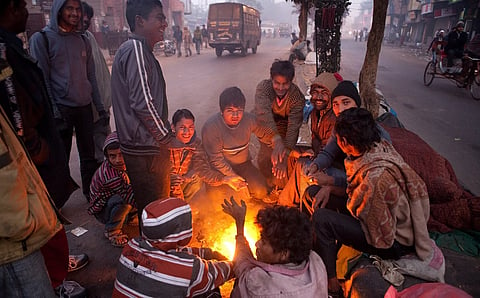


India recorded 24 cold wave/cold day events in January 2026, with no such conditions reported in February, an analysis by Down To Earth (DTE) has found. With the winter season officially ending on February 28, the total is unlikely to rise further, especially as the India Meteorological Department (IMD) has forecast maximum and minimum temperatures to remain 2-4°C above normal across most parts of the country.
Cold wave to severe cold wave conditions were last observed on January 25 in isolated pockets of East and West Rajasthan, Himachal Pradesh and Haryana, while cold day to severe cold day conditions persisted in parts of Himachal Pradesh until January 27, after which winter intensity eased nationwide
No cold wave event has been recorded in the month of February 2026. This absence of any cold wave or cold day event in February 2026 marks a clear break from recent trends according to the DTE analysis of cold waves/cold days for the period 2022 to 2025.
Between 2022 and 2025, February recorded six cold wave days in 2022, 1 in 2023, 7 in 2024 and 5 in 2025. However, with the last cold wave/cold day recorded on January 27 this year, February 2026 becomes the first in five years when a cold wave has not been recorded, according to the analysis based on the interactive atlas of weather disasters managed by Centre for Science and Environment/DTE data centre.
So overall, winter 2026 will close with 24 cold wave/cold day events reported across 15 states and Union Territories, making it the second-lowest seasonal total in the past five years after 2023, which recorded 21 days. The figure is significantly lower than the spike of 38 days in 2024 and also below the 30 days recorded in 2022 and 26 days in 2025.
The IMD declares a day as ‘cold day’ when the maximum temperature drops by 4.5°C to 6.4°C than average. If the deviation is more than 6.4°C, it is considered a ‘severe cold day’.
Similarly, a cold wave occurs occur when the minimum temperature drops by 4.5°C to 6.4°C than normal. When the minimum temperature drops by more than 6.4°C than normal, it is said to a ‘severe cold wave’.
The DTE analysis has considered all four categories.
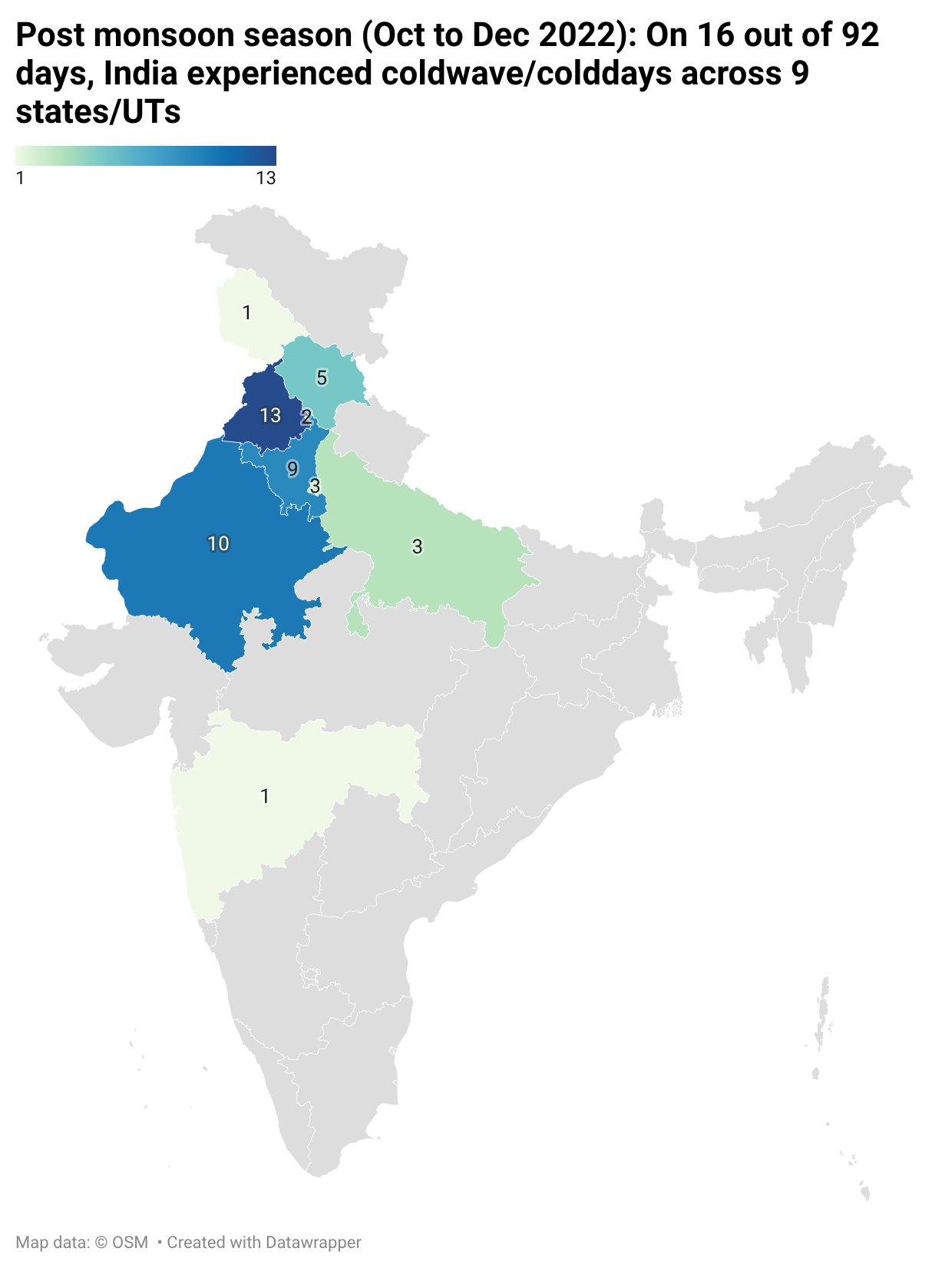
Between 2022 and 2026, cold waves largely remained concentrated in northern, northwestern and central India, though their spatial spread fluctuated each year during winter as well as the post-monsoon season.
In 2022, cold waves were recorded on 30 of 59 winter days across 14 states, with no impact in south or southeast India.
The footprint widened in 2023 to 17 states — the highest in five years — even though the number of cold wave days fell to 21. However, there were two southern states — Telangana and Karnataka which reported 2 and 4 cold wave days respectively.
In 2024, the total number of cold wave/cold days in the winter season increased to 38 of 60 days, but was geographically confined to 13 states, again excluding the southern and southeastern regions.
The spread of cold waves, narrowed further in 2025 to just 9 states/UTs, with Telangana from the south recording one cold wave day.
In 2026, the geographical reach expanded again to 15 states — the second highest after 2023 — with Karnataka emerging as the only southern state affected, reflecting intermittent but limited southern penetration within an otherwise north-centric cold wave pattern.
In 2026, after recording cold wave on 2 days in January 2022 and one day in February, Odisha has once again experienced cold wave/cold days on seven days.
The weather conditions in February 2026 are quite similar to the conditions in February 2023 as an El Nino is going to develop in the equatorial Pacific Ocean. NOAA’s latest update says that El Nino Southern Oscillation neutral conditions may give way to El Nino conditions in August. La Nina conditions in the post monsoon season could have been the reason for the cold waves in south, central and east India and the coming El Nino could have heralded an early end to the winter season and scorching summer season.
The lack of cold waves or cold days can impact rabi crops like wheat significantly.

Although the IMD classifies January and February under the winter season, cold wave conditions typically begin setting in from November and continue through December — both officially part of the post-monsoon season.
The winter season has been found to account for a major share of the cold wave/cold days in a year. For instance, between 2022 and 2024, winter accounted for 65 per cent, 72 per cent and 67 per cent of the annual total, while the post-monsoon share was much lower, ranging between 28 per cent and 35 per cent.
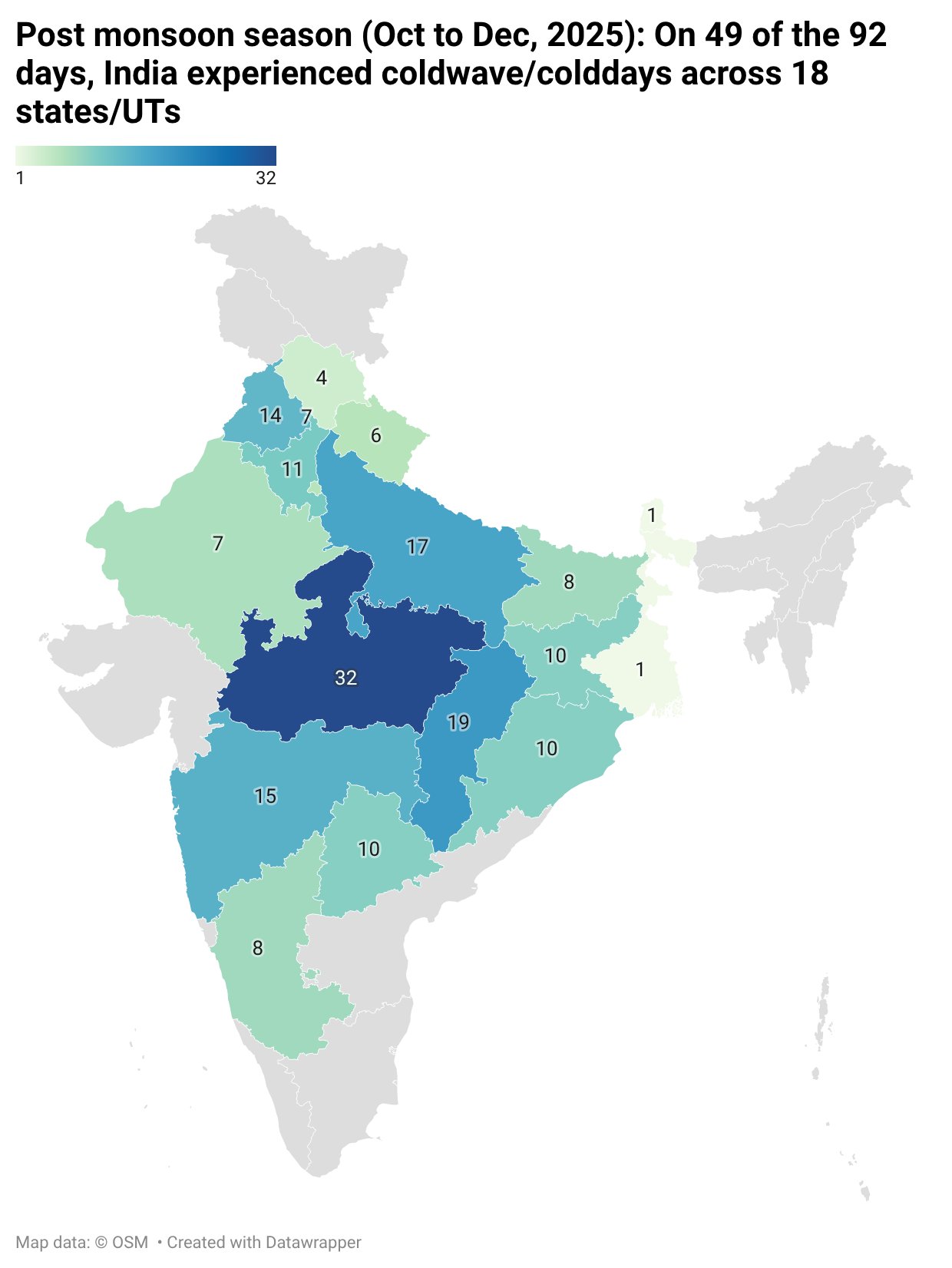
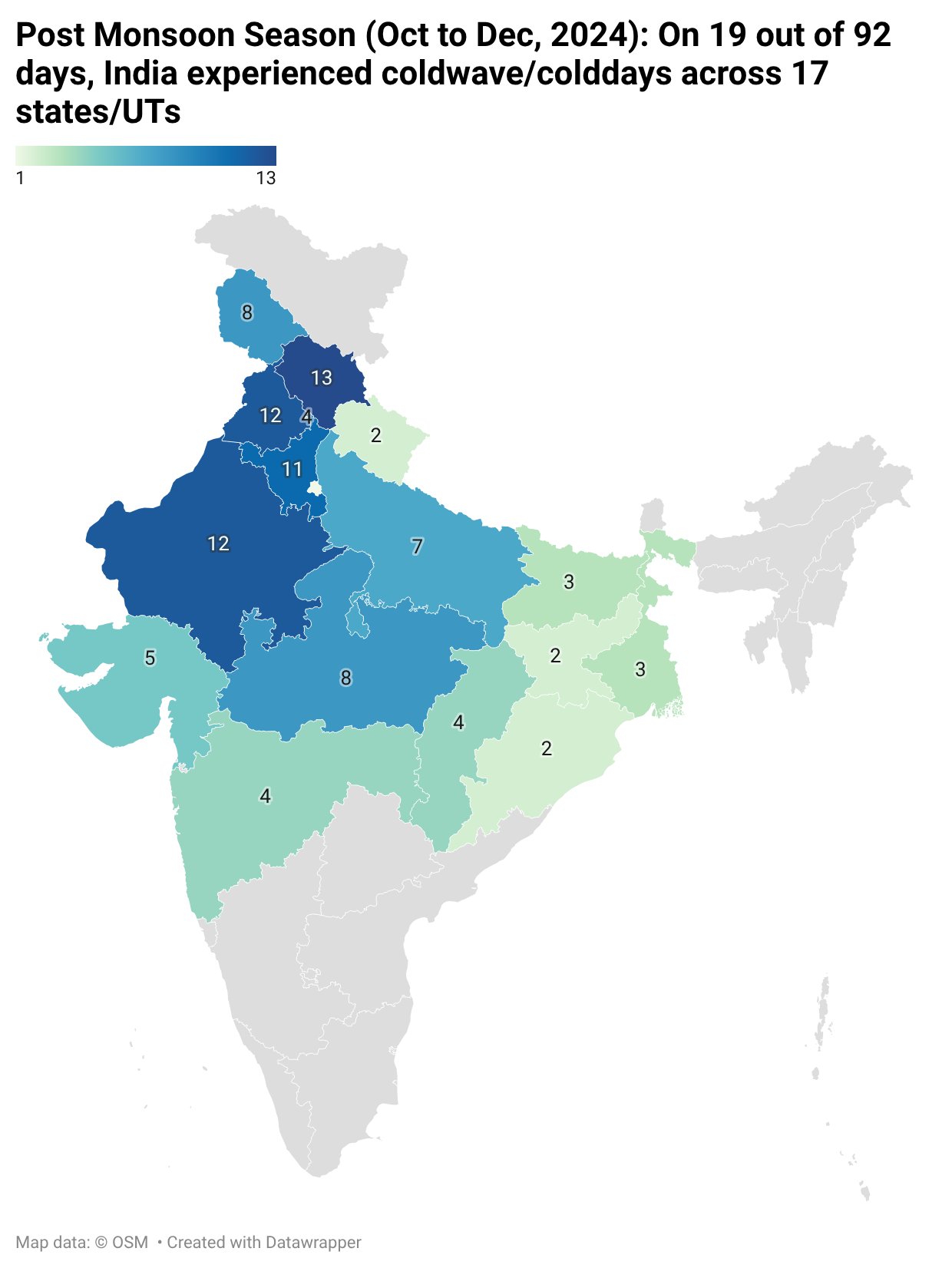
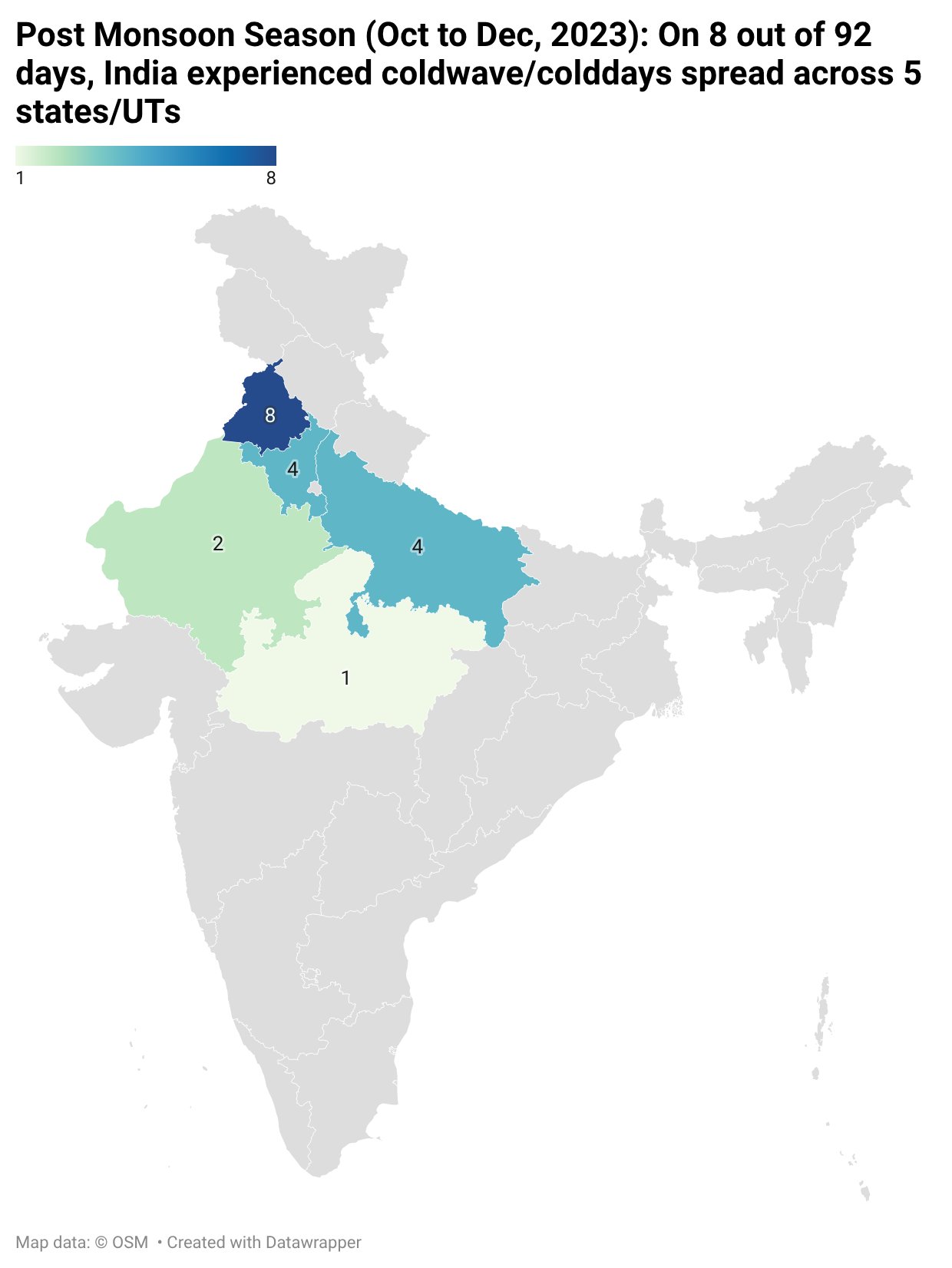
However, the pattern changed dramatically in 2025. In the post-monsoon period ending December 2025, 65 per cent of the year’s total cold wave days were recorded, compared to just 35 per cent during winter. The post-monsoon season recorded 49 cold wave/cold days — the highest in five years and more than double the previous peak — marking a sharp surge from 16 events in 2022, 8 in 2023 and 19 in 2024.
 |  |
 |  |
| Source: IMD & India’s Atlas on weather disasters | |
The shift in 2025 was driven by an unusual surge in cold wave days in November of that year. The month alone recorded 20 cold wave days — the highest since 2022. In comparison, November saw just two cold wave days in 2022, none in 2023, and only 1 in 2024. This represents an almost tenfold increase over recent years.
Not just this, cold waves also arrived earlier than in recent years, beginning on November 7 compared with November 21 in 2022. In previous years, November cold waves were confined to Maharashtra and Rajasthan.
In 2025, however, cold wave conditions were reported in 13 states across all four regions of India (seven states in the northwest, four in central India, one in the east and northeast, and one in the southern peninsula), indicating a significant expansion in geographical spread across all regions.
The DTE analysis for the period, 2022–2026 shows that cold wave events are no longer confined to the core winter months, as highlighted by the sharp post-monsoon surge in 2025 driven by an early and widespread November. The shifting timing and expanding or contracting geographic spread of these events indicate increasing variability in how cold extremes manifest across India. Closely tracking these trends will be crucial to determine whether they represent short-term fluctuations or signal a broader shift in the country’s winter climate pattern.
(With inputs from Akshit Sangomla)