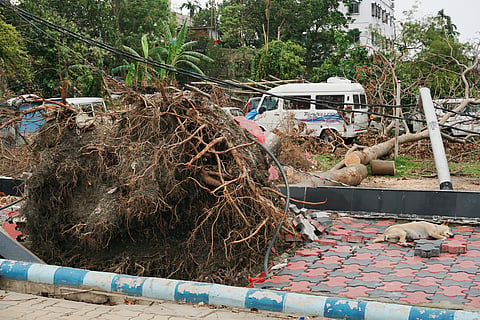


India has significantly improved its disaster response, with Odisha evacuating 1.2 million people ahead of Cyclone Fani in 2019, two decades after a super cyclone killed nearly 10,000 people.
The Sixteenth Finance Commission has earmarked Rs 2.84 lakh crore for disaster management between 2026 and 2031, but funding remains heavily skewed towards relief rather than prevention.
Disasters cost India an estimated 0.4% of GDP annually, according to the OECD, highlighting the economic consequences of extreme weather events.
Early warning systems must translate forecasts into timely action, while infrastructure needs to be designed for a changing climate.
Investing in locally tailored disaster plans, community preparedness and natural ecosystems can help protect homes, livelihoods and infrastructure.
The International Day for Disaster Risk Reduction served as a reminder to reassess disaster preparedness and ensure that it keeps pace with climate change and the growing intensity of extreme weather events.
In 1999, a super cyclone killed nearly 10,000 people in Odisha. Two decades later, cyclone Fani, the strongest storm to hit the state since, prompted the evacuation of a record 1.2 million people in less than 48 hours. The official death toll was 64. Every death was a tragedy, but the loss of life was far lower than it might have been. Few countries have improved so much, so quickly, at moving people out of harm’s way.
Fani also damaged more than 350,000 homes, brought down power lines and flattened coastal trees. Families survived, but much of what they had built did not. That is the next frontier: having learned to save lives, we must now learn to protect livelihoods and the homes, roads, crops, water systems and forests that communities depend on long after the storm has passed.
The need to do more is growing more urgent. Floods, cyclones, heatwaves and wildfires are becoming more frequent and intense. This year, floods killed about 100 people in Assam, landslides struck Kerala, cloudbursts killed about 31 in Jammu and Kashmir, and lightning claimed 14 lives in Jharkhand, most of them farm workers. The Organisation for Economic Co-operation and Development (OECD) estimates that disasters cost India about 0.4 per cent of GDP a year.
Public spending is beginning to reflect the scale of the challenge. The Sixteenth Finance Commission has earmarked about Rs 2.84 lakh crore for disaster management over 2026-31 and recommended adding heatwaves and lightning to the national list of notified disasters. Yet the allocation within these funds remains heavily skewed towards response: about Rs 1.64 lakh crore for relief, against Rs 40,880 crore for mitigation. That amounts to roughly Rs 4 for response for every rupee spent on prevention.
This imbalance deserves closer scrutiny. Every rupee invested wisely in prevention can reduce the cost and pain of relief and recovery later. The challenge now is to develop a strong pipeline of projects that can turn greater allocations into tangible gains. Four priorities stand out.
India's alert system has sent more than 134 billion SMS alerts in over 19 languages, and cell-broadcast alerts are being rolled out nationwide. The next step is to turn forecasts into decisions: when a farmer should harvest, when forest officials should deploy resources ahead of wildfires, when fishing fleets should return to shore, and when districts should open cooling centres or change working hours. Ahmedabad offered an early model with India's first heat action plan, estimated to have averted about 1,190 deaths a year in its early years.
Roads, embankments, homes, water supplies and power lines designed for yesterday's rainfall and wind speeds will fail more often as the climate changes. India established the Coalition for Disaster Resilient Infrastructure to promote climate-resilient infrastructure worldwide. Applying the same principle at home means assessing major public investments for climate risks and rebuilding to higher standards, rather than repeating the designs that have already failed.
Tailor disaster plans to local risks: A cloudburst in the Himalayas, a slow-moving flood on the Brahmaputra, a cyclone on the Odisha coast, a heatwave across the northern plains and a wildfire in central India each demand a different response. District disaster management plans should thus reflect local hazards, draw on local data and be rehearsed before the season begins. They are more likely to work than a single template imposed everywhere.
After the 1999 cyclone, researchers found that mangrove cover in villages in Odisha's Kendrapara district had declined by about two-thirds. Wetlands absorb floodwater, while healthy forests and grazing commons can help limit the spread of fires and reduce erosion and landslide risks. Panchayats, forest committees and self-help groups understand their landscapes and are often first on the scene. Funding them to protect and restore these natural buffers, while sharing the benefits with the communities that maintain them, is among the most cost-effective investments in disaster resilience.
No strategy can replace an effective emergency response. But better preparedness and prevention can make that response less necessary, while cost and pain far less than repairing the damage afterwards. Odisha has shown what sustained investment and clear purpose can achieve in a generation. India has built one of the world's most effective systems for moving people out of harm's way. The next task is to ensure that the homes, livelihoods and ecosystems to which they return are still standing.
Views expressed are the author’s own and don’t necessarily reflect those of Down To Earth