

A University of Kashmir study has identified five glacial lakes in the Kashmir Himalaya as highly susceptible to glacial lake outburst floods.
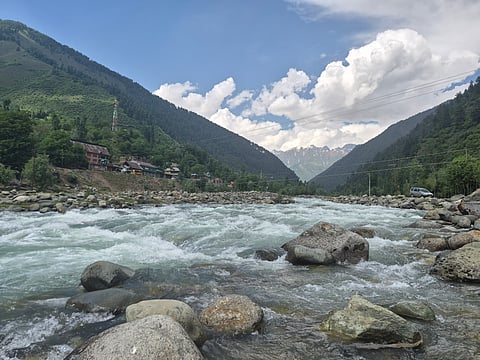
Gangabal and Nundkol lakes in Ganderbal district are among those flagged, with both draining into Wangath Nullah and then the Sindh river.
Researchers estimate that a flood from Nundkol alone could affect 1,184 buildings, four bridges and a hydropower plant downstream.
Villagers and shepherds below the lakes say they have not received official information, evacuation guidance or warnings in local languages.
Scientists say the lakes do not show signs of imminent failure, but call for monitoring, early-warning systems and community preparedness as glaciers retreat.
Two glacial lakes above villages in central Kashmir have been classified as highly susceptible to glacial lake outburst floods, but residents living downstream say they have not been warned about the risks.
Gangabal and Nundkol lakes, both fed by glaciers below the 16,870 feet (over 5,100 metres) Harmukh peak in Ganderbal district, were among five high-risk lakes identified in a University of Kashmir study published in the Journal of Glaciology.
The issue was raised in March inside the Jammu and Kashmir Assembly, where Chief Minister Omar Abdullah referred to the study and said five glacial lakes in the Kashmir Himalaya had “very high susceptibility” to glacial lake outburst floods (GLOF).
But shepherds and villagers who use the landscape each season say they have received no official information about what a possible lake breach could mean for settlements downstream.
“We know the glacier is melting faster than before. But we do not know what happens if the lake breaks. Nobody has told us anything,” said Mudasir Ahmad Chopan, a young shepherd from Barnabugh village who is studying for a Bachelor of Science.
Barnabugh is about 45 kilometres north of Srinagar in Ganderbal district.
The University of Kashmir study mapped 155 glacial lakes across the Kashmir Himalaya using satellite data from 1992 to 2024. It found that ice-contact lakes in the region expanded by 26 per cent over that period.
The glaciers feeding them are thinning by 0.66 metres a year, faster than much of the broader Himalayan range, according to the study. A flood from Nundkol alone could reach 1,184 buildings, four bridges and a hydropower plant downstream, the researchers calculated.
Gangabal and Nundkol both drain into Wangath Nullah, which flows south through Ganderbal and eventually joins the Sindh river. The five highest-risk lakes together place more than 2,700 buildings and 15 bridges in potential flood paths across districts including Ganderbal, Shopian and Kulgam, the study found.
The researchers called for community-based early warning systems, restrictions on construction in flood corridors and stabilisation of natural dam structures. No such measures have been publicly announced so far.
There are no early warning systems on any of the five lakes identified as highly susceptible, according to researchers. There are no sirens, sensors or community alert systems downstream.
The University of Kashmir study is the first hazard baseline for glacial lakes in Kashmir. The absence of warning systems is significant because glacial lake outburst floods can be sudden and destructive.
In October 2023, a GLOF in Sikkim killed 178 people and destroyed three hydropower projects within hours.
Irfan Rashid, one of the lead researchers behind the University of Kashmir study, said the Harmukh glaciers do not currently show signs of imminent failure. But he stressed that susceptibility is not the same as prediction.
“Susceptibility reflects the potential for a hazardous event, not a prediction that one will happen in the immediate future. It means the physical conditions required for a glacial lake outburst flood are present, and the lakes are particularly vulnerable if a triggering event occurs,” he said.
The risk can change quickly as glaciers retreat, lakes expand, slopes destabilise and temperatures rise, researchers say.
The average maximum temperature in the Kashmir Himalaya has increased by 1.4C over the past four decades, according to the study.
The region also lies in seismic zone five, India’s highest earthquake-risk category.
A glacial lake forms when a retreating glacier leaves behind a wall of debris, known as a moraine, and meltwater accumulates behind it. Unlike an engineered dam, a moraine is a compressed heap of irregular boulders, loose sediment and rock dragged down the mountain over centuries.
It was never built to hold water, said Khurshid Ahmad, assistant professor of geography at Government Degree College Pulwama. When this natural dam gives way, the sudden release of water and debris can rush down the valley at great speed.
An outburst can be triggered by an avalanche, earthquake or the rising weight of water behind the moraine. Rashid said a basic monitoring system could provide an important first layer of preparedness. He suggested that time-lapse cameras could be installed around Nundkol and Gangabal to transmit images every few minutes to a monitoring station downstream.
The system could later be expanded to include water-level sensors, weather stations and siren-based alerts, he said. “Even a relatively simple camera-based monitoring network would substantially improve situational awareness and provide valuable information during periods of elevated risk,” he said.
Environmental activist and researcher Raja Muzaffar Bhat said the failure was one of communication as much as policy.
“There is no information in the general public about what glacial lakes exist beneath the areas where they are living. The government is not informing people that they are in a vulnerable zone,” he said.
He said residents should be informed in local languages about risks and preparedness.
“The Chief Minister spoke about GLOFs in the Assembly. But on the ground, there is nothing. No information in the local language. No awareness. Just silence,” Bhat said.
He also said government officials often do not engage with journalists, making it harder for information to reach the public.
“There should be proper guidelines from the PR department about communication between officials and journalists,” he said.
This reporter attempted to contact officials for comment on the government’s preparedness. The District Magistrate of Ganderbal disconnected the call, saying he was in a meeting, and did not respond to a subsequent WhatsApp message. The MLA for Kangan constituency in Ganderbal also disconnected the call and did not respond later.
No official response was received from any government authority despite repeated attempts.
Ghulam Qadir Chopan, 55, has been walking to Gangabal and Nundkol lakes for 35 years. His father made the same journey before him, and his grandfather before that. The shepherd from Barnabugh village sits in the shadow of Harmukh, the peak whose glacier feeds both lakes, and says he is not worried. “I have seen the same snow at Harmukh every year. The lakes are the same. You still need a firepot to keep warm up there,” he said.
For generations, shepherds have read the mountain through snow, wind and water levels at the lake edge. That knowledge remains valuable. But younger residents such as Mudasir Ahmad Chopan say the glacier is changing.He says the snowline is higher than it used to be and the glacier appears to be retreating.
What he does not know is what those changes mean for the valley below. No one, he says, has explained it.
Arjumand Wani is a mentee at Climate Change Media Hub, Asian College of Journalism (ACJ), Chennai.