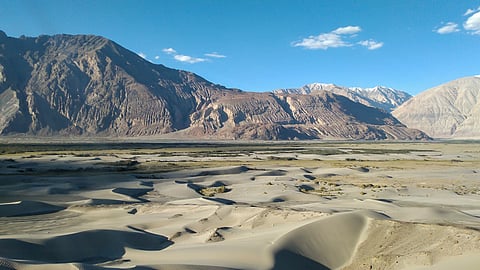


Ladakh has recorded 65% more rainfall than normal this monsoon, the highest rainfall excess of any state or Union Territory in India as of July 15.
The cold desert has received above-normal monsoon rain for five consecutive years since 2022, including four years in the IMD’s large-excess category.
The trend contrasts sharply with traditionally wetter states such as Meghalaya and Kerala, which have recorded rainfall deficits this season.
Repeated excess rain has raised concerns over cloudbursts, flash floods, landslides and the long-term impact on Ladakh’s fragile communities and ecosystems.
Ladakh, usually known as a dry cold desert, has recorded the highest rainfall excess in India this monsoon season, according to India Meteorological Department data.
As of July 15, the Union Territory had received 65 per cent more rainfall than normal. It is the only state or Union Territory in the country to fall under the “large excess” rainfall category during the 2026 monsoon season.
The pattern is not new — Ladakh has received above-normal monsoon rainfall for five consecutive years since 2022. But the long-term impact of this shift on local communities, livelihoods and ecology remains largely unknown.
In 2026, Ladakh’s rainfall pattern stands in sharp contrast to traditionally wetter states. Meghalaya has recorded a 55 per cent rainfall deficit, while Kerala has received 32 per cent less rain than normal between June 1 and July 15.
Ladakh has received more than its normal share of monsoon rain in each of the past five years. In four of those years, the rainfall excess was above 60 per cent, which the India Meteorological Department (IMD) classifies as “large excess”.
In 2021, Ladakh received 21.9 millimetres (mm) of actual rainfall, which was 42 per cent below the then-normal level of 37.7 mm.
In 2022, the IMD revised its long-period average for all-India rainfall, changing the reference period from 1961-2010 to 1971-2020. This brought Ladakh’s normal monsoon rainfall down from 37.7 mm to 22.3 mm.
The revision coincided with a period of increased monsoon rain in the region. In 2022, Ladakh received 37.6 mm of rainfall against the revised normal of 22.3 mm, an excess of 69 per cent.
In 2023, the excess increased to 103 per cent, with the region receiving 45.2 mm of rainfall.
The only year in this period when rainfall was not in the large-excess category was 2024, when Ladakh received 17 per cent more rain than normal.
The sharpest spike came in 2025, when Ladakh recorded 98.6 mm of monsoon rainfall, 342 per cent above normal. August 2025 also saw the Union Territory’s highest monthly rainfall on record since 1973, at 80.2 mm.
Several parts of Ladakh have faced cloudbursts, flash floods and landslides during years of excess rain, particularly in 2023 and 2025. Such events are often triggered by intense rainfall over a short period and can cause road blockages, damage to homes and disruption of essential supplies.
On July 22-23, 2023, a cloudburst in Leh town damaged shops and houses.
Disruptions like these can have serious consequences in Ladakh, where many communities depend on road networks for supplies, mobility and livelihoods.
A report by the Manohar Parrikar Institute for Defence Studies and Analyses recorded 15 cloudburst events in Ladakh between 2005 and 2023, citing climate change as one of the factors linked to such events.
The current period of excess rainfall could leave lasting ecological impacts in Ladakh, whose cold desert ecosystem is ill-equipped to cope with such wet conditions. These long-term consequences, however, have not yet been scientifically examined.